Santa Maria della Gancia: A Franciscan Church and Convent in Palermo


Site at a Glance
- Rating
- 4.6
- Popularity
- Low
- Country
- Italy
- Primary era
- Early Modern
- External website
- Open
- Eras represented
- Medieval, Early Modern
- Civilizations
- Kingdom of Sicily, Spanish
- Site type
- Religious
- Remains
- Church
On this page33 sections
History
Santa Maria della Gancia, also known as Santa Maria degli Angeli, is a Roman Catholic church and adjoining Franciscan convent in Palermo, Italy. The Franciscans began constructing the present Renaissance church around 1490, and completed it in the early sixteenth century. Its original purpose was closely connected with the gancia, a dependent hospice or establishment serving a religious house, where the sick, poor, pilgrims, visitors, and traveling friars could receive accommodation and assistance.
Foundation and Franciscan development
The institution grew from the work of Fra Matteo de Gallo and Gimarra, a Franciscan later appointed bishop of Agrigento and subsequently beatified. In 1426 he founded the convent of Santa Maria di Gesù and obtained the primitive church of San Girolamo outside Palermo’s walls as a gancia. The establishment linked the Franciscan community at Santa Maria di Gesù with the city and provided a place of care and lodging for people entering Palermo.
The church was initially Renaissance in character, but its interior developed through successive additions. Late Gothic, Renaissance, and Baroque elements were incorporated into the building, while artists including Antonello Gagini, Antonello Crescenzio, Vincenzo degli Azani da Pavia, Pietro Novelli, Filippo Tancredi, Antonio Grano, and Giacomo Serpotta contributed to its decoration. The church was solemnly consecrated on 29 November 1645 by Giovanni Domenico Spinola, bishop of Mazara del Vallo.
The convent expanded alongside the church. A cloister was added in 1609, and a large refectory was built for more than 200 friars. In 1615 the earlier refectory was rented to the Franciscan Third Order, a branch of the Franciscan movement for laypeople and other secular members. It was converted into the Oratorio dei Terziari Francescani, also known as the Oratorio dei Pescatori.
Collapse and Baroque rebuilding
On the night of 2 April 1672, an imprudent enlargement of the crypt weakened the building. The transept, presbytery, and two lateral tribunes collapsed. The high altar and the tribune made by Bartolomeo Berrettaro and Giuliano Mancino were destroyed in the disaster. Gaspare Guercio directed the initial recovery work, followed by extensive rebuilding and decoration in 1673. These interventions gave much of the interior its present Baroque configuration.
Giuseppe Venanzio Marvuglia directed another restoration in 1782. A later neoclassical high altar and a crucifix by Marvuglia belong to the subsequent development of the presbytery. The building therefore preserves several chronological layers, from the Renaissance foundation and surviving late Gothic details to the Baroque reconstruction and later neoclassical work.
The convent, the archives, and the Gancia Revolt
The convent entered a new phase in the nineteenth century. In 1854 the Bourbon government designated the large complex for archival use, and notarial records were transferred there in 1859. After the suppression of religious orders in 1866, much of the convent was requisitioned. The Italian state acquired the remaining building for the State Archives, and the Gancia branch of the State Archives was established in 1872. The former convent and the Oratorio dei Pescatori remain associated with archival use.
The complex also gave its name to the Gancia Revolt of 1860, an anti-Bourbon uprising in Palermo. On 4 April, the campanile bell and a flag signaled the insurrection. Bourbon troops stormed the convent, killing nearly twenty insurgents and arresting thirteen, who were later executed without trial. Gaspare Bivona and Filippo Patti escaped by hiding among the corpses and tunneling through the wall. Their escape route, known as the buca della salvezza, survives as a small opening in the exterior wall of the transept on Via Alloro. The conspiracy failed, although the revolt became associated with the name of the Gancia. Giuseppe Garibaldi’s Expedition of the Thousand subsequently helped liberate Palermo from Bourbon rule.
Devotion and modern conservation
Popular devotion at the church continues to center on the Bambinello della Gancia, a wooden image of the Child Jesus. Tradition holds that a monk of the convent recovered the image from the sea, while the statuette itself was brought from Jerusalem in 1719. Devout families kept it in turn throughout the year and returned it to the church on 25 December. The neighborhood celebrated the image at Epiphany.
A long restoration campaign commissioned by the Friars Minor took place in 2000 and 2001 and lasted 23 months. The work formed part of the modern conservation history of the church and convent, whose religious, artistic, archival, and political associations remain visible in their surviving fabric.
Remains
Facade and central nave
Santa Maria della Gancia is embedded among the buildings of central Palermo. Its principal front faces the narrow Vicolo della Gancia, while the south wall extends along Via Alloro. The extremely plain west facade combines a late Spanish Gothic portal with Renaissance details. Its central portal, dated 1530, has round-headed archivolts and an elegant single-light window above. The northern side portal has an outer cusped archivolt whose apex contains a lozenge depicting the Virgin of the Angels. A surviving section of a marble monument by Gagini is set into the wall to the left of this portal.
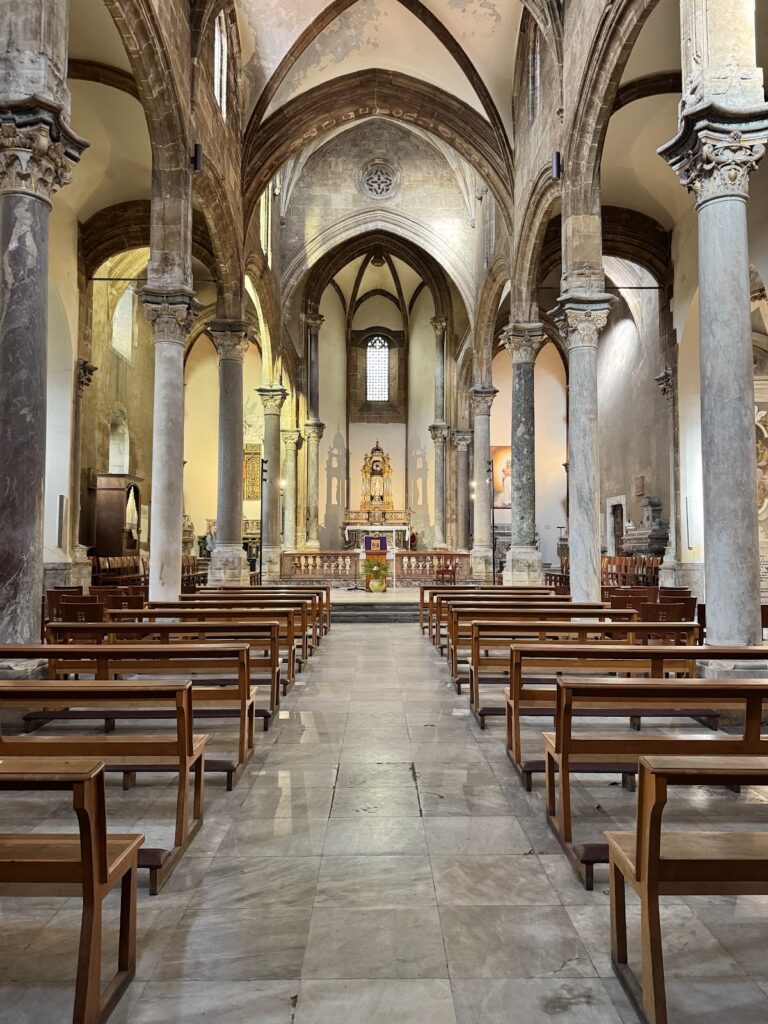
The church follows a Latin-cross basilical plan, with a single nave flanked by twenty chapels. Above the central entrance, the choir gallery is supported by two gilded telamons, or sculpted human figures used as architectural supports, in a Mannerist design. The sixteenth-century wooden ceiling is divided into panels, each centered on a gilded star. Beneath the choir, the panels contain rosettes and an octagon with a carved dove, the symbol of the Holy Spirit.
The historic choir organ was built by Raffaele La Valle in 1615 on commission from the Senate of Palermo. Giacomo Andronico reworked it in 1772, retaining original components. The instrument is surmounted by the Franciscan coat of arms and can be played independently or from the console of the Tamburini organ, opus 482, built in 1962 and installed on the floor of the apse. Above the chapels, frescoes of Franciscan saints extend along both sides of the nave. Filippo Tancredi began the cycle around 1697, and Antonio Grano completed it about three years later. The right side shows Diego of Alcalá, John of Capestrano, Peter of Alcántara, Elizabeth of Hungary, Louis of Toulouse, and Anthony of Padua. The left side shows Paschal Baylon, James of the Marches, Bernardino of Siena, Clare of Assisi, Bonaventure of Bagnoregio, and Francis of Assisi.
Chapels on the right side of the nave
Chapel of Blessed Francis of Prado
The first right-hand chapel is dedicated to Blessed Francis of Prado and was formerly the Chapel of the Holy Cross and the Martyrdom of Blessed John of Prado. It contains Vincenzo Bongiovanni’s 1729 canvas, the processional vara of the Bambinello della Gancia, and the Sitajolo family tombs. Filippo Sitajolo’s 1528 sarcophagus rests on winged sphinxes, Vincenzo Sitajolo’s 1587 sarcophagus is supported by lions, and Simone Sitajolo’s monument dates from 1632.
Chapel of Our Lady of Montserrat
The second chapel, now dedicated to Our Lady of Montserrat, was formerly the primitive Requesens Chapel. Its works include a seventeenth-century Roman-school Holy Family with Saint Anne, Saint Joachim, and donors; a wooden Saint Philomena; and a marble Saint John Nepomuk from about 1730, formerly at Castello a Mare. A fresco of Francis Solano baptizing non-Christians is attributed to Antonio Grano. Antonello Crescenzio’s 1528 Madonna of Montserrat between Saints Catherine of Alexandria and Agatha remains in the chapel, whose vault frescoes depict the Presentation of Mary in the Temple, the Nativity of the Virgin, and the Announcement to Anna of her motherhood. These paintings are attributed to Grano. The altar also has a statue of Saint Paschal. Fabio Bologna’s 1600 sarcophagus survives here, while the former Requesens monuments included the tomb of Calcerando Requesens, begun in 1521 and commissioned from Antonello Gagini by Laura Requesens. The chapel was rebuilt after the collapse of 1672.
Chapel of Saints James of the Marches and Francis Solano
The third chapel was formerly dedicated to Our Lady of Perils. Its altar painting of the Virgin with Saints John of Capestrano, James of the Marches, Bernardino of Siena, and Francis Solano is attributed to Olivio Sozzi and dates from around 1740. Other works show James of the Marches condemning cruel punishments and Francis Solano giving a blessing. The latter fresco is attributed to Filippo Tancredi, while architectural elements painted in illusionistic form are attributed to Andrea Palma. The Amari family tombs include those of Nicolò Amari, dated 1543, and Antonio Amari and Elisabetta Bologna, dated 1585.
Chapel of Santa Maria di Gesù
The fourth chapel contains a Virgin and Child attributed to Antonello Gagini, transferred from the primitive arch associated with the sculptor. Other works include late seventeenth-century and eighteenth-century paintings of the Ecstasy of Saint Francis and the Trinity Appearing to Saint Francis, together with a heavily repainted vault fresco of the saint of Assisi. The chapel holds the tomb of Flaminia Campisciana, dated 1618, and a late sixteenth-century tomb belonging to a member of the Del Voglia family.
Chapel of Saint Anthony of Padua
The fifth chapel has abundant polychrome marble decoration and twisted columns framing the saint’s niche, a design attributed to Paolo Amato. The niche contains an eighteenth-century polychrome terracotta Saint Anthony. Late eighteenth-century canvases show Saint Anthony giving the Eucharist to the destitute and healing a boy’s foot, while two fresco tondos of episodes from his life are attributed to Antonio Grano. Inlaid marble on the balustrade and pilasters forms symbols of thunder and the flaming sword. Beside the arch stands a five-panel marble pulpit from the Gagini school. Its central panel shows the Risen Christ, the sides show the four Evangelists, and the remaining scenes depict Christ in Limbo and the Resurrection.
Chapel of Saint Francis of Assisi
The sixth chapel was formerly dedicated to Blessed Salvator of Horta. Its altar has an eighteenth-century wooden statue of Saint Francis and a mensa, or altar table, in polychrome marble. Marble inlay on the entrance jambs depicts the Visitation and the Flight into Egypt.
Chapel of the Immaculate Conception
The seventh chapel has an eighteenth-century altar of polychrome marble with gilded columns supporting Sebastiano Spirito’s Immaculate Conception. Two large paintings by Filippo Tancredi depict Judith Decapitating Holofernes and Esther at the Court of Ahasuerus in Persia. The upper tondos show the Virgin and Child and the Virgin appearing to Franciscans. The chapel also served as a burial place for the Notarbartolo family.
Chapel of the Most Holy Crucifix
The eighth right-hand chapel is now dedicated to the Most Holy Crucifix. It was formerly the Chapel of Bonaventure of Bagnoregio and originally the Chapel of Margaret of Cortona. Eufemia, the wife of Berardo Requesens, established it under her patronage in November 1517. Her tomb, a statue of Margaret of Cortona, and a kneeling portrait of the noblewoman were made by Antonello Gagini. After the 1672 rebuilding, the statue was transferred to Palazzo Drago. It was later mutilated and is now displayed at the Cleveland Museum of Art. The sculpture retains a book and a dragon at the saint’s feet.
Chapels on the left side of the nave
Chapel of Elizabeth of Hungary
The first chapel on the left is dedicated to Elizabeth of Hungary. Its altar has Antonio Grano’s painting of the Ecstasy of Saint Francis, dated around 1700. A side-wall fresco shows Elizabeth of Hungary Giving Alms, and the vault depicts her glory. The adjoining small Chapel of Saint Conrad formerly held a painting of the saint by Vincenzo degli Azani, now displayed at the Galleria Nazionale della Sicilia in Palazzo Abatellis.
Chapel of the Nativity
The second chapel was sponsored by the Bardi-Mastrantonio family. It contains Vincenzo degli Azani’s 1520 Nativity, commissioned by the family, and a seventeenth-century wooden Ecce Homo. The family tombs include the 1633 sarcophagus of Aloysio Mastrantonio and Bardi, supported by lions, and Giuseppe Mastrantonio’s 1584 sarcophagus, which bears a carved image of the deceased in Franciscan dress. A canvas of the Crucifixion of the Japanese Martyrs dates from the beginning of the seventeenth century and depicts Franciscans martyred at Nagasaki in 1597. Another full-length Ecce Homo stands near the balustrade.
Chapel of Peter of Alcántara
The fourth chapel is dedicated to Peter of Alcántara and was patronized by the Gambacorta family. Its altar painting of the saint was made by Pietro Novelli around 1645. Two large frescoes attributed to Filippo Tancredi, dated around 1706, depict the Virgin appearing to Peter and Christ giving him Communion. The vault shows the saint’s penance. Funerary monuments commemorate Modesto Gambacorta, whose monument dates from 1587, and his wife. One includes a marble high-relief portrait of the deceased.
Chapel of Elizabeth
The fifth chapel, now dedicated to Elizabeth, was formerly the Chapel of Rose of Viterbo. Its deteriorated frescoes of the Glory and Death of Rose of Viterbo are attributed to Filippo Tancredi. A 1941 painting shows Elizabeth healing a crippled woman. The chapel also contains Francesco Saladino’s 1599 sarcophagus, supported on elephant feet.
Chapel of the Ecce Homo
The sixth chapel has an altar completely covered with polychrome marble and containing a wooden Ecce Homo. The side walls carry frescoes of the Sacrifice of Isaac and the Adoration of the Brazen Serpent, attributed to Guglielmo Borremans and dated around 1730. The vault was painted illusionistically in 1727. Funerary monuments of the Guascone family remain in the chapel.
Chapel of Our Lady of the Rosary
The seventh chapel was formerly the Chapel of Catherine of Bologna and originally the Chapel of Diego of Alcalá. It contains Antonello Gagini’s high relief of Christ in Limbo, once part of Lorenzo Salvaggio’s tomb of 1517, which no longer survives. A Gagini-school relief represents Saint Michael the Archangel. Other works include an eighteenth-century painting of Christ on the Cross consoling the Virgin, paintings of Blessed Matteo of Agrigento and Margaret of Cortona by unidentified artists, and a statue of the Blessed Virgin of the Rosary between saints.
Chapel of the Child Jesus
The eighth chapel is dedicated to the Child Jesus. Formerly the Chapel of Saint Mary Annunciate, it is also known as the Chapel of the Bambinello della Gancia. Its altar has a seventeenth-century Annunciation, with stucco statues of David and Isaiah by Gaspare Firriolo. Frescoes on the walls depict the Adoration of the Magi and the Adoration of the Shepherds. The wooden Child Jesus statuette associated with the Bambinello devotion is kept here. The chapel also contains Maria Porcaro Bonamico’s 1639 monument, with an urn supported by lions, and Pietro Porcaro’s 1590 tomb, whose aedicule contains a painted Virgin and Child. Marble tondos of Bernardino of Siena and Bonaventure of Bagnoregio, from the first half of the sixteenth century, belong to the Gagini school.
Transept and apse
Chapel of the Franciscan Third Order
The transept includes an exterior room dedicated to the Holy Crucifix and patronized by Francesco Cangialosi in 1545. It is associated with the Franciscan Third Order. Its decoration includes a fresco of Clare driving away the Saracens attributed to Filippo Tancredi, funerary monuments of Domenico Testasecca and Giuseppe Lucchesi Palli dated 1764 and 1762 respectively, and monuments attributed to Ignazio Marabitti. Other works are a canvas of Francis receiving the Portiuncula from the Virgin, attributed to Giuseppe Salerno; an anonymous Flemish-Caravaggesque painting of the Miracle of Blessed Salvator of Horta; a Gagini-school marble Pietà; four eighteenth-century Passion canvases; and a wooden Crucifix from the second half of the sixteenth century.
Chapel of the Marriage of the Virgin and Saint Joseph
The interior transept chapel of the Marriage of the Virgin and Saint Joseph contains Vincenzo degli Azani’s Marriage of the Virgin, bordered by angels. Stucco angels in the style of Giacomo Serpotta support the frame, above which is Serpotta’s 1706 group of the Emperor Augustus and the Cumaean Sibyl. Serpotta’s stucco figures of a monk and an angel also survive here. Other features include a late seventeenth-century wooden tempietto tabernacle, a small temple-shaped Eucharistic cabinet, and paintings of Aaron Offering a Sacrifice of Grain, the Death of Saint Joseph, Moses Receiving Grapes from the Promised Land, and the Rest during the Flight into Egypt. Filippo Tancredi’s frescoes of the Trinity and Angels, dated around 1706, cover the vault.
A large fresco opposite the Marriage chapel depicts the Miracle of Saint Clare and the Pyx. A pyx is a container used to carry or reserve the consecrated Eucharist. Another work on the left transept wall represents the Holy Family and Saint Francis.
Apse chapel and choir
The apse chapel and choir were patronized by the Villaraut family and contain the tomb of Giovanni Villaraut, lord of Prizzi. The apse wall has a marble Virgin and Child in Glory with angels and a scene of Saint Francis receiving the Franciscan rule from the Virgin. These works probably incorporate surviving elements of the monumental tribune made by Bartolomeo Berrettaro and Giuliano Mancino in 1509 for Carlo Villaraut, baron of Prizzi. The tribune was destroyed in the collapse of 1672, but two marble panels, the Announcing Angel and the Annunciated Virgin, remain embedded in the piers beside the altar. Other surviving elements include statues of Bernardino of Siena and Anthony of Padua, reliefs of Bernardino and Louis of Toulouse, and Franciscan symbols held by angels along the apse cornice.
The apse has a richly decorated neoclassical altar of polychrome and gilded marble. Its tempietto tabernacle has a domed canopy, marble columns, and gilded statuettes. A crucifix by Venanzio Marvuglia rises above it, and Old Testament scenes decorate the altar. Filippo Tancredi’s frescoes show the Last Supper, Moses Leading His People toward the Promised Land, and Christ in Glory with Franciscan Saints.
Chapel of the Blessed Virgin of Guadalupe
The Chapel of the Blessed Virgin of Guadalupe was founded and patronized by the Castilian and Biscayan community and formed part of the building’s early nucleus. In 1508 it was granted to the family of Giovanni del Rio, a royal secretary, for the burials of Palermo’s Spanish Brotherhood, including senior Sicilian inquisitors. The chapel was seriously damaged in the collapse of 1672 and completely rebuilt. Its pilasters and entrance arch are covered with polychrome marble inlay and bear the arms of the Spanish nation.
The chapel contains Vincenzo Bongiovanni’s paintings of the Finding of the Image of Our Lady of Guadalupe and the Virgin appearing to Ignatius of Loyola and Francis Xavier, dated around 1730. Other works include prophets Daniel and David attributed to Vincenzo degli Azani; stucco decoration by Giacomo and Procopio Serpotta, dated around 1706; a wooden Virgin and Child; an early eighteenth-century marble Eternal Father among angels; and a late seventeenth-century marble tabernacle with twisted columns and a painted Risen Christ on its door. The floor and the exterior space before the chapel are covered with funerary slabs commemorating Spanish nobles and inquisitors of the Inquisition. One is the tomb of Juan Lopez de Cisneros, an inquisitorial prelate killed by the heretic Diego La Matina.
On the southern wall of the present transept is the tomb of Giovanni Osorio Quiñones, dated 1563. Its sarcophagus holds the remains of a member of the Quiñones family and is surmounted by a relief of Death and a Spanish epitaph concerning the inevitability of death. Additional funerary slabs cover the floor. Above the convent entrance on the left side of the Spanish chapel is an early sixteenth-century panel of Our Lady of Loreto. The right wall has Bongiovanni’s painting of the Virgin of Guadalupe appearing to Juan Diego, dated around 1730. A segmental-arched window above is the only visible remnant of the sixteenth-century temple structures.
Convent complex and associated rooms
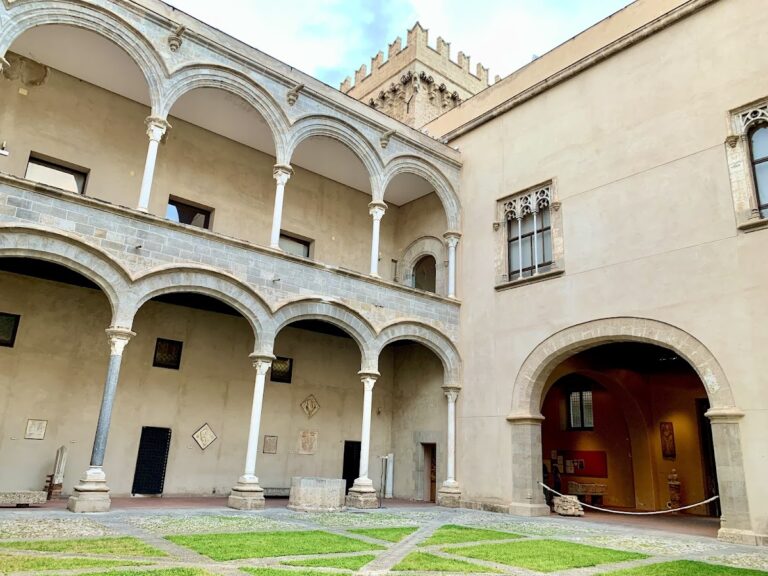
The convent complex includes a large refectory, two cloisters, a campanile, or bell tower, and the former Third-Order oratory. The campanile incorporates an ancient Arab-period tower. The first cloister is rectangular, approximately as long as the nave, and extends mainly along an east-west axis. Its covered porticoes have columns arranged in groups of three bays. A cobbled floor and a marble well occupy the courtyard.
The first cloister contains the Oratory of Santa Maria degli Angeli for secular tertiaries, the Oratory of Saint Placidus for a congregation from Messina, and the Oratory of the Japanese Martyrs for a Seraphic congregation. It also includes a night choir, rooms for the schools of philosophy and theology, cells, an archive, and a pantry.
A passage connecting the cloister, sacristy, and church contains four decorated chapels. The Chapel of the Forty Martyrs was patronized by the prince of Camporeale and marquis of Sambuca. The Chapel of the Blessed Virgin of Carmel contains Gaspare Vazzano’s 1618 Madonna of Carmel and associated saints. The Chapel of Saint Mary of Graces, also called Our Lady of the Snows, has a canvas by Vincenzo degli Azani. The Chapel of Saint Ursula contains Filippo Paladini’s Saint Ursula and the Holy Virgins.
Former Oratorio dei Pescatori
The former Oratorio dei Pescatori is a small Baroque room whose walls and vault are covered with stucco figures, putti, and marine creatures attributed to Vincenzo Messina or to Giacomo and Giuseppe Serpotta. Its central vault fresco, attributed to Vincenzo Bongiovanni, shows the Virgin giving the Portiuncula to Saint Francis. The room is now part of the State Archives.
Former convent archive courtyard
The former convent archive courtyard provides a view of the ancient Arab-period campanile tower. Its walls contain a seventeenth-century fresco of the genealogical tree of the Sicilian Friars Minor and a depiction of the Virgin giving the Franciscan rule to Saint Francis, attributed to Antonio Grano.
Buca della salvezza
The buca della salvezza is a small opening excavated through the exterior wall of the transept on Via Alloro. It is the surviving physical marker of the escape route used by Gaspare Bivona and Filippo Patti during the Gancia Revolt of 1860.
Nearby sites