Palazzo Abatellis: A Gothic-Catalan Palace and Medieval Art Gallery in Palermo


Site at a Glance
- Rating
- 4.5
- Popularity
- Medium
- Country
- Italy
- Primary era
- Medieval
- External website
- Open
- Eras represented
- Medieval, Early Modern, Modern
- Civilizations
- Crown of Aragon, Italian, Kingdom of Sicily, Spanish
- Site type
- Domestic
- Remains
- Elite Residence
On this page20 sections
History
Construction and the Abatellis family
Palazzo Abatellis is a late-fifteenth-century palace in Palermo, Italy, built in 1495 for Francesco Abatellis, the port master of the Kingdom of Sicily. Designed by Matteo Carnelivari, a leading figure in Sicilian Gothic-Catalan architecture, the building belonged to the architectural culture of fifteenth-century Mediterranean urban palaces. Its construction reflected the position of Abatellis, a high-ranking official of Lucchese origin who served Ferdinand II of Aragon.
Abatellis became captain and later held the offices of Grand Seneschal and Praetor for three successive terms between about 1486 and 1495. As he had no heirs, he arranged for the palace to pass first to his second wife. After her death, it was to become a women’s monastery dedicated to Santa Maria della Pietà and governed according to the Benedictine rule.
Conversion into a monastery
The planned religious foundation took a different form. On 19 May 1526, Dominican nuns from the monastery of Santa Caterina moved into the palace. The building was extensively altered for monastic life, and by 1553 it was known as the Monastery of the Portolano.
Between 1535 and 1541, Antonio Belguardo built a chapel for the community under the dedication of Santa Maria della Pietà. In the seventeenth century, the construction of a larger church with the same dedication on Via Butera changed the chapel’s function. It was abolished and converted into a parlatory, a room for controlled conversation with visitors, together with storage rooms. The monastery was exceptionally retained for the Dominican nuns when laws suppressing religious institutions were enacted.
War damage and the regional gallery
During the night of 16 to 17 April 1943, an Allied air raid caused the collapse of the loggia, portico, south-western wing, and the wall of the western tower. The damage led to a major postwar campaign to consolidate and restore the palace.
After the war, Palazzo Abatellis was selected to house a Gallery of Art for Medieval Collections. The works had previously belonged to the Pinacoteca of the Royal University and, from 1866, to Palermo’s regional archaeological museum, later known as the Antonio Salinas Museum. That collection had incorporated works transferred from religious institutions suppressed by the state. Mario Guiotto first directed the restoration, followed by Armando Dillon. The work was completed in mid-1953, and Carlo Scarpa then designed the gallery’s installation and furnishings. The Galleria Regionale della Sicilia opened to the public on 23 June 1954.
Responsibility for cultural heritage passed to the Sicilian Region in 1977, and the gallery became a regional institution. The palace has been used by the region since the 1990s and is owned, together with certain other historic buildings in Palermo, by the Fund for Houses of Worship of the Italian Ministry of the Interior. After a restoration closure beginning in 2008, the museum reopened in 2009. Scarpa’s installation was retained, while upper-floor areas, including the Green and Red Rooms and a roof terrace, were added or reorganized. The gallery now presents Sicilian figurative culture from the twelfth through the seventeenth centuries through works acquired, donated, or transferred from suppressed religious institutions.
Remains
Palace and monastic fabric
Palace layout
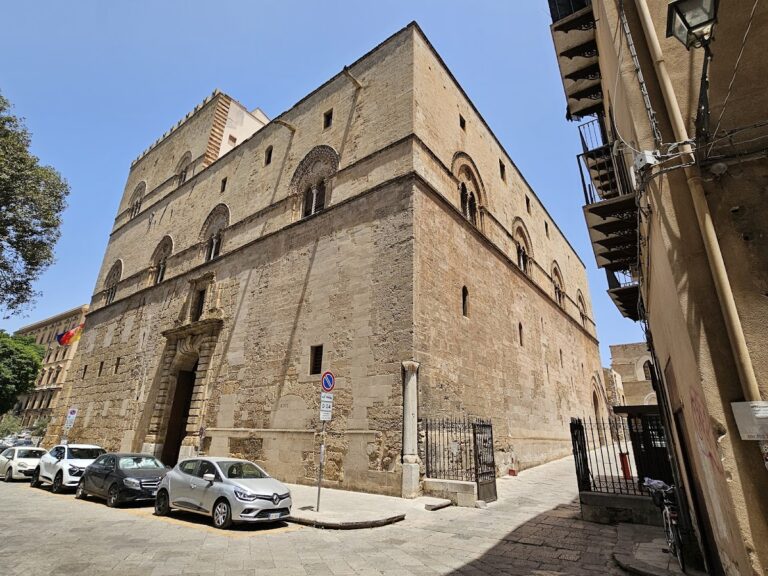
Palazzo Abatellis is a rectangular, two-storey building arranged around an internal courtyard. Dressed stone forms the principal construction, and a corner tower is incorporated into the structure. Two opposing external stairways connect the levels. A two-tiered loggia has segmental arches on the ground floor and round arches above. The principal entrance, set between two prominent crenellated towers, has a stone frame and bears arms associated with the Patella-Abatellis family above the centre of the portal. Refined three-light windows decorate the piano nobile, the main residential floor.
The courtyard, entrance, and tower were originally worked in tufa. The palace was not substantially remodelled during the Baroque period, so its Gothic-Catalan form and structural organization remain legible. The surviving fabric also preserves the relationship between the earlier aristocratic residence, its courtyard, and the later gallery installation.
Former chapel
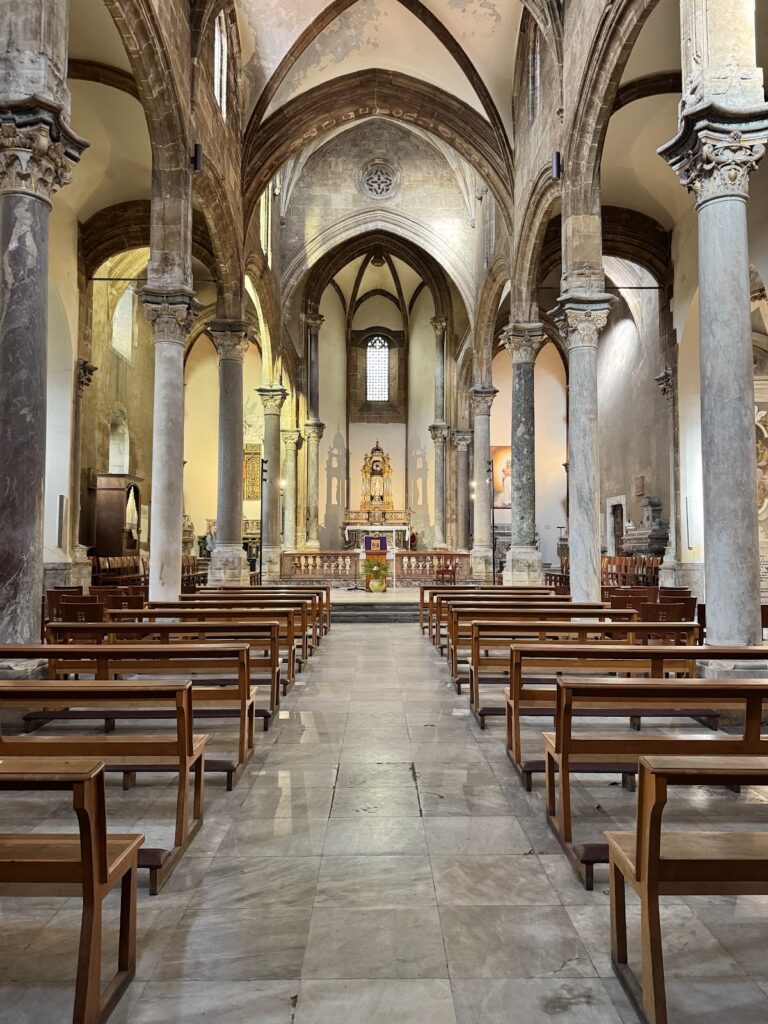
The former chapel occupied the left side of the palace and concealed one of its façades. Its original façade faced north, while its altar faced south beside the palace’s old entrance. Following its conversion to other monastic uses, the altar was removed, a doorway was opened through the apse wall, and the rear portion was turned into storage rooms. The former chapel later became the setting for the large fresco Triumph of Death.
Gallery rooms and collections
Ground-floor works
The gallery occupies sixteen rooms, including ground-floor, first-floor, and later upper-floor spaces. The ground floor contains twelfth-century carved wooden works, fourteenth- and fifteenth-century sculpture, painted maiolica with metallic lustre dating from the fourteenth to the seventeenth centuries, and painted panels from wooden ceilings. Sculptural highlights include Antonello Gagini’s Annunciation and Portrait of a Young Man, Domenico Gagini’s Madonna of the Milk, and Francesco Laurana’s fifteenth-century Bust of a Gentlewoman, traditionally known as Eleanor of Aragon.
Triumph of Death
Room II contains the large fresco Triumph of Death, probably painted in 1445 and the years that followed. It originated at Palazzo Sclafani and is displayed in the former chapel with overhead lighting. Death appears on a skeletal horse entering a garden and shooting among young revellers and noblewomen. The scene also includes figures representing the earthly hierarchy, including laypeople, clergy, popes, and emperors, after they have been struck down.
Antonello Room
Room X, known as the Antonello Room, contains Antonello da Messina’s fifteenth-century Virgin Annunciate. The painting presents the Virgin at the moment of the Annunciation, with an invisible angel positioned before her. Its distinctive features include the hand gesture, trapezoidal mantle, highly polished forms, and intense gaze. Three panels showing Church Doctors, Saint Augustine, Saint Gregory the Great, and Saint Jerome, were formerly the pinnacles of a dispersed polyptych, a multi-panel altarpiece.
First-floor paintings
The first-floor route includes Jaume Serra’s Last Supper and the Hall of Crosses, which contains painted crosses by Pietro Ruzzolone and the Master of Galatina. Other works include Bartolomeo Camulio’s Madonna of Humility in Room VII, Riccardo Quartararo’s Coronation of the Virgin in Room XI, and sixteenth-century paintings by Antonello Crescenzio.
Room XIII contains fifteenth- and sixteenth-century Flemish paintings, including Jan Gossaert’s Malvagna Triptych. The triptych shows the Madonna and Child between angels, with Saint Catherine of Alexandria and Saint Dorothy at the sides. The reverse bears the arms of the Lanza family. The room also contains Jan Provost’s Deposition.
Later European and Sicilian painting
Rooms XV, XVI, and XVII contain works by Vincenzo da Pavia and Jacopo Palma the Elder, along with mythological paintings such as Giuseppe Cesari’s Andromeda Freed by Perseus and Francesco Albani’s Venus and Adonis. Mannerist works include Giorgio Vasari’s two-part Fall of the Manna, Girolamo Muziano’s Saint Andrew, and Marco Pino’s Transfiguration.
The wider collection includes Agnolo Bronzino’s Madonna and Child with the Young Saint John; Mattia Preti’s Christ and the Canaanite Woman, Christ and the Adulteress, and The Four Evangelists; Luca Giordano’s Rape of Deianira and Massacre of the Innocents; Jusepe Ribera’s Saint Paul the Hermit and Saint Augustine Turning the Pages of a Book; Antoon van Dyck’s Madonna of the Rosary; and Cesare Fracanzano’s The Torment of Tityus. Other paintings by Pietro Novelli include Annunciation, Madonna of Grace with Saints Rosalia and John the Baptist, Moses, Coronation of Saint Casimir, Saint Peter Freed from Prison, and Communion of Saint Mary Magdalene.
Green Room
The Green Room presents late Sicilian Mannerism, particularly the Counter-Reformation style associated with Giuseppe d’Alvino, Gaspare Bazzano, and Pietro D’Asaro. It also contains Filippo Paladini’s Saint Francis and Ecstasy of Saint Catherine. Among its religious objects is the Golden Sphere, a large monstrance, or vessel for displaying the consecrated Eucharistic host, made in seventeenth-century Palermo from gold, gilt silver, enamel, and diamonds. It formerly belonged to the House of the Oratorian Fathers at Olivella.
Red Room
The Red Room presents Caravaggesque and seventeenth-century painting. Its works include Simon Vouet’s Saint Agatha in Prison Visited by Saint Peter, Battistello Caracciolo’s Sleeping Cupid, an anonymous copy of Caravaggio’s Supper at Emmaus in the National Gallery version, and Antoon van Dyck’s Saint Rosalia Crowned by Angels, Madonna and Child, and attributed Lamentation. The room also contains further works by Pietro Novelli, including Moses, Coronation of Saint Casimir, Saint Peter Freed from Prison, and Communion of Saint Mary Magdalene.
Polyptychs, stored works, and drawings
Corleone Polyptych
The fifteenth-century Corleone Polyptych depicts the Coronation of the Virgin with saints, the Transfiguration, the Magdalene, the Annunciation, Saint Lucy, Christ in Pity, and apostles. It came from the sacristy of the monastery church of the Most Holy Saviour at Corleone.
Stored paintings
Works kept in storage include Pietro D’Asaro’s Nativity of Jesus with Saint Clare, Saint Francis of Assisi, and Saint John the Baptist, formerly associated with the church of San Vito at Chiusa Sclafani; his Penitent Magdalene, from the Capuchin friars’ convent at Castronovo di Sicilia; and The Stoning of Saint Stephen. The stored collection also includes a 1611 Last Supper from the convent of Santa Maria di Gesù, two sketches for altarpieces depicting the Adoration of the Magi from about 1613, Saint Francis Embracing the Crucifix, and Orpheus Playing the Violin.
Models and architectural drawings
The gallery holds models and drawings by or attributed to Giacomo Serpotta, Giacomo Amato, Antonio Grano, Paolo Amato, Pietro Aquila, Guglielmo Borremans, and Francesco Ferrigno. The material includes Serpotta’s terracotta model Charity, dated 1699, as well as designs for church façades, portals, altars, arches, frames, reliquaries, catafalques, and ceremonial furnishings. Drawings connected with Santa Maria della Pietà, San Matteo al Cassaro, Sant’Agostino, and other Palermo institutions preserve evidence of late seventeenth- and early eighteenth-century ecclesiastical and civic decoration.
Nearby sites