Palazzo Butera: A Baroque Aristocratic Palace in Palermo


Site at a Glance
- Rating
- 4.7
- Popularity
- Medium
- Country
- Italy
- Primary era
- Early Modern
- External website
- Open
- Eras represented
- Early Modern, Modern
- Civilizations
- Kingdom of Sicily, Spanish
- Site type
- Domestic
- Remains
- Palace
On this page6 sections
History
Palazzo Butera is a monumental Baroque palace complex in Palermo, Italy, built and enlarged during the late seventeenth and eighteenth centuries in the city’s historic Kalsa quarter. Its position beside the port made it a prominent entrance point to Palermo and placed it within the architectural setting formed by the seafront and nearby Porta Felice.
Branciforte foundation and enlargement
In 1692, Girolamo Branciforte, Marquess of Martini, acquired land occupied by properties belonging to the Imperatore family and commissioned a small palace or casino. Construction associated with the Branciforte family began in 1701. After Girolamo’s son, Ercole Michele Branciforte e Gravina, married Caterina Branciforte e Ventimiglia in 1718, the family obtained the hereditary title of Prince of Butera. Ercole Michele then ordered the palace’s enlargement and refurbishment, with designs by Giacomo Amato contributing to its development.
The building reached its eighteenth-century form through successive alterations. A fire in 1759 caused extensive damage and led to a major reconfiguration and refurbishment under Prince Ercole Branciforte. The work continued during the rule of his son, Prince Salvatore Branciforti, with contributions from Paolo Vivaldi and other artists and craftsmen. In 1760, the adjoining Moncada palace was incorporated into the complex, creating a large ballroom and extending the aristocratic residence.
Public life and later history
Palazzo Butera was connected to several notable events in eighteenth-century Palermo. In 1773, Ercole Michele Branciforti e Pignatelli, Prince of Pietraperzia, supported a local Sicilian rebellion and was imprisoned by the viceroy Caracciolo. In 1784, he witnessed the release of a Montgolfier-type hot-air balloon from the palace terrace. The residence also hosted Johann Wolfgang von Goethe, Wilhelm II, Philipp Hackert, Dominique-Vivant Denon, Jean-Pierre Houël, and Friedrich Münter.
After Stefania Branciforte died, the titles passed to the Lanza family, Princes of Trabia and Dukes of Camastra. Prince Pietro Lanza Galletti and his wife, Giulia Florio d’Ondes, continued to live in the palace during the Second World War, when two of their sons died. After 1950, the building passed through the ownership or administration of various local-government institutions and housed a tourism institute.
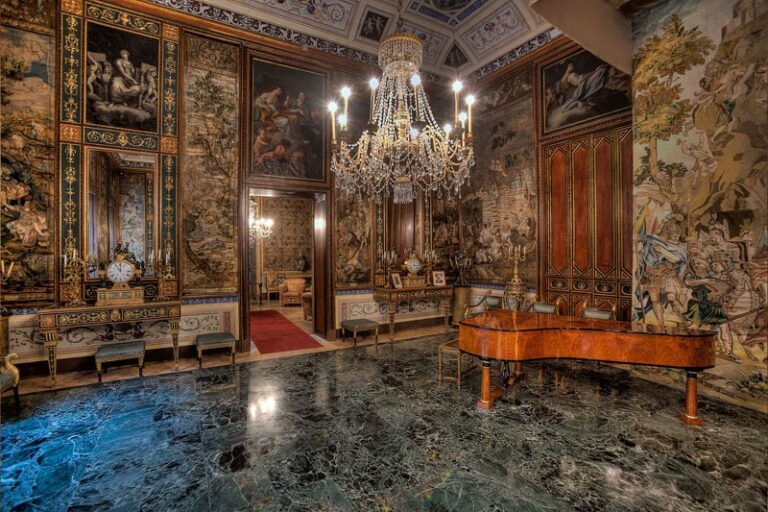
Massimo and Francesca Valsecchi acquired Palazzo Butera in 2016 and financed a comprehensive structural and artistic restoration. Work began in January 2016 under the architect Giovanni Cappelletti, who also designed the museographic installation for the collections. From spring 2021, the restored palace reopened with the first complete installation of the Francesca and Massimo Valsecchi Collection. The intervention converted its rooms into exhibition spaces for contemporary art, old-master paintings, monochrome porcelain, iridescent glass, and English furniture and objects associated with the Industrial Revolution era.
Remains
Palazzo Butera is a long Baroque complex facing the Mediterranean and the Foro Italico, Palermo’s seafront park. Its seaward façade has pronounced contrasts of colour, or bichromy, and extends along a broad terrace built over the base of the former city walls. Known as the Passeggiata delle Cattive, this terrace overlooks the Gulf of Palermo. The principal entrance lies on the landward side in Via Butera, while the palace’s opposite elevation faces the sea and forms part of the architectural setting at Palermo’s entrance with Porta Felice.
Exterior and principal circulation
The city-facing elevation opens into a long enfilade, a sequence of rooms aligned along a common axis, extending toward Via Butera. A marble staircase leads to the piano nobile, the ceremonial upper floor containing the principal reception rooms. Its decoration includes the Branciforte coat of arms with a lion. By 1735, the palace had acquired a roofline with a balustrade. The 1760 incorporation of the Moncada palace created the large ballroom within the expanded complex.
Interiors and decoration
The interiors retain an eighteenth-century spatial arrangement, although later alterations made them varied in character. Neoclassical work was added over the post-1759 refurbishment, and later changes included the Moorish Room. Frescoes are associated with Gioacchino Martorana, Olivio Sozzi, Emanuele Interguglielmi, Elia Interguglielmi, and Pietro Martorana. Ferdinando Fuga designed some interior decorations between 1728 and 1741, while Gaspare Fumagalli produced quadratura, an illusionistic architectural painting technique using painted perspectives and structural details. Giuseppe Li Gotti led stucco and artisanal construction, and Francesco Alaimo completed parts of the stuccowork. Nineteenth-century painted decoration attributed to Elia Interguglielmi reflects the transition from the late eighteenth-century manner to Neoclassical art. During the twentieth century, maiolica floors, made from tin-glazed decorated earthenware, were replaced and some eighteenth-century furnishings were disposed of. The restored rooms now contain the Valsecchi Collection’s artworks, porcelain, glass, furniture, and objects.
Nearby sites