Borisoglebsky Monastery: A Historic Russian Orthodox Monastery in Torzhok


Site at a Glance
- Rating
- 4.7
- Popularity
- Low
- Country
- Russia
- Primary era
- Early Modern
- External website
- Open
- Eras represented
- Early Modern, Modern
- Civilizations
- Russian
- Site type
- Religious
- Remains
- Monastery
On this page16 sections
History
Borisoglebsky Monastery is a Russian Orthodox men’s monastery in Torzhok, Russia, on the bank of the Tvertsa River. Tradition dates its foundation to 1038 and attributes it to Efrem of Novotorzh, a boyar, or high-ranking nobleman, of Hungarian origin who had served as equerry to Prince Vladimir I. The monastery is dedicated to Boris and Gleb, princes of Kievan Rus who became among the earliest canonized saints of the Russian Orthodox tradition. Its historical foundation date remains uncertain, since the first reliable written reference dates to 1534, but the community is regarded as one of the earliest monastic foundations in Rus.
Foundation and Early Tradition
According to the foundation tradition, Efrem withdrew from secular life after Svyatopolk’s killing of Boris and Gleb and established a monastery beside the Tvertsa in their honor. Svyatopolk was a prince of Kievan Rus associated in later tradition with the princes’ murder, while Vladimir I was the ruler traditionally linked with the Christianization of Rus. A stone church dedicated to Boris and Gleb was said to have been built in 1038, and its dedication gave the monastery its name.
The community grew around the church through the work of Efrem’s disciples and followers. Efrem died in 1053 and was buried at the monastery. Tradition holds that his relics were later transferred during the reign of Ivan the Terrible, the sixteenth-century grand prince and first tsar of Russia. Arkady of Novotorzh, one of Efrem’s disciples, was also later recognized as a saint. Particles associated with the relics of Boris and Gleb, Efrem, and Arkady remain connected with the monastery’s religious tradition.
Sixteenth and Seventeenth Centuries
During Ivan the Terrible’s reign, two side chapels were added to the old Borisoglebsky Cathedral, in 1577 and 1589. The right chapel honored Efrem, the founder, while the left was dedicated to Joachim and Anna. The surviving lists of monastic superiors begin with appointments made in the sixteenth century.
The monastery suffered severe damage during the Polish capture of Torzhok in 1607. Polish forces burned an old wooden church together with members of the brotherhood and some townspeople. The Vvedenskaya Church was later built on the site of that destroyed church. A stone church dedicated to the Entry of the Lord into Jerusalem was added in 1717.
Imperial Reconstruction
A major fire damaged the monastery in 1742, but the community began to recover during the second half of the eighteenth century. Before the church reform of 1764, the monastery was recorded as owning 2,232 peasant households and having three attached monasteries: the Rozhdestvensky Monastery, the Udomlya Theological Monastery, and the Semyonovskaya Hermitage. The reform placed Borisoglebsky Monastery in the second class, an administrative category used for Russian monasteries after the eighteenth-century changes.
The old Borisoglebsky Cathedral was replaced by order of Empress Catherine II, who ruled Russia from 1762 to 1796. Catherine laid the foundation stone on 20 June 1785 and provided financial support for the project. The new cathedral was completed between 1785 and 1796. During the rebuilding, the monastery’s former liturgical furnishings were dispersed among other churches, and sacred vessels and part of the equipment associated with Efrem were found inside one of the old cathedral’s pillars.
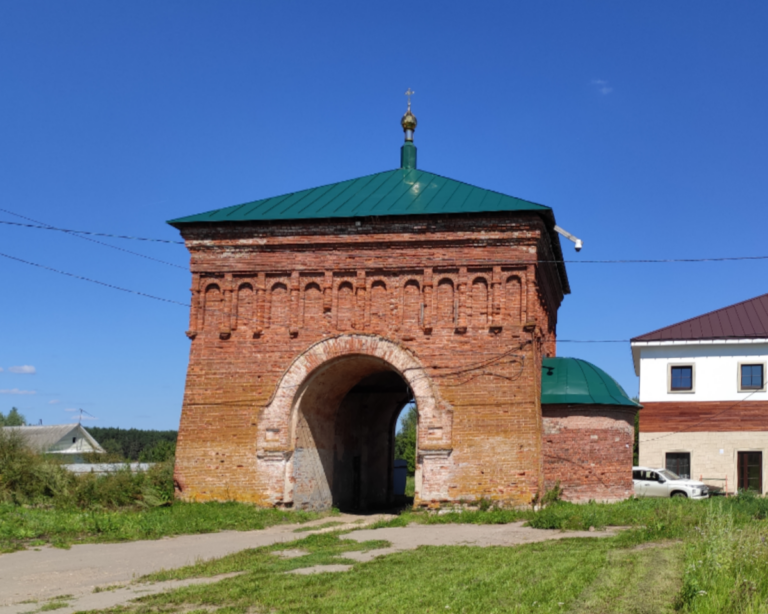
A new gate church dedicated to the Savior Not Made by Hands, together with its bell tower, was begun in 1804 and completed in 1811. The work was carried out by the architect Yakov Ananyin, although the design has also been attributed, with qualification, to Nikolai Lvov, a Russian architect and artist associated with neoclassical design.
Twentieth-Century Disruption and Revival
After the fall of the monarchy, the monastery was dissolved in 1925. Its buildings were used for approximately fifty years as a strict-regime prison and later as a medical-labor facility for people suffering from alcoholism. These uses altered and damaged parts of the historic ensemble.
From the end of 1980, the complex housed the All-Russian Historical and Ethnographic Museum. The museum administration initiated restoration of the buildings after the prison period. In 1993, part of the monastery was returned to the Russian Orthodox Church while the museum continued to occupy the remainder. Five monks settled there in 1995, and liturgical life resumed on 24 June 1998, the feast day of Efrem. The community was reactivated by decree of Viktor Oleinik, Bishop of Tver and Kashin, who appointed Abbot Vassian Kuraev as superior.
Restoration and recovery have continued since 2008 under the Culture of Russia program. The Vvedensky Church was consecrated in 2020, while restoration of the gate church was still underway when its cross was consecrated in 2019. The monastery is a federally significant cultural-heritage property of the Russian Federation under a designation recorded in 1960. It remains active and has affiliated compounds including the Transfiguration Cathedral and a church dedicated to Clement, Pope of Rome.
Remains
Cathedral and Churches
Borisoglebsky Cathedral
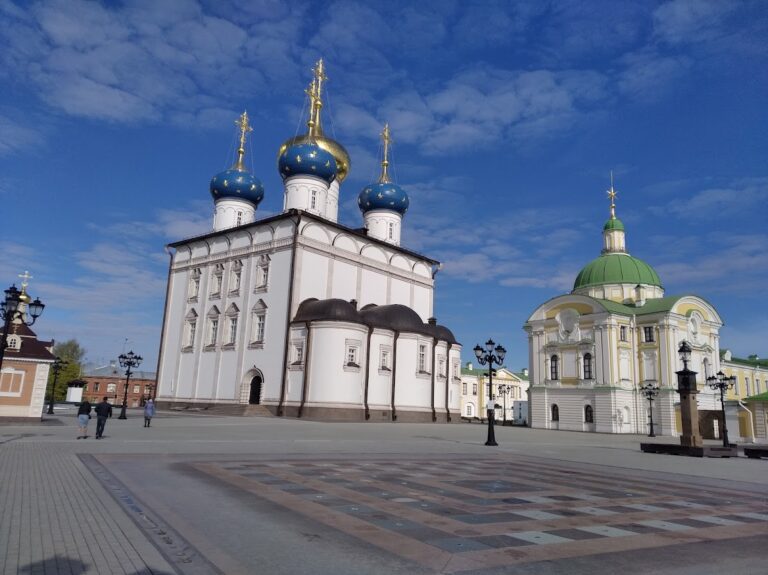
The present Borisoglebsky Cathedral is a three-altar stone church built between 1785 and 1796 to a design by Nikolai Lvov, under the supervision of the local architect Fedor Butsi. Between 1785 and 1788, the state assigned 22,750 rubles for construction, while donations brought the total to 50,000 rubles. The building measures 14 sazhens and 2 arshins in both length and width, and 14 sazhens and 1.5 arshins from the ground to the top of the cross. Its altars were consecrated on 22 June 1785. The former Joachim and Anna chapel was rededicated to the Great Martyr Catherine, and Catherine II donated the vestments.
The cathedral received a wooden iconostasis, the screen separating the sanctuary from the main body of an Orthodox church, in 1789. It had carved decoration and a black-gilded finish around its perimeter. In 1795, Vladimir Borovikovsky produced 37 religious icons on cardboard for it. Between 1839 and 1840, the cast-iron floor was replaced with a wooden one, the iconostasis was renewed, the walls and columns were plastered to imitate marble, and stone vaults were added. The side altars were consecrated in 1841 in honor of Efrem and Arkady of Novotorzh, and a new principal altar was installed in 1876. Further interior work took place in 1892, followed by reconsecration on 14 October 1895.
Vvedenskaya Church
The single-domed stone Vvedenskaya Church was built in 1620 on the site of the wooden church burned during the Polish attack of 1607. It was replanned in 1833, and a chapel dedicated to Joachim and Anna was added on the left in 1879. A new porch with a dressed-stone staircase was later constructed. In 1887, the dome was gilded and a heating stove was installed. Efrem’s relics were temporarily transferred to this church on 22 July 1784, when the old cathedral was being dismantled.
Church of the Entry into Jerusalem
The stone Church of the Entry of the Lord into Jerusalem was built in 1717 without an iconostasis. The old iconostasis from the Borisoglebsky Cathedral was installed there in 1786. The church was restored during the 1980s and forms part of the surviving group of religious buildings within the monastery walls.
Church of the Savior Not Made by Hands
The Church of the Savior Not Made by Hands was built between 1804 and 1811 on the site of the former stone Church of the Exaltation of the Cross. It was consecrated on 8 September 1811 and incorporates a three-tier bell tower 24 sazhens high. The tower was equipped with striking clocks, and its largest bell weighed 500 poods, approximately 8.2 metric tons.
Monastic Buildings and Enclosure
Abbot’s and Brotherhood Buildings
The abbot’s building is a two-story structure with an iron roof, built in 1717. It measures 11 sazhens by 6 sazhens. A two-story brotherhood building with an iron roof was constructed in 1818–1819 and measures 10 by 5.5 sazhens. A separate wing near the abbot’s building housed monastic services.
Guesthouse and School Wing
A two-story wing beside the bell tower was built in 1811. Its ground floor contained a guesthouse for pilgrims, while the upper floor became a parish school for children on 22 September 1889.
Towers and Walls
The monastery’s principal buildings stand within enclosing walls that include towers on the northern and eastern sides. The unusually shaped Candle Tower occupies the corner opposite the bell tower. It contained the monastery library and was restored during the 1970s and 1980s. The ensemble also includes other service structures, while the surviving fabric bears alterations from its twentieth-century prison use and the effects of subsequent restoration.
The Old Cathedral Site and Relics
The original Borisoglebsky Cathedral was a single-altar stone church with three domes and iron crosses. The principal altar cross had a foot, cherubim, seraphim, and full gilding. After the additions of 1577 and 1589, the cathedral measured 9 sazhens and 2 arshins in length and 12 sazhens and 1 arshin in width. Efrem and his disciple were buried beneath the floor on the right side of the western corner of the narthex, the entrance hall of the church.
The old cathedral was dismantled between September and 1 December 1784 because of its dilapidated condition. During demolition, sacred vessels and part of the church equipment associated with Efrem were found inside one of its pillars. The cathedral’s principal cross was removed on 27 August, and its former iconostasis was transferred to the Church of the Entry of the Lord into Jerusalem in 1786. Some icons went to the Vvedenskaya Church, while others were sold in 1789 to the village of Yesenovichi for 400 rubles.
Efrem’s relics were confiscated during the 1920s. They may later have been held in a museum of religion and atheism, but their subsequent location is uncertain. Particles associated with the relics of Boris and Gleb, Efrem, and Arkady of Novotorzh remain linked with the monastery’s religious heritage.