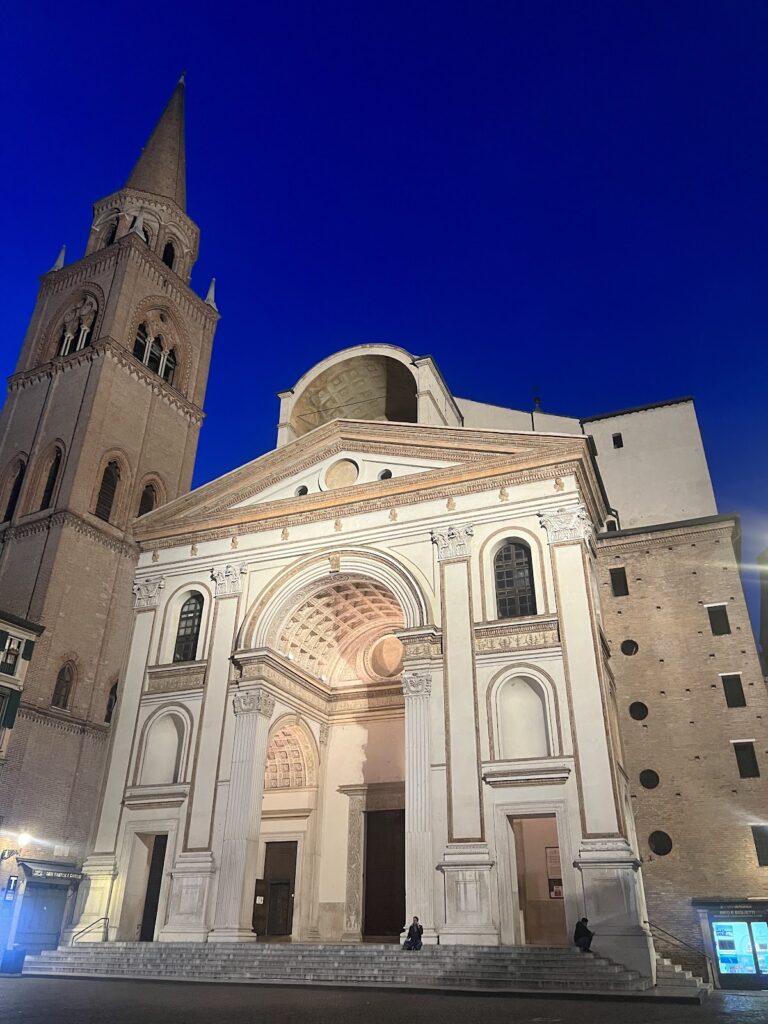
Beata Vergine delle Grazie: A Sanctuary and Minor Basilica in Italy


Site at a Glance
- Rating
- 4.6
- Popularity
- Medium
- Country
- Italy
- Primary era
- Medieval
- External website
- Open
- Eras represented
- Medieval, Early Modern
- Civilizations
- Holy Roman Empire
- Site type
- Religious
- Remains
- Basilica
On this page18 sections
History
Beata Vergine delle Grazie is a Roman Catholic Marian sanctuary in Italy, in Grazie, a hamlet of Curtatone in Lombardy. Dedicated to the Blessed Virgin Mary as Madonna delle Grazie, it is part of the Diocese of Mantua and has the status of a minor basilica. The present Lombard Gothic church was commissioned around 1399 by Francesco I Gonzaga after a plague epidemic in Mantua, as an act of thanksgiving for the Virgin’s supposed intercession.
Origins and Gonzaga foundation
The origins of the sacred site are placed around 1200, or more broadly between 1150 and 1200, when the locality was known as Prato Lamberto. Fishermen and peasants venerated an image of the Virgin and Child on a small altar set on a promontory among the reeds of the Mincio wetlands. A votive chapel was later built to shelter the image from the weather, and the image acquired a reputation for miraculous powers.
Francesco I Gonzaga, whose family ruled Mantua from the fourteenth century until the early eighteenth century, entrusted the new church to Bartolino da Novara. The work cost 30,000 gold scudi, and the church was consecrated in August 1406 in the presence of Francesco Gonzaga and the bishops of Mantua and Cremona. Its foundation transformed the earlier place of devotion into a major pilgrimage sanctuary.
The sanctuary’s reputation was reinforced by traditions of miracles and answered prayers. One tradition says that Bernardino of Siena crossed the nearby Mincio in 1420 after placing his mantle on the water and invoking the Virgin’s help. Pilgrims traditionally walked to the church during the August feast as an act of thanksgiving or to fulfill a vow.
Pilgrimage and the August fair
Important visitors included Antipope John XXIII in 1414, Pope Martin V in 1419, Pope Pius II in 1459 and 1460, Pope Clement VIII in 1598, Emperor Joseph II in 1786, and Pope John Paul II in 1991. Emperor Charles V also visited the sacred image. These visits formed part of the sanctuary’s long religious history and its connection with Mantua’s ruling dynasty.
Donations and bequests enlarged the complex after the church was built. Between 1412 and the end of the fifteenth century, a convent, school, oratory, and library were added. Wealthy Mantuan families established private chapels, some serving as burial places, while Giulio Romano and his workshop later worked in the church and sacristy.
On 11 August 1425, the fair of Porto was moved to the square before the church. A portico for merchants was constructed around the square in 1521, establishing the tradition that developed into the annual Fiera delle Grazie. A further wing of porticoes and a sacristy with an altar were added in 1642. In 1700, Anna Isabella Gonzaga of Guastalla requested a plan for fifteen chapels along the road to Mantua, but the project was never completed.
War, suppression, and restoration
The convent was closed and converted into a hospital in 1782. During the Napoleonic invasion, much of the sanctuary’s collection of votive offerings was confiscated or lost, and the library was dispersed, destroyed, or looted. The Franciscans were expelled when the convent was dissolved again in 1810, and substantial parts of the architectural complex were dismantled in 1812.
The sanctuary was also drawn into the military events of the First Italian War of Independence, the 1848 conflict in which forces seeking Italian independence fought the Austrian Empire. Tuscan troops camped at Grazie before the Battle of Curtatone and Montanara in May 1848. After the Battle of Goito on 30 May, Sardinian troops entered the locality. Local inhabitants had brought about one hundred wounded Austrian soldiers into the sanctuary and shut the doors when King Charles Albert wished to enter. General Eusebio Bava attributed their action to sympathy for the imperial cause.
Later restoration took place under the bishops of Mantua Giovanni Corti, Giuseppe Rota, and Giuseppe Sarto, the future Pope Pius X. Franciscans returned in 1886, but Passionists replaced them in 1905. Since 1935, diocesan clergy have served the sanctuary. The church and historic complex form part of the Mantua and Sabbioneta World Heritage property, inscribed in 2008, and the site is also protected as an Italian cultural heritage property.
Continuing traditions
The August celebrations continue to include the Fiera delle Grazie and the National Meeting of the Madonnari. Madonnari are artists who create large pavement images, especially sacred images of the Madonna, with coloured chalk. Their drawings are intentionally temporary and disappear through exposure to weather, preserving a living cultural practice alongside the sanctuary’s older devotional traditions.
Remains
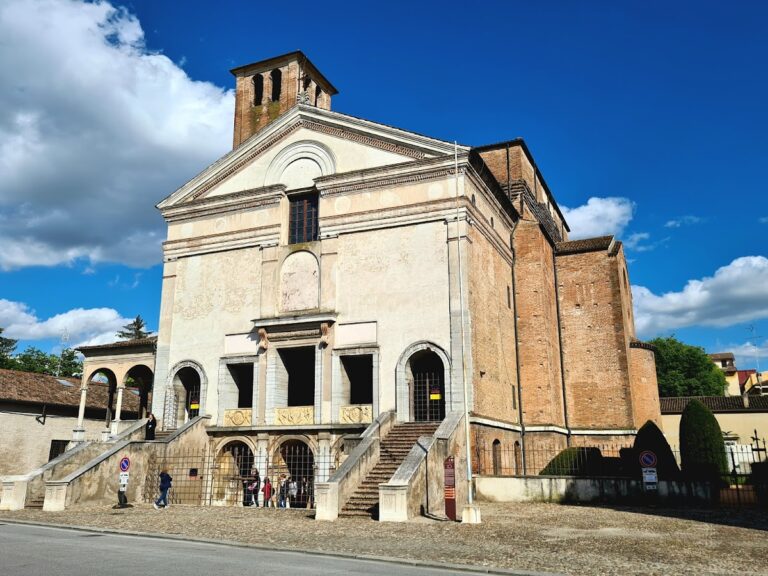
The sanctuary is a Lombard Gothic brick church built on a broad square above the marshy waters of the Mincio. Its facade faces south. The original Gothic structure survives together with additions from later periods, creating a complex in which the church, portico, chapels, and surviving convent buildings reflect successive phases of construction and use.
Exterior and surviving complex
Facade and entrance
The brick facade is crowned by three pinnacles. Its Renaissance portal is made of red marble and carries the inscription Sacrum Celesti Reginae Dicatum. Above the entrance, a lunette, meaning a semicircular field used for decoration, contains a fresco of the Madonna and Child.
Portico and cloister
A portico runs perpendicular to the facade. The present structure has thirteen round arches supported by columns and decorated with terracotta details. Its lunettes contain late-sixteenth-century frescoes depicting episodes from Mantuan history, each linked with the Madonna or with a miracle attributed to her. The original complex had four cloisters, chapels, and numerous associated buildings. Only the Cloister of the Gate and the east wing survive from those structures.
Church interior
Nave and wooden votive structure
The church retains its Gothic character through a single rectangular nave, a raised choir and apse, and two substantial buttresses. Noble chapels were added along the sides. The nave is covered by a ribbed cross-vault decorated with floral frescoes, while the walls are lined by a large wooden structure of columns, tympana, and niches. Made in 1517 and associated with the Franciscan Francesco da Acquanegra, it extends along the middle section of the nave walls.
The structure originally held eighty niches in two parallel rows. Descriptions mention fifty-three life-size figures, while about forty statues survive. They portray people believed to have escaped dangers through the Virgin’s intercession, including hanging, execution, being thrown into a well, military violence, and other threats. The figures were made mainly from papier-mache and related materials. Layers of paper and canvas were hardened with plaster and painted with pigments bound with substances including honey. Moulded elements or wood formed the faces, hands, and feet, depending on the pose; horsehair supplied hair, and acorns were used for some details.
The figures’ clothing consists of woven cotton pieces attached with hooks and dates mainly from the late nineteenth century. Twelve suits of armour were reassembled from the figures. Six are rare Italian Gothic defensive armours formed from multiple steel elements in the fifteenth century; the others are more modest armours dating mainly from the sixteenth century. The six rare fifteenth-century examples were transferred to the Francesco Gonzaga Diocesan Museum in Mantua. They may have been gifts from Gonzaga rulers, although the circumstances of their arrival at the monastery remain uncertain.
Metopes, framed decorative panels, beneath the niches describe the graces or dangers represented by the figures. Some statues no longer correspond to the panels below them, showing that the figures were moved over time. Investigations behind the wooden structure found that the walls had originally been plain and undecorated.
Devotional image and ex votos
The principal devotional image is a Madonna and Child in the Eleusa, or “Virgin of Tenderness,” type. In this Byzantine-derived form, the Child touches the Virgin’s face and looks toward the viewer. The Virgin wears a decorated two-coloured veil with roses and small cockerels, while halos and crowns stand out against the background.
The image has been altered and restored several times, particularly around the eyes and hands. Its surviving stylistic features place it in the late fourteenth century, making it the oldest work in the church. It is plausibly the original image that inspired construction of the present sanctuary, although this has not been verified by radiographic study.
Wax ex votos, objects offered in fulfillment of a vow or in thanksgiving for an answered prayer, are arranged in rows and serpentine patterns around the columns and along the arches of the niches. They represent anatomical parts and conditions, including hearts, hands, eyes, breasts, and plague buboes. Other votive material includes prostheses, metal plaques shaped as eyes, hands, feet, hearts, and breasts, weapons, flags, photographs, letters, embroidered works, painted tablets, and hearts made from materials including silver. A football used in Mantua’s promotion to Serie A in 1961 is also preserved among these offerings.
Crocodile suspended in the nave
A real taxidermied Nile crocodile hangs from the ceiling at the centre of the nave. It was installed in the fifteenth or sixteenth century and has itself undergone restoration, forming one of the sanctuary’s most unusual surviving objects.
Chapels, artworks, and burials
Chapel of San Bonaventura
The Chapel of San Bonaventura contains the mausoleum of Baldassarre Castiglione and his wife, Ippolita Torelli, designed by Giulio Romano, as well as the mausoleum of their son Camillo Castiglione. Giulio Romano’s painting of the Madonna and Child with Saints Bonaventure and Francis of Assisi is also preserved there.
Other family chapels
The Bertazzolo family chapel contains Lorenzo Costa’s Martyrdom of Saint Lawrence. In the Aliprandi Chapel, a wooden icon of the Madonna and Child has panels showing God the Father and Saints Elizabeth, Catherine, Anne, and Apollonia. Giovanni Battista Viani made the icon, and his brother Antonio Maria Viani painted it.
The Chapel of Mater Gratiae contains the principal sacred image of the Madonna and Child, the remains of Carlo II Gonzaga-Nevers and his wife, and votive pictures. The Zimbramonti Chapel contains Francesco Bonsignori’s Altarpiece of Saint Sebastian, while Rinaldo Mantovano, a pupil of Giulio Romano, painted its wall frescoes.
Gonzaga memorials
Memorials or burials associated with numerous Gonzaga family members are distributed through the sanctuary. They include Aloisio Gonzaga and his son Alfonso, Carlo Gonzaga, Maria Gonzaga, Carlo Gonzaga-Nevers, Giulia Gonzaga, Ginevra Gonzaga, Ludovico Gonzaga, and Ercole Gonzaga. A white-marble plaque commissioned by Ippolita Maggi commemorates the burials of Aloisio and Alfonso Gonzaga.
Filmed spaces
The sanctuary’s interior and exterior served as filming locations for Bernardo Bertolucci’s film Novecento. The interior also appeared in the 1982 television adaptation of The Charterhouse of Parma, where it represented a church in Parma.
Nearby sites