Chalepa Monastery: An Orthodox Monastery in Crete


Site at a Glance
- Rating
- 4.7
- Popularity
- Low
- Country
- Greece
- Primary era
- Early Modern
- External website
- Open
- Eras represented
- Early Modern, Modern
- Civilizations
- Ottoman
- Site type
- Religious
- Remains
- Fortified Monastery
On this page9 sections
History
Chalepa Monastery is an Orthodox monastery in Greece, located above Tsachiana in the Municipality of Mylopotamos on Crete. Dedicated to the Transfiguration of the Savior, it has an uncertain foundation date, with its earliest known references appearing in notarial documents from 1555 to 1625, when it functioned as a women’s monastery.
Destruction and refoundation
Ottoman forces destroyed Chalepa and the nearby Monastery of Agia Marina in 1646, during the Cretan War, the seventeenth-century conflict in which the Ottoman Empire conquered Crete from Venice. The destruction reached the Mylopotamos region and was recorded by the Rethymnian poet Marinos Tzane Bounialis.
A hieromonk, an Orthodox monk ordained as a priest, named Jeremiah Sgouros refounded Chalepa in 1673. An inscription above the entrance records this rebuilding. The monastery then became a men’s monastery. In 1676 it received stauropegic status, meaning that it was placed directly under patriarchal authority rather than the ordinary jurisdiction of a local bishop, while remaining a dependency of Vosako Monastery.
Ecclesiastical status and modern history
An exchange of gifts between the monastery and Maximos Proyiannakopoulos, Metropolitan of Crete, a senior Orthodox bishop responsible for a metropolitan district, took place in 1783. This exchange may indicate that Chalepa had become independent. In the early eighteenth century, Chalepa and Vosako lost their stauropegic status, but both regained it in 1790–1791. Chalepa’s status was renewed again in 1850.
During the Greek uprising of 1821, the revolt that began the Greek War of Independence against Ottoman rule, the abbot Nestor Kokkinidis led rebels. Together with other monks, he formed an independent guerrilla force. In late August 1822, Turco-Egyptian forces advancing eastward camped at the monastery. Men from Mylopotamos and Anogeia attacked them, and the fighting damaged the monastery.
Chalepa continued to operate and was counted among Crete’s 41 active monasteries in 1841. During the 1866 uprising, it faced financial difficulties and sheltered refugee families. In 1868 it sold a large estate, followed later by a house in Heraklion. The monastery also took part in the 1897 uprising.
The monastery was abandoned in 1960 after the death of its last monk, and its new abbot subsequently carried out his duties from Diskouri Monastery, another Orthodox monastery in Crete. Chalepa was designated a historic protected monument in 1979. Reconstruction took place between 1997 and 2000, and restoration of the buildings has continued.
Remains
Chalepa Monastery stands on a hill above Tsachiana at the foothills of Mount Psiloritis, among vineyards, olive groves, and oak forests. Its fortified complex is arranged around a central courtyard on two levels. The upper level contains the courtyard and principal church, while the southeastern side holds the abbot’s residence, monks’ cells, communal spaces, and refectory. Farther west, the lower level contains stables, an olive press, and storerooms.
The fortified monastery complex
Entrance and courtyard buildings
The present entrance is a passage gate, or pylon, on the southwestern side of the complex. An inscription dated 1673 marks the refoundation associated with Jeremiah Sgouros. The courtyard and the principal church occupy the upper level, with residential and communal buildings extending along the southeastern side. The lower western level preserves the agricultural and storage functions of the monastery, including stables, an olive press, and storerooms. Parts of older monastery buildings survive as ruins around the standing structures.
The principal church
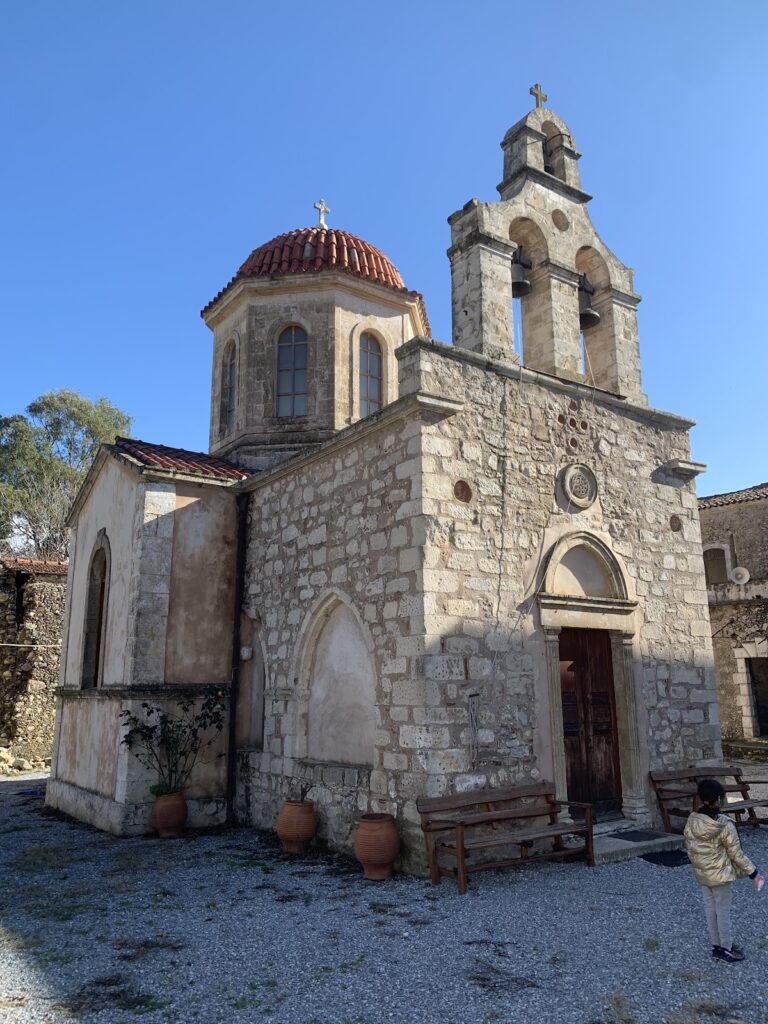
The principal church, known as the katholikon, stands at the eastern edge of the central courtyard. A katholikon is the main church of an Orthodox monastery. The building is a two-aisled basilica without a dome. One aisle is dedicated to the Transfiguration of the Savior and the other to the Nativity of Christ.
An unfinished newer church surrounds the older two-aisled building. Construction began in the early twentieth century under Abbot Iakovos Ploumis but stopped in 1912. Because the monastery remained active, the older church was retained until the new one could be completed. The old katholikon and its icon screen, the screen bearing icons that separates the sanctuary from the main worship space, have been restored.
The stone fountain
West of the church’s entrance gate stands a stone fountain built in 1759 during the abbacy of Maximos Vergitsis. It is now dry and includes sculptural elements.
Agia Marina Church
The Byzantine church of Agia Marina lies approximately 300 to 500 metres from Chalepa Monastery. Its arches and wall paintings date to the thirteenth or fourteenth century, and some of the paintings were executed over reliefs. A relief melon appears above the entrance. The church also bears the coat of arms of the Calergis family, a Cretan noble lineage, which may indicate that the surrounding area was once their fief.
Nearby sites