Moni Asomaton: A Historic Monastery in Crete, Greece


Site at a Glance
- Rating
- 4.4
- Popularity
- Low
- Country
- Greece
- Primary era
- Medieval
- Eras represented
- Medieval, Early Modern
- Civilizations
- Byzantine, Venetian
- Site type
- Religious
- Remains
- Fortified Monastery
On this page8 sections
History
Moni Asomaton is a monastery in Greece, in the fertile Amari Valley of Crete, probably established during the island’s second Byzantine period, from 961 to 1204. Dedicated to the Archangel Michael, it became a spiritual and cultural center for the surrounding region. Its exact foundation date is unknown, although tradition attributes its establishment to a noblewoman from Chandakas, modern Heraklion, who chose the site on the advice of a monk from nearby Kaloidena Monastery.
Byzantine and Venetian periods
The monastery has been identified with a Monastery of Michael the Archangel mentioned in a thirteenth-century document. During that century, it operated as a fortified center enclosed by a strong wall and served as a base for the Chortatzis revolt against Venetian rule. Its history has also been associated with the Varoucha aristocratic family near the end of the Venetian period, when the monastic buildings were renewed.
The central church may date from the period after the Byzantine reconquest of Crete from Arab rule, beginning in 961 under Emperor Nikephoros II Phokas. Archaeological remains and finds support this possible early date, although the attribution remains uncertain. The church was remodelled in the thirteenth century in a Venetian-Byzantine style and received a wooden roof.
Ottoman rule and revolutionary upheavals
Moni Asomaton retained religious, national, and cultural importance during Ottoman rule and became a center of regional cultural activity. Its support for uprisings against the Ottoman authorities, including movements in the eighteenth century, brought repeated destruction and looting. During the seventeenth century, donations from local villagers helped the monastery flourish, and it established a school at Monastiraki that continued operating until 1898.
A vaulted roof was added to the church in the seventeenth century. An earthquake in 1810 caused extensive damage to the monastic complex. In 1812, the Ottoman envoy Osman Pasha reportedly received Communion there. Ottoman forces destroyed the complex several times during the Greek revolutionary period, after which the monastery was abandoned in the early twentieth century.
Agricultural school and renewed monastic use
In the late 1920s, parts of the monastery were transferred to the newly established Asomaton Agricultural School, an institution for agricultural and livestock education. The complex consequently became known also as the Asomaton School. The Metropolitan See of Lambi, Syvritos, and Sfakia, based at Spili, later reorganized it as a nunnery. The Greek Ministry of Culture’s 28th Ephorate of Byzantine Antiquities in Rethymno has undertaken the gradual restoration of the monastic buildings.
Remains
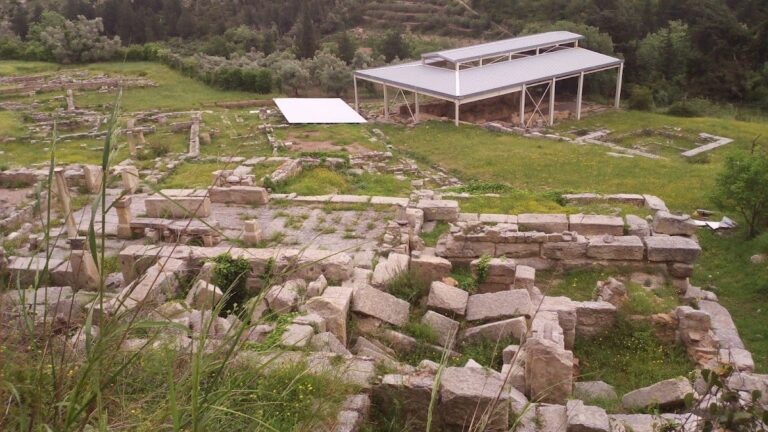
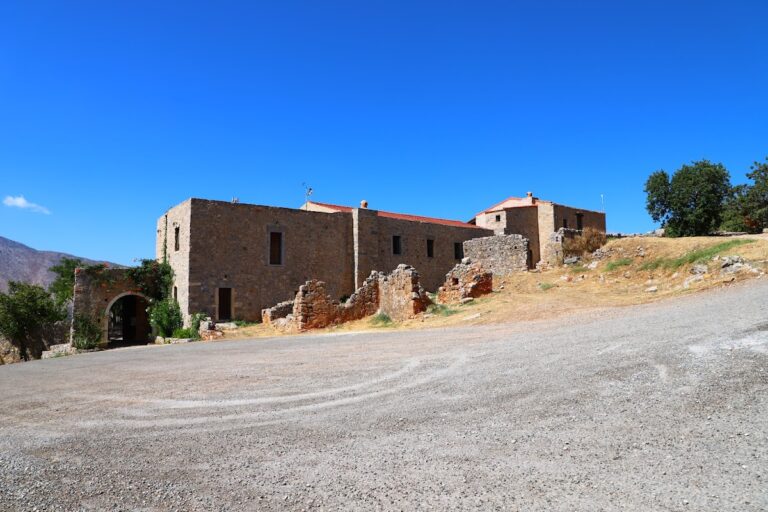
The monastery stands in the central Amari Valley on the plain known as Asomathianos Kambos, at an elevation of approximately 320 to 345 metres. It is associated with the small Platy River and its tributaries, which irrigate the western part of the valley. The restored church occupies the center of the complex, while four two-storey buildings surround the monastic courtyard.
The monastic church
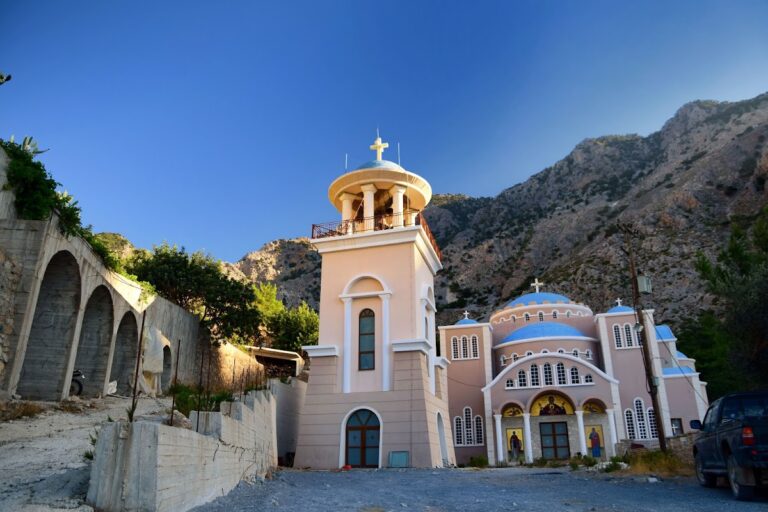
The restored katholikon, the principal church of an Orthodox monastery, is a cross-domed church dedicated to the Synaxis of the Archangels. This dedication concerns Michael, Gabriel, and Raphael, known in Eastern Orthodox tradition as the Taxiarchs, or leaders of the heavenly hosts, and the Bodiless Ones, a term for incorporeal angels. The church’s central dome organizes its principal spaces around a cross-shaped plan.
The church preserves phases from different periods. Its thirteenth-century remodelling gave it a Venetian-Byzantine character and a wooden roof, while the vaulted roof belongs to the seventeenth century. Parts of the side walls and dome were destroyed in the early twentieth century, and the building has since been restored. The sanctuary contains an important icon of the Holy Trinity dated 1619 and an icon of the Archangels painted by the abbot Manasses.
Courtyard buildings and cemetery
The eastern side of the courtyard is formed by the abbey, or abbot’s house, whose facade has notable decoration. The other buildings contain the refectory, monks’ cells, workrooms, storerooms, and stables. They are uninhabited and partly severely deteriorated, although restoration is proceeding in some sections. A fountain remains in the cloister of the former monastery.
A cemetery lies southeast of the principal courtyard, separated somewhat from the main complex. Palm trees and orchards surround it. Another monastic building is being adapted for a future museum.
Library and surviving possessions
The monastery possessed a theological library, ecclesiastical vestments, Gospel books, liturgical objects, valuables, a bishop’s throne, carved wooden elements from the iconostasis, the decorated screen separating the sanctuary from the main body of the church, and numerous icons. Some of these possessions are housed in the restored church, while others are stored in the entrance building pending display in the planned museum.
After the monastery declined, valuable possessions were transferred for safekeeping or display to the Metropolitan’s buildings in Spili, Preveli Monastery, and the Historical Museum of Crete in Heraklion. These include high-quality gold-embroidered ecclesiastical vestments and a silver blessing cross.