Church of Michael the Archangel: A Medieval Bulgarian Orthodox Church near Saparevo


Site at a Glance
- Rating
- 4.7
- Popularity
- Very Low
- Country
- Bulgaria
- Primary era
- Modern
- Eras represented
- Medieval, Early Modern, Modern
- Civilizations
- Bulgarian, Ottoman
- Site type
- Religious
- Remains
- Church
On this page6 sections
History
Medieval origins
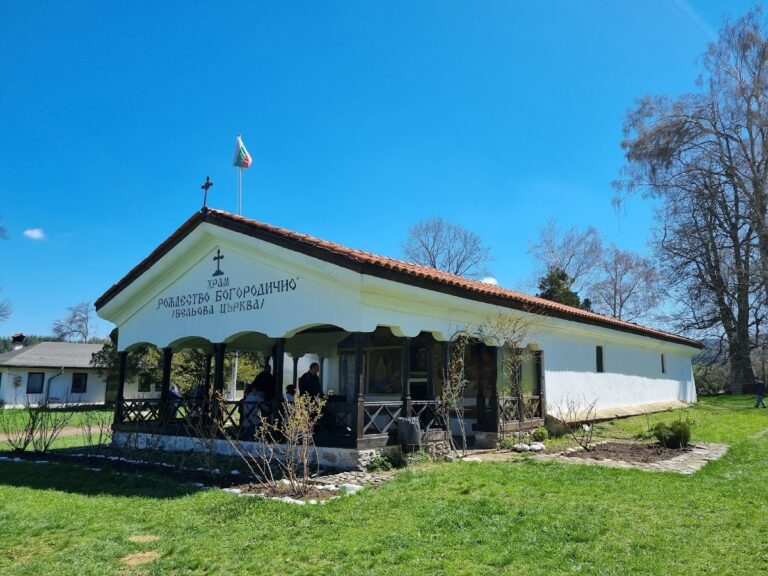
The Church of Michael the Archangel is a medieval Bulgarian Orthodox church near Saparevo, Bulgaria, built during the second half of the fifteenth century. It stands within the Saparevo Monastery dedicated to Michael the Archangel, the chief archangel in Christian tradition and a protector and defender of divine law. The church’s dimensions and painted decoration suggest that it probably served as the church of a monastery, a metochion, or a skete. A metochion was a dependent religious establishment belonging to a larger monastery or church, while a skete was a small monastic settlement or hermitage.
A Christian complex formerly occupied the site before it was destroyed by the Turks. Its foundations were uncovered in 1997 during excavation work for a new monastery building, providing evidence of an earlier religious settlement associated with the location.
Repairs and later development
The church underwent major repairs in 1895, 1977, and 1997. Part of the surviving building belongs to the Bulgarian National Revival, a period of cultural, religious, and political renewal among Bulgarians during the eighteenth and nineteenth centuries. An inscription in the east-wall lunette dates one restoration to 1863. A lunette is a semicircular or segmental area of wall, often placed above an opening.
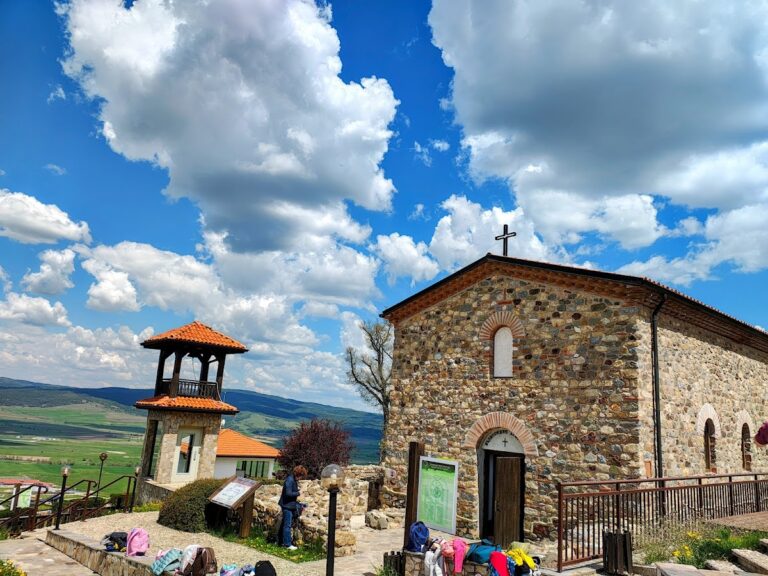
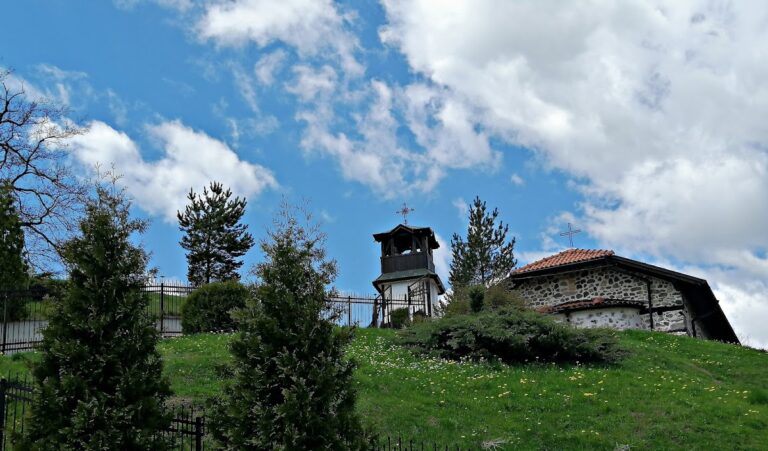
In 1997, a western entrance hall, or narthex, was added and opened. New monastery buildings, a bell tower, and a substantial enclosing wall were also constructed around the church, creating the present monastery complex. The new monastery building was consecrated on 8 November 1997, Archangel Day, in the presence of Patriarch Maksim, then head of the Bulgarian Orthodox Church. The monastery is not currently active. The church was restored, and its feast day continues to be celebrated on 8 November.
Remains
Building and setting
The church stands about 1.5 kilometres southeast of Saparevo, in the valley of a small stream at the foothills of the Rila Mountains. It is a small, single-nave structure with internal dimensions of approximately 4.94 metres in length, 3.4 metres in width, and 3.69 metres in height. Its walls are about 70 centimetres thick. The interior is covered by a semi-cylindrical vault and includes an apse and a prothesis niche in the east wall. The prothesis is the part of an Orthodox church associated with preparing the Eucharistic offerings. A small window pierces the south wall.
Two principal construction phases remain visible in the fabric of the church. The south wall and part of the east wall belong to the medieval phase, while the remainder was built during the Bulgarian National Revival. The 1863 restoration inscription is set in the lunette of the east wall, linking the later work to the surviving structure.
Fresco decoration
Parts of the medieval fresco decoration from the fifteenth and sixteenth centuries survive inside the church. The east wall and apse preserve sections of the Melismos, the Adoration of the Sacrifice, and the Annunciation. The Melismos is an Orthodox Eucharistic composition representing the sacrificial aspect of Christ and commonly incorporating church fathers and liturgical imagery. Here it includes Saint John Chrysostom, Saint Gregory the Theologian, Saint Cyril of Alexandria, Saint Dionysius the Areopagite, Saint Nicholas, and an angel holding a liturgical fan. Saint Spyridon of Trimythous appears in the Adoration of the Sacrifice.
The south wall preserves figures in the lowest register, including Saint Spyridon and an unidentified bishop holding liturgical scrolls. Other surviving scenes and fragments include part of Jacob Wrestling with the Angel, Saint Prohor of Pcinja, a fragment of the Last Supper, and Saint Joachim of Osogovo, also known as Sarandapor. Inscriptions identifying figures on the east and south walls are in Bulgarian, while the words on the scrolls are in Greek.
The images and inscriptions indicate two painting periods. The frescoes on the east wall date from the late fifteenth century, while those on the south wall were painted later, probably in the early sixteenth century. Because the church has not yet undergone detailed investigation, further paintings may remain concealed beneath later lime plaster. The preserved decoration makes the church an important monument of Bulgarian medieval art.
Nearby sites