St. Emmeram’s Cathedral, Nitra: Cathedral Church within Nitra Castle


Site at a Glance
- Rating
- 4.8
- Popularity
- Low
- Country
- Slovakia
- Primary era
- Medieval
- External website
- Open
- Eras represented
- Medieval, Early Modern, Modern
- Civilizations
- Great Moravia, Hungarian
- Site type
- Religious
- Remains
- Cathedral
On this page11 sections
History
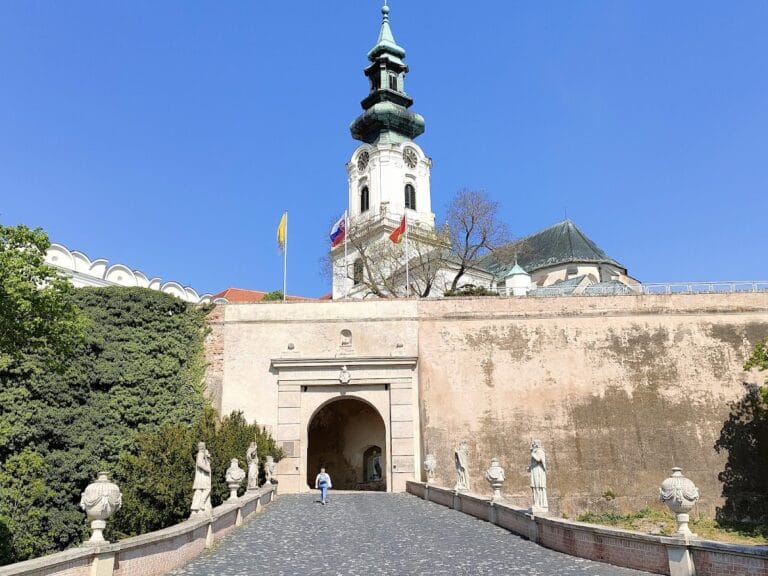
St. Emmeram’s Cathedral is the cathedral church of the Roman Catholic Diocese of Nitra in Nitra, Slovakia, and forms part of Nitra Castle. Its complex combines a Romanesque church or chapel from the eleventh to twelfth centuries, an upper Gothic church built between 1333 and 1355, and a lower church constructed between 1621 and 1642. These successive buildings were later reshaped into a unified Baroque complex.
The Diocese and Romanesque Foundations
The Diocese of Nitra was founded in 880, disappeared after the fall of Great Moravia, and was restored in 1110 within the Principality of Nitra and the Kingdom of Hungary. Great Moravia was a major ninth-century Slavic polity in Central Europe. The diocese is described as belonging to the oldest bishopric in Central and Eastern Europe, and the cathedral has been associated with its long ecclesiastical history.
The Romanesque chapel is the oldest surviving part of the cathedral. Romanesque architecture uses forms that prevailed in western Europe before the Gothic period. The chapel was once identified as the original ninth-century church of Pribina, but research disproved that interpretation. More recent research places the chapel on foundations dating from the ninth century. The Romanesque church was rebuilt after a fire in the second half of the thirteenth century.
Destruction and Gothic Rebuilding
In 1317, the army of Matúš Čák of Trenčín destroyed the Romanesque church. Bishop Meško initiated the rebuilding of the sacred complex in 1333, and the work was completed in 1355. The new upper church substantially altered the earlier building, while the late Romanesque crypt, a church chamber often associated with burial or relic veneration, was lost and filled in.
During the reign of Matthias Corvinus, the Romanesque part of the castle church was burned again. Matthias Corvinus, also known as Matthias I of Hungary, was a fifteenth-century king of Hungary and Croatia. The repeated fires and rebuilding phases contributed to the complex character of the cathedral, in which earlier ecclesiastical structures remained incorporated into later ones.
The Lower Church and Baroque Transformation
Bishop Telegdy initiated the construction of the lower church between 1621 and 1642. It was built alongside the southern long side of the upper church and the narrow side of the Romanesque church, and a staircase connected it with the upper church.
After Nitra Castle ceased to have a strategic function after 1711, the churches underwent a fundamental rebuilding in the Baroque style. Baroque architecture, a seventeenth- and eighteenth-century style known for elaborate spatial and decorative effects, was applied according to designs by the Italian architect Domenico Martinelli. The new cathedral’s high altar was consecrated in 1732, and the rebuilding was completed in 1736. Much of the interior furnishing dates from this period.
Title, Restoration, and Later Additions
The church was already described as a basilica in the eleventh century. A basilica is an honorific ecclesiastical title that may be granted to a church. Pope John Paul II restored the title on 21 October 1998 after visiting Nitra in 1995, although the basilica title is not consistently included in the cathedral’s designations.
Restoration in 1931 to 1933 preceded state celebrations connected with the Pribina commemorations. During restoration in 2012, medieval frescoes dating from the fourteenth or fifteenth century were discovered behind an altar. The cathedral was declared one of Slovakia’s first national cultural monuments in 1961 and was registered as a national cultural monument on 2 October 1963.
A bell named for St. Andrew Svorad and St. Benedict was installed in 2000. On 8 July 2013, another bell was installed in the cathedral tower as a gift from the Nitra cathedral chapter for celebrations marking 1,150 years since Saints Cyril and Methodius arrived in Great Moravia. Their Byzantine Christian mission had lasting importance for Slavic Christianity. A new organ with 30 stops, two manuals, and a pedal was made by Orgelbau Kögler in 2016.
Remains
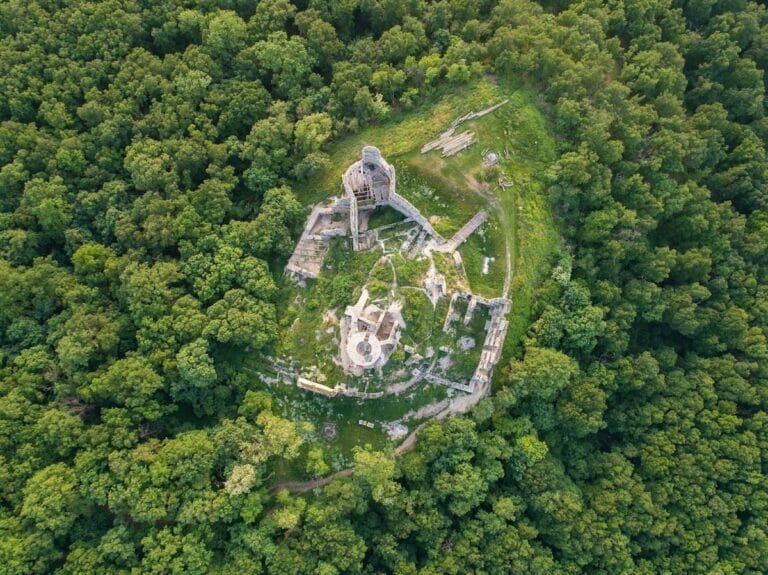
The cathedral stands on the highest point of a rocky rise within Nitra Castle. Its stone-built complex contains the Romanesque church, the upper Gothic church, and the seventeenth-century lower church. Taken together, the buildings have two naves and one tower. The later Baroque work enclosed the separate structures within a more unified composition, closed the Romanesque section with a transverse wall, and narrowed the nave of the lower church.
Romanesque Church
The Romanesque church preserves the oldest surviving portion of the cathedral complex and stands beside the later Gothic and lower churches. Its foundations reach back to the ninth century, while the surviving chapel is dated to the eleventh or twelfth century. The church contains a silver reliquary from 1674. A reliquary is a container made to preserve or display a religious relic. A relic of St. Cyril’s remains was brought from Rome through Bishop Karol Kmeťko, the twentieth-century bishop of Nitra. The interior also contains works by the modern Slovak artists František Pospíšil, Ľudovít Fulla, and Ladislav Majerský, together with traces of the 1931 to 1933 restoration.
Upper Gothic Church
The upper church is a single-nave Gothic building. Gothic architecture is associated with pointed arches and an emphasis on vertical height. Its dimensions were constrained by the narrow space between the steep slope of the castle hill and the Romanesque church. The church has a high altar dedicated to the Saviour, framed by monumental columns, and a ceiling fresco by the Austrian painter Anton Galliarti.
Lower Church
The lower church occupies the space alongside the upper church and the Romanesque building, with a staircase linking it to the upper church. Its distinctive altar combines architecture and sculpture. At the centre is a relief of the Deposition from the Cross by the Austrian sculptor Hans Pernegger, with a marble relief of the Entombment beneath it. The church also contains three tombstones of Nitra bishops and three Late Baroque side altars dating from the eighteenth century.
Frescoes, Windows, and Altar
The medieval frescoes found behind an altar during the 2012 restoration date from the fourteenth or fifteenth century and are regarded as among the most valuable paintings in Slovakia. Coloured stained-glass windows by Ľudovít Fulla depict St. Andrew and St. Benedict. The modern gilded-onyx altar bears a tall wooden cross with the crucified Jesus Christ, a work by J. Pospíšil.
Tower and Organ
The bell installed in 2013 has the note C1, a lower diameter of 1,555 millimetres, and a weight of 2,450 kilograms. The Dytrych family bell foundry cast it, and it completed a group with three earlier bells from 1949 and 1959. The bell bears the names of St. Maurus, St. Emmeram, and St. Bystrik, while academic sculptor Daniel Ignác Trubač created the relief decoration. The cathedral’s 2016 organ has 30 stops, two manuals, and a pedal.
Nearby sites