Church of St Nicholas, Sapareva Banya: A Medieval Bulgarian Orthodox Church


Site at a Glance
- Rating
- 4.8
- Popularity
- Low
- Country
- Bulgaria
- Primary era
- Medieval
- External website
- Open
- Eras represented
- Medieval
- Civilizations
- Bulgarian
- Site type
- Religious
- Remains
- Church
On this page8 sections
History
The Church of St Nicholas is a medieval Bulgarian Eastern Orthodox church in Sapareva Banya, Bulgaria, generally dated to the twelfth or thirteenth century. Its exact date remains uncertain, with scholarly estimates ranging from the eleventh to the fourteenth century. The church belongs to the Bulgarian Orthodox Church, within the Sofia Diocese and the Dupnitsa Deanery, although it is now inactive.
Medieval origins and changing interpretation
Local tradition connects the church with the burial of a feudal lord named Nikola. His identity remains uncertain, and archaeologist Nikola Mavrodinov proposed that the building was more likely a chapel or cemetery church associated with a larger place of worship. Its small size also supports the view that it may not have been founded as an independent church.
In 1838, during preparations for a new church, foundations and columns belonging to a larger building were uncovered west of St Nicholas. These remains support the possibility that the larger church once stood nearby. It was probably demolished at the beginning of Ottoman rule in Bulgaria, the period when Bulgarian lands were incorporated into and governed by the Ottoman Empire. St Nicholas survived, but repairs were prohibited, and the building gradually fell into ruin.
Decline and restoration
A late nineteenth-century tradition states that a stone from the altar was excavated and sent to the National Archaeological Museum in Sofia. Professor R. Hristov reportedly read the date 1160 on the stone, but that date has not been independently confirmed.
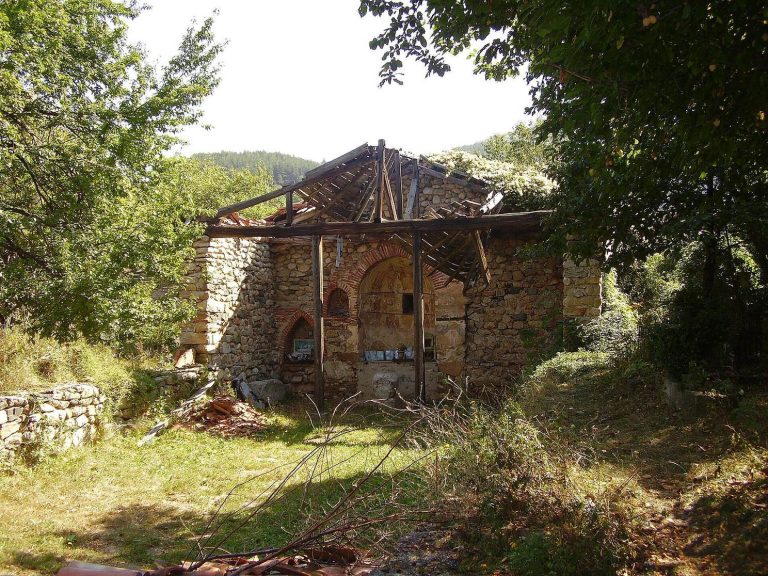
By 1931, the church had lost its roof. One tradition attributes the damage to Circassians who settled near Sapareva Banya after the Crimean War. They allegedly tried to dismantle the roof, but one man fell with part of the dome and died inside the church, after which the attempt was abandoned. The roof had been completely destroyed by the time of Bulgaria’s Liberation.
The church underwent thorough reconstruction in 1937 under the direction of architect Alexander Rashenov. Architects Hristo Ganchev and Y. Farkov led extensive study and another restoration project in 2016. The building was designated a monument of culture of national importance in 1968 and was later declared an artistic monument of culture of national importance in 1978.
Remains
The Church of St Nicholas stands in the central urban park of Sapareva Banya as a compact Byzantine cross-in-square building. Its plan centers on a domed space with short projecting arms, a single nave, and an eastern apse. Stone foundations support walls made of red bricks bonded with white mortar, with the bricks laid in a sunken-brick technique in which mortar covers alternate courses.
Plan and masonry
Cross-in-square structure
The church has an approximately square appearance, although published measurements vary. One description gives about 7.20 by 5.50 metres, another 6.60 by 5.40 metres, and a further measurement 7.20 by 5.70 metres. The dome probably reached about 6.60 metres, while the cornice stood approximately 4.20 metres high. The cross arms are unusually short and equal in size, while the twelve-sided dome is relatively large for the building without being especially tall.
Exterior arches and entrance
The eastern end forms a deep, semicircular apse lit by one window. On the west facade, the entrance is set within a two-stepped niche that widens into four archivolts, bands following the curve of an arch. Each longitudinal exterior wall is divided by two two-stepped arches. Twelve similar arches encircle the dome, and four contain windows. Together, these niches, arches, the twelve-sided dome, and the sunken-brick masonry create the church’s distinctive exterior.
Interior decoration
The interior was originally covered with frescoes. Isolated fragments survive, preserving part of the church’s painted decoration. Mavrodinov compared the building’s design and ornament with the Church of St Pantaleon at Gorno Nerezi near Skopje and the Church of St Theodore at nearby Boboshevo.