Praskvica Monastery: A Serbian Orthodox Monastic Center in Montenegro


Site at a Glance
- Rating
- 4.8
- Popularity
- Low
- Country
- Montenegro
- Primary era
- Medieval
- External website
- Open
- Eras represented
- Medieval, Modern
- Civilizations
- Serbian
- Site type
- Religious
- Remains
- Monastery
On this page14 sections
History
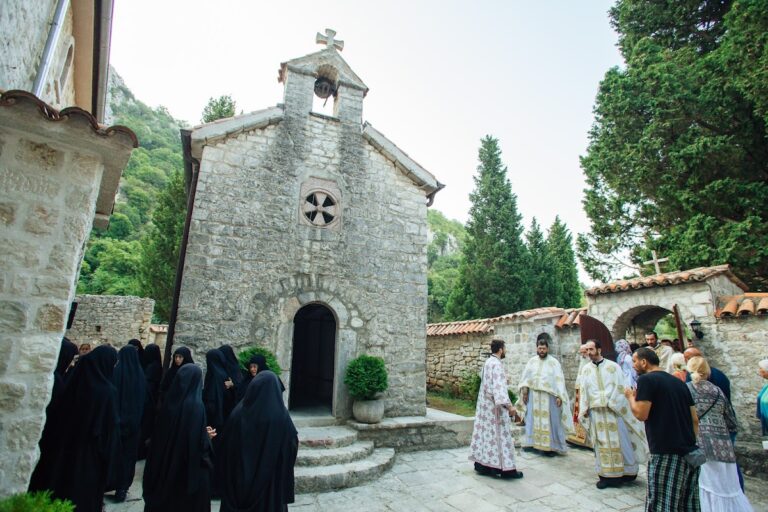
Praskvica Monastery is a Serbian Orthodox male monastery in Montenegro, traditionally founded in 1050 and historically associated with the Paštrovići community. It stands in Čelobrdo above Sveti Stefan and Miločer beach, near the coast. The monastery’s first documentary appearance dates to 1307, when King Stephen Uroš II Milutin of Serbia confirmed the Church of the Holy Trinity’s ownership of villages previously granted by his mother, Queen Helen of Anjou.
Medieval foundations
The institutional origins of Praskvica remain connected with two historical traditions. One identifies it as a branch of the Benedictine Monastery of Our Lady of Ratac, while Serbian tradition associates its foundation with the Nemanjić dynasty, the medieval Serbian ruling house linked with the Serbian kingdom and empire. During the period of Raška rule, Queen Jelena granted the monastery estates and churches in Paštrovići. Milutin confirmed those possessions in his 1307 charter, issued during a visit to Kotor.
In 1413, Balša III, ruler of Zeta, and his mother Jelena built and endowed the Church of Saint Nicholas, assigning it part of Balša’s possessions. A small house was erected beside the church in the same year. The monastery later suffered a prolonged interruption of religious activity when Ottoman conquests affected the Paštrovići hinterland. Catholic monks departed, and the complex was abandoned for an extended period.
Orthodox revival and international connections
Orthodox monks arrived in the seventeenth century and adapted and decorated the monastery in Orthodox architectural and artistic forms. Praskvica nevertheless retained connections with Catholicism. In the late eighteenth century, it became an important center for efforts to promote church union. The monastery also maintained close relations with monasteries in Serbia and Russia.
From the second half of the eighteenth century, Empress Catherine II of Russia provided regular financial support. Emperors Paul I and Alexander I later confirmed this assistance. These links formed part of the monastery’s wider religious and political connections beyond the Paštrovići region.
French occupation and restoration
During the Napoleonic occupation of the Littoral, French-controlled territory along the eastern Adriatic administered between 1809 and 1813, the Paštrovići resisted the loss of privileges they had held under the Venetian Republic. French forces plundered Praskvica in 1812, destroyed part of its archive, and demolished the Church of Saint Nicholas. The monks Dionysius Ljubiša and Petronius Miković were shot by French forces in Budva.
Archimandrite Sinesije Davidović, a senior monastic leader, and Hieromonk Josif Mitrović, a monk ordained as a priest, led the restoration of the Church of Saint Nicholas in 1847. Local contributions funded the work. In the late nineteenth century, a learned and devout nun lived at the monastery. Mother Paraskeva served as its superior during the 1930s and is also identified as the wartime Chetnik Leposava Dedić-Kučanka. The monastery received royal assistance, and Queen Maria visited it with her children.
Traditions and later changes
A popular tradition tells of Jegor Stroganov, a one-armed Russian military officer who became a monk at Praskvica and vowed silence. In the early nineteenth century, he is said to have spent ten years building a three-kilometre stone road from Sveti Stefan to the monastery. Known as Jegor’s Road, the story later inspired a drama by the Serbian playwright Vida Ognjenović.
Praskvica is associated with six churches, including two in the principal monastery complex and four on Sveti Stefan island. One of the island churches was destroyed by communist forces during the Second World War and later converted into a casino. The monastery’s name derives from the peach-flavoured water of a nearby spring, using a diminutive form of the word for “peach.”
Remains
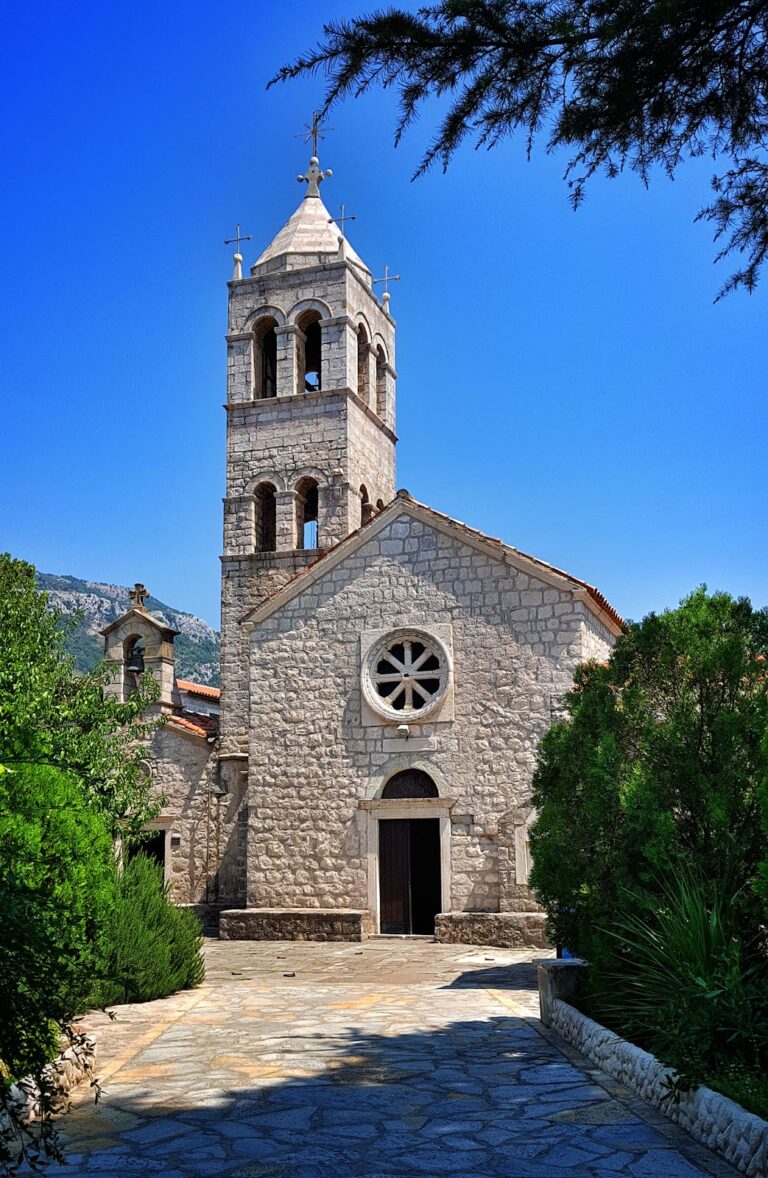
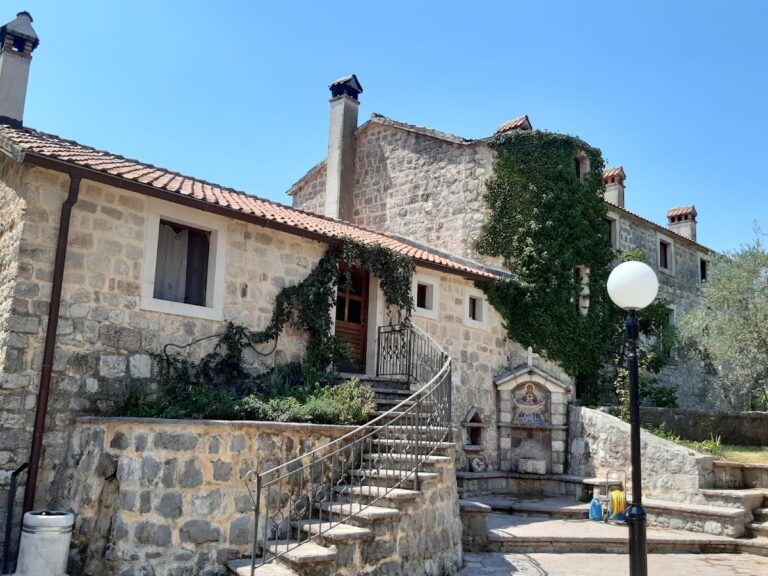
Praskvica forms a compact monastic complex containing the Church of the Holy Trinity, the larger Church of Saint Nicholas, a residential and service building known as a konak, and a nearby smaller Church of the Holy Trinity. The complex also includes a former school building, a library, an archive, and associated churches on Sveti Stefan island.
Principal churches and monastic buildings
Church of the Holy Trinity
The older church in the main complex is dedicated to the Holy Trinity and serves as the central church of the monastery. Its construction is tentatively attributed to Queen Jelena. The church belongs to the older core of the complex and remains closely connected with the monastery’s medieval institutional history.
Church of Saint Nicholas
The Church of Saint Nicholas was built in 1413 in the Raška architectural-school style, a medieval Serbian tradition of church design developed in the Raška region. A small house stood beside it from the same year. French forces demolished the church in 1812, and its restoration in 1847 left part of one wall from the original building. Some monastery icons were painted in 1681 by the painter Radul.
Konak and monastery school
The konak, a residential or service building within a Balkan monastery complex, was constructed in two phases. Its older phase is traditionally attributed to the period of Balša III. A small one-storey building beside the Church of the Holy Trinity formerly housed the monastery school. The monastery library remains in that building, although its collection is considerably smaller than in the past.
Associated churches and stone road
Sveti Stefan churches
Four churches belonging to Praskvica are situated on Sveti Stefan island. The Church of Saint Stephen is among the island churches that remain connected with the monastery. Their association extends the monastery’s religious complex beyond the principal buildings at Čelobrdo.
Jegor’s Road
Jegor’s Road is a three-kilometre stone road running from Sveti Stefan to the monastery. Tradition attributes its construction to Jegor Stroganov and places the work in the early nineteenth century, with the building process said to have lasted ten years.
Archive, library, and sacred objects
Praskvica preserves an archive and library containing the manuscript Gospel of Gavrilo Cetinjski, donated by Bishop Danilo Petrović, a collection of Paštrovići documents, and correspondence between the monastery administration and Montenegrin bishops. The monastery is also associated by tradition with the cross of Emperor Dušan.