Osiou Gregoriou Monastery: An Athonite Monastic Complex in Greece


Site at a Glance
- Rating
- 4.9
- Popularity
- Low
- Country
- Greece
- Primary era
- Early Modern
- External website
- Open
- Eras represented
- Early Modern, Modern
- Civilizations
- Greek, Ottoman
- Site type
- Religious
- Remains
- Monastery
On this page12 sections
History
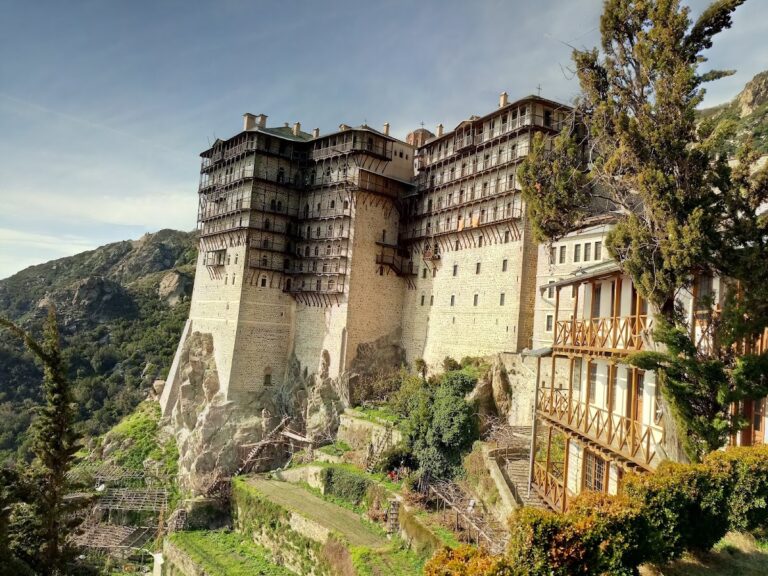
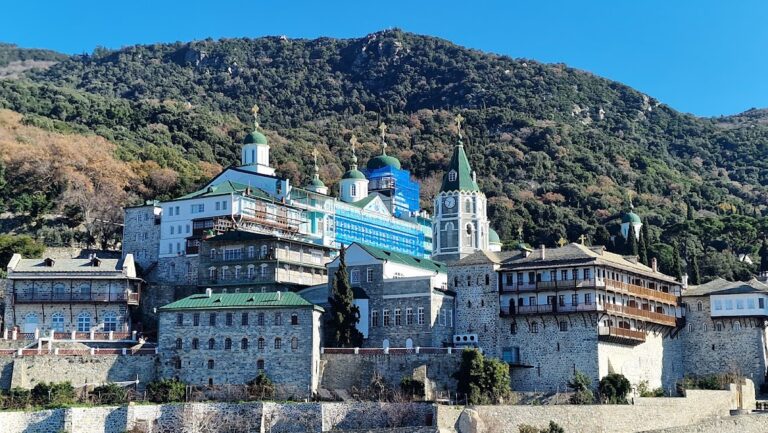
Osiou Gregoriou Monastery is a fourteenth-century Orthodox monastery in Greece, located on the southern coast of the Athonite peninsula. Founded probably around 1310 by Gregory the New, a hesychast ascetic and disciple of Gregory the Sinaite, it follows Eastern Christian monasticism and Byzantine architectural traditions. It is one of the twenty major monasteries of Mount Athos and has held seventeenth place in the Athonite hierarchy since 1574.
Foundation and Athonite Status
Gregory the New gave the monastery its name and established it shortly before the middle of the fourteenth century. Hesychasm, the Eastern Christian tradition of inner stillness and contemplative prayer, shaped the spiritual world of its founder. The monastery stands on a seaside promontory between Simonopetra and Dionysiou, beside a rich fishing ground.
Gregoriou is both patriarchal and stavropegic under the Ecumenical Patriarchate of Constantinople. A stavropegic monastery is directly subordinate to a patriarch rather than to a local diocesan bishop. Within Mount Athos, an autonomous monastic territory in Greece with a fixed hierarchy of major monasteries, this status places Gregoriou within the jurisdiction of the senior Eastern Orthodox patriarchate in matters of honor and coordination.
Attacks, Fires, and Rebuilding
Pirate attacks and major fires repeatedly damaged the monastery and destroyed parts of its historical record. Fires around 1500 and in 1761–1762 were especially destructive. Orthodox rulers, particularly those of Moldavia, supported successive restorations. John Stephen the Great, the fifteenth-century Moldavian ruler remembered in Orthodox tradition as a patron and defender of monasteries and churches, played a decisive part in the revival of Gregoriou and is regarded there as a second founder.
After the fire of 1761–1762, Abbot Joachim led the rebuilding. The monastery was tested again during the Greek Revolution of 1821, the uprising that created the independent Greek state, while its present period of prosperity began in the early twentieth century. Its principal church, the katholikon, or main church of an Orthodox monastery, is dedicated to Saint Nicholas and was begun after the 1761 fire.
George Kapsanis and the Modern Brotherhood
George Kapsanis became abbot in 1974 after arriving at Mount Athos with six monks on 8 July and being elected on 26 July. During his abbacy, he investigated the monastery’s history and published his findings in 1979. Monks from the Serbian monastery of Gornjak presented Gregoriou with relic fragments associated with Gregory the New in 1977 and 1979.
The brotherhood also undertook missionary work in Kolwezi, first in Zaire and, since 1997, in the Democratic Republic of the Congo. The mission operated a boys’ boarding school, established fifty-five parishes, and baptized more than 1,500 local people. After the missionary priest Kosmas Gregoriatis died in a motor-vehicle accident in the Congo on 27 January 1989, the missionary priest Meletios continued the work.
George Kapsanis retired and died in 2014, when Christoforos Pigasiou became abbot. Around 2020–2021, the monastic community numbered approximately 100–105 people. Reconstruction of the eastern wing began in 1997, and a new church dedicated to Seraphim of Sarov was under construction in 2008.
Remains
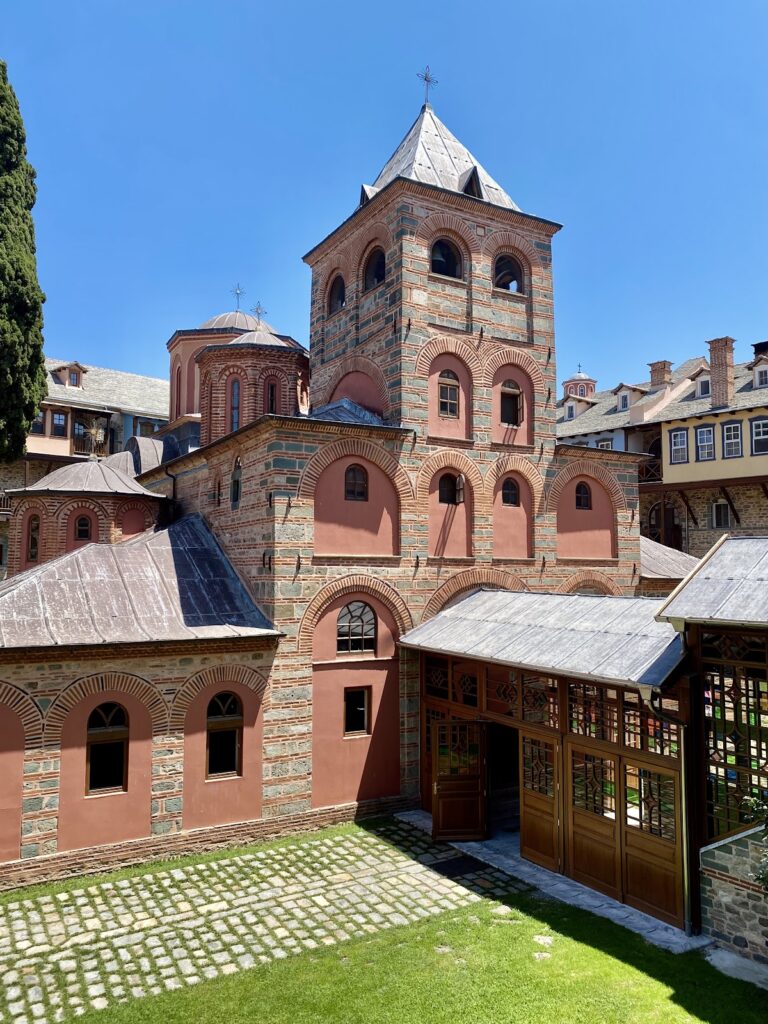
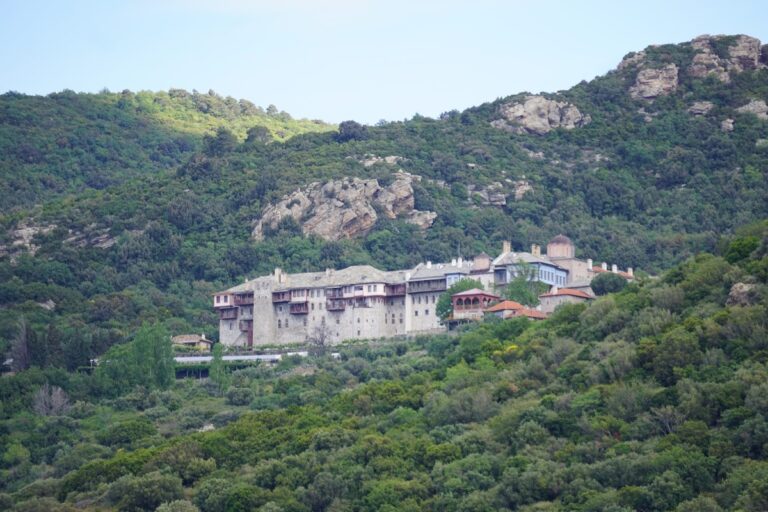
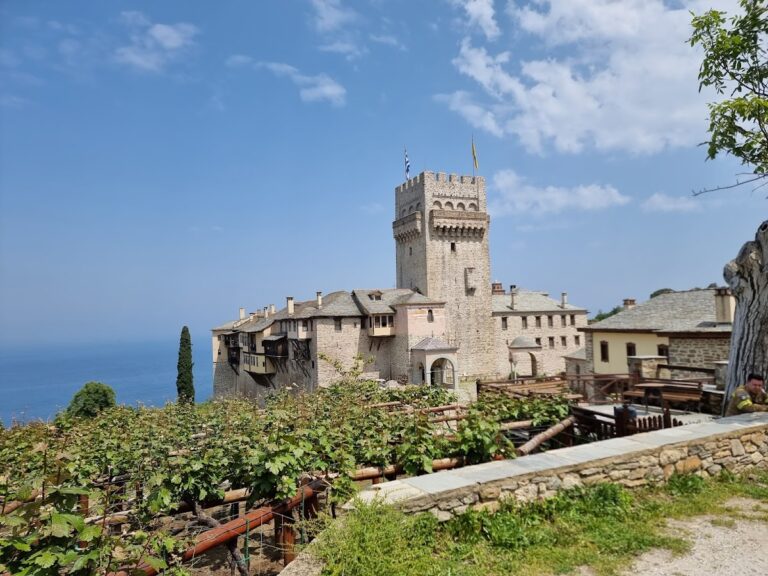
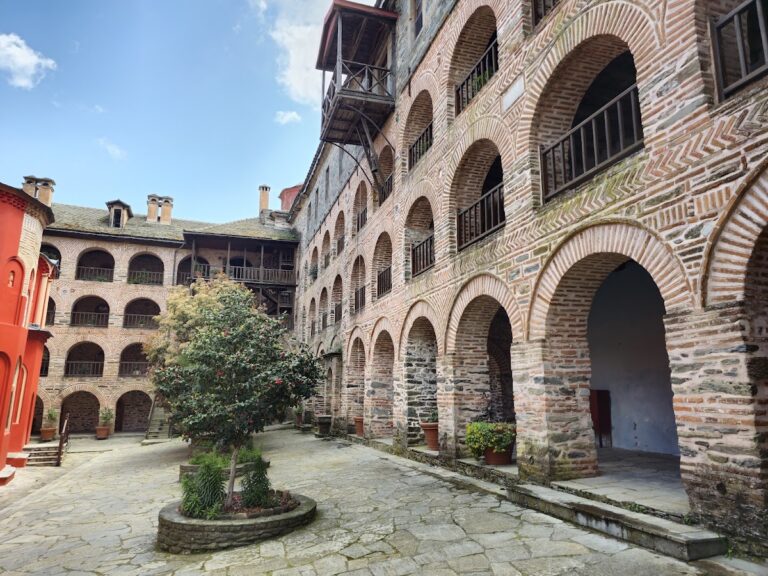
Gregoriou is a coastal monastic complex arranged on a promontory of the Athonite peninsula. Its buildings include the principal church, numerous chapels, residential and service wings, a cemetery church, and dependent settlements elsewhere on Mount Athos. The complex combines older surviving structures with rebuilding from the eighteenth century onward.
Principal Church and Courtyard Chapels
Katholikon of Saint Nicholas
The katholikon of Saint Nicholas was begun after the fire of 1761 and constructed during the eighteenth century. Its interior contains wall paintings dated 1779. The chapel of Gregory the New was built in 1851 and incorporated into the northern side of the church, preserving a direct architectural connection with the monastery’s founder.
Chapels of the Monastery
The chapel of Saint Anastasia of Rome, built in 1775, stands in the western part of the old courtyard. Other chapels are dedicated to Saint Demetrius, the Life-Giving Spring of the Virgin, Saints Cosmas and Damian, and Saint Spyridon. The chapel of Saint Demetrius belongs to the eighteenth century, while the chapel of Saint Spyridon belongs to the nineteenth.
Additional chapels are dedicated to the Archangels Michael and Gabriel and to Saint John the Baptist. The older Saint John the Baptist chapel is ruined, while a new domed chapel dedicated to the same saint was incorporated into the eastern wing during its reconstruction, begun in 1997. Gregoriou has fourteen chapels in total, seven within the monastery and seven outside it. Its cemetery church is dedicated to All Saints.
Cells and Kathismata
Cells in Karyes
The monastery’s dependencies include six cells in Karyes and its representative office dedicated to Saint Tryphon. A monastic cell is a small dependent settlement for one or a few monks, usually with a chapel. The cell of Saints Cosmas and Damian and the cell of the Presentation of Christ in central Karyes are occupied by icon painters. The cell of Saint Philotheos of Kokkinos, near the Protaton church, was renovated in 1995. Other cells are dedicated to Saint Nicholas, northeast of Karyes at Kommeni, and to Saints Athanasius and Cyril in the Kapsala area.
Forest and Founder’s Retreats
Gregoriou’s associated kathismata, smaller monastic retreats or dependencies, include the nineteenth-century Kathisma of the Athonite Fathers, renovated between 1976 and 1990, and the eighteenth-century Kathisma of the Virgin. The kathismata of the Holy Apostles and Saint John the Theologian stand in the forest at an elevation of 700 metres. Other retreats are dedicated to Saint Artemius, Saint Stephen the Protomartyr, and the Prophet Elijah, whose kathisma also serves as a forest-fire lookout.
The Kathisma of the Virgin lies thirty metres from the cave where Gregory the New practiced asceticism. Saint Acacius of Kavsokalyvia spent one year there before settling permanently at Kavsokalyvia. These retreats preserve the physical setting associated with the ascetic practices of the monastery’s founder and later monks.
Library, Treasury, and Sacred Objects
The library holds approximately 280–300 manuscripts, including eleven written on parchment, along with roughly 4,000–6,000 printed books. Among its holdings is a manuscript of The Shepherd of Hermas, described as the only surviving manuscript of this early Christian work. Probably written during the first half of the second century AD and composed in Greek at Rome, the text is traditionally attributed to Hermas, an Apostolic Father associated with the generation immediately after the apostles. Discovered in the late nineteenth century and published by the Metropolitan of Philadelphia, it illuminates the life of the early Roman Church and early Christianity more broadly.
The monastery preserves the icon of the Virgin Hodegetria, dated 1497, as well as a sacred treasury containing vessels, vestments, and relics. These include relics associated with Saint Anastasia of Rome, the hieromartyr Charalambus, the martyr Julitta, Cosmas and Damian, the martyr Quiricus, Gregory of Nazianzus the Elder, Saint Photini, and other saints. A fragment of the True Cross is also preserved among the monastery’s sacred objects.
Nearby sites