Krupa na Vrbasu Monastery: A Serbian Orthodox Monastery in Bosnia and Herzegovina


Site at a Glance
- Rating
- 4.9
- Popularity
- Medium
- Country
- Bosnia and Herzegovina
- Primary era
- Medieval
- External website
- Open
- Eras represented
- Medieval, Modern
- Civilizations
- Habsburg, Kingdom of Bosnia
- Site type
- Religious
- Remains
- Monastery
On this page8 sections
History
Krupa na Vrbasu Monastery is a Serbian Orthodox monastery in Bosnia and Herzegovina, generally dated to the late thirteenth or early fourteenth century. It belongs to the Banja Luka Eparchy, the diocese of the Serbian Orthodox Church responsible for the monastery. Its foundation remains uncertain. Tradition attributes it either to Milutin, the medieval Serbian ruler also known as King Stefan Uros II, or to Stefan Nemanja, founder of the Nemanjic ruling dynasty.
Medieval foundation and noble patronage
The monastery appears in documents from the fourteenth and fifteenth centuries, when the Lower Regions, a medieval region of the western Balkans, were ruled by the Horvatinich family. It served the nobility and military forces of nearby Greben, while the Vojsalich family was associated with the care of the monastic community.
Krupa na Vrbasu Monastery was probably linked to Krupa Monastery in Dalmatia. One tradition holds that monks from the Dalmatian monastery founded it in 1317. Another reverses the connection, claiming that the Dalmatian monastery was established by monks who came from Krupa na Vrbasu.
Ottoman rule and nineteenth-century rebuilding
The monastery was abandoned during Ottoman rule and had become ruined by 1718–1739, although local inhabitants continued to remember it. A wooden church was later erected, while the wider monastic complex remained in ruins until the Ottoman withdrawal from the region after 1878.
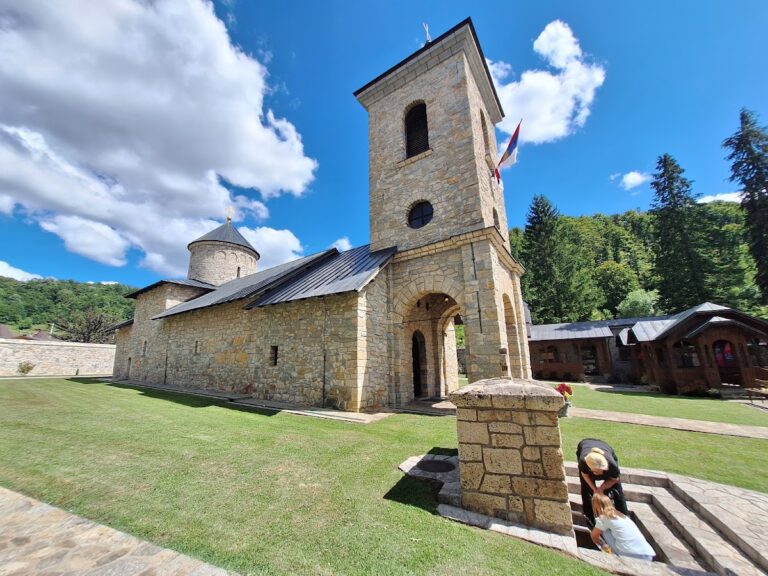
In 1889, the Church of Saint Elijah was rebuilt on the medieval site under Metropolitan Sava Kosanovic, a senior Orthodox bishop who served in Sarajevo. Nearby villagers, parish churches, and Gomionica Monastery contributed to the work. A bell tower was added afterward, since the earlier church had not possessed one.
Wartime destruction and restoration
Austro-Hungarian forces burned the monastery again in 1914 during the conflicts between the Habsburg monarchy and the Ottoman Empire. In 1916–1917, its bell was removed and melted for military material. A replacement bell was installed after the war.
On 27 September 1941, during the Second World War, the Ustashas, a Croatian fascist and ultranationalist movement that ruled the Independent State of Croatia, burned the church. The fire destroyed its furnishings, including the iconostasis, the screen of icons separating the sanctuary from the main worship space, as well as its liturgical objects. The roof collapsed, and a bell weighing more than 360 kilograms fell and broke apart.
Reconstruction began in 1961, but the church was destroyed again by the 1969 earthquake and was later restored. Archaeological and conservation work continued from 1986 to 1991. In 1989, Metropolitan Efrem of Banja Luka restored the church’s status as a monastery and appointed the monk Sava Nedeljkovic to its community. The restored monastery was consecrated on 14 October 2009, after which Nedeljkovic became its abbot. The monastery is protected as a state monument and appears on the provisional list of national monuments of Bosnia and Herzegovina.
Remains
Monastery church
The Church of Saint Elijah, popularly called Ilinka, stands near the Krupa River at the confluence of the Krupa and Vrbas rivers, about 20–25 kilometres south of Banja Luka. The building is approximately 24 metres long and 12 metres wide. Its basilical, single-nave plan ends in a semicircular apse, the rounded end of the church that commonly contains the altar. Roughly broken stone forms the walls, while the interior has a flat wooden ceiling and the exterior a two-sided pitched roof. The bell tower stands on the western side and was added after the church was rebuilt.
Archaeological remains beneath and around the church
The present church stands over the foundations of the medieval monastery. Excavations east of the building uncovered the remains of an earlier Gothic altar area with tombs arranged according to Roman Catholic burial practice. Buildings to the north formed part of a complex around a quadrangular courtyard adjoining the church. These remains have been interpreted as evidence that an earlier Roman Catholic monastery occupied the site before the Serbian Orthodox church was rebuilt in 1889.
Excavations near the church also brought to light fragments of painted plaster dating from before 1527–1528. The fragments contain blue, ochre, and red pigment, with engraved outlines forming geometric ornament. They preserve evidence of an earlier decorated religious interior associated with the monastery site.
Surrounding structures and monuments
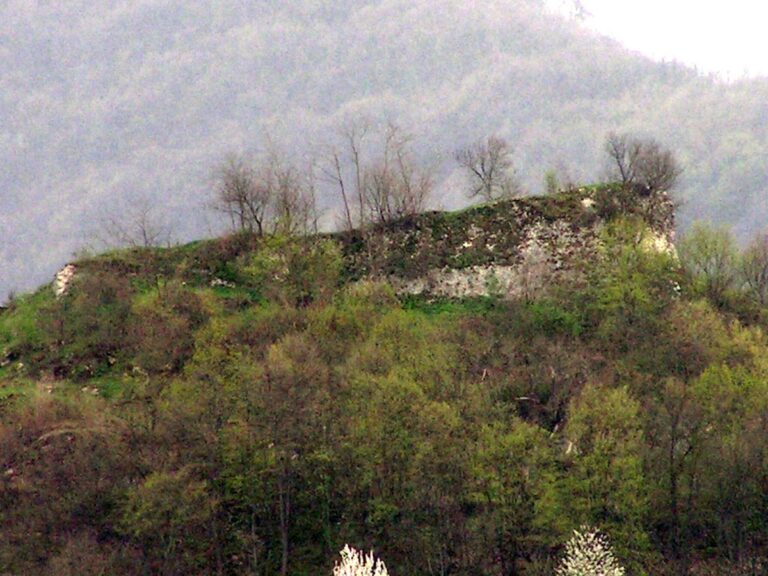
A monastery residence, or konak, and auxiliary buildings stand beside the church. Above it, on the rock, are the remains of the medieval Greben fortress. A ste?ak, a medieval monumental stone tombstone characteristic of the western Balkans, is located beside the monastery.