Boboshevo Monastery: A Bulgarian Orthodox Monastic Complex in Bulgaria

Site at a Glance
- Rating
- 4.6
- Popularity
- Very Low
- Country
- Bulgaria
- Primary era
- Medieval
- External website
- Open
- Eras represented
- Medieval, Modern
- Civilizations
- Bulgarian, Ottoman
- Site type
- Religious
- Remains
- Church
On this page8 sections
History
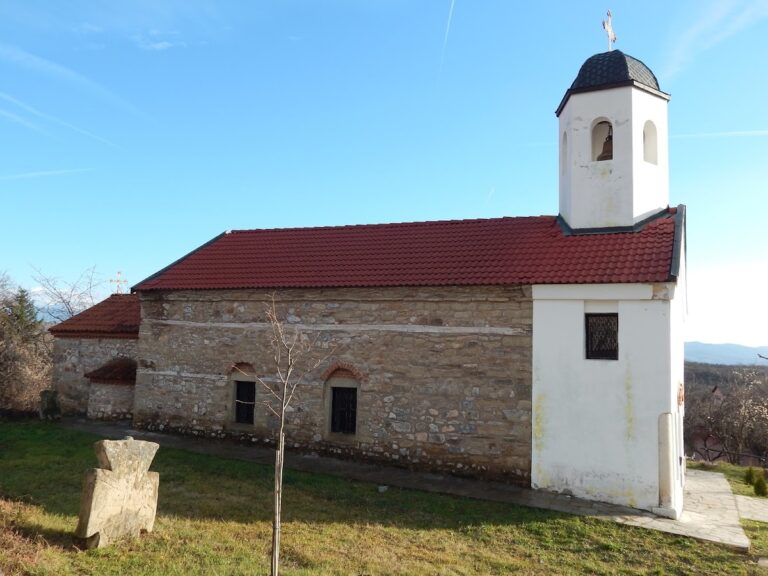
Boboshevo Monastery is a Bulgarian Orthodox monastery dedicated to Saint Demetrius in Bulgaria, whose surviving church was completed in 1488 during the late medieval period and decorated in the tradition of the Ohrid School. Saint Demetrius of Thessaloniki, a major Eastern Orthodox martyr and saint of the late third and early fourth centuries, gives the monastery its dedication. The monastery became a religious, educational, and literary center, although it is now inactive and its church is the only preserved part of the complex.
Origins and the Skrino tradition
The monastery’s earliest history remains uncertain. One tradition places its foundation in the early tenth century above the village of Skrino and identifies it with the monastery where Saint John of Rila began his monastic life. Saint John of Rila was a medieval Bulgarian hermit and the principal founder of the Rila monastic tradition.
Evidence from the Ottoman tax register for 1570 to 1573 distinguishes a Saint Demetrius monastery near Boboshevo from a separate “Holy Father” monastery above Skrino. The church at Boboshevo incorporates the foundations of an earlier building from the second half of the fourteenth century, indicating that the monastery at this location was founded in the fourteenth century or earlier. The older foundation above Skrino may have been abandoned or damaged during the Ottoman interregnum of 1402 to 1413, a period of internal Ottoman struggle, but its relationship to the later Boboshevo foundation remains unresolved.
Rebuilding under Ottoman rule
The monastery at its present location, southeast of the earlier site and above Boboshevo, was rebuilt during the reign of Sultan Bayezid II, who ruled the Ottoman Empire from 1481 to 1512. Its church was completed after 1481, and an inscription dated 1488 records its completion and consecration. The inscription names the monk-priest Neofit and his sons, the priests Dimitar and Bogdan, as the painters, and records the church’s consecration by Bishop Jacob.
During the Ottoman period, Boboshevo Monastery served as an important spiritual, literary, and educational center. It operated a school for children from nearby communities and functioned as a station on the pilgrimage route between Rila Monastery and Mount Athos. Its literary activity included the Boboshevo Gospel, produced in 1565 by the monk-priest Gavril. Other manuscripts copied or preserved at the monastery added to its documentary heritage.
Decline and modern preservation
Following Bulgaria’s liberation after the Russo-Ottoman War of 1877 to 1878, the monastery gradually lost its former importance. Its monastic population declined, monks ceased to reside there, and administration passed first to the municipality of Boboshevo and later to local priests.
By about 1930, the monastery held 694 decares of land, a decare being 1,000 square metres, on the eastern slopes of Mount Ruen. The holdings included 300 decares of forest, 250 of arable land, 100 of pasture, 30 of meadow, 10 of orchards, four of vegetable gardens, and a five-decare vineyard in the Struma River gorge. The complex also possessed a dependency in Boboshevo. Its buildings then included residences, a kitchen, bakery, granary, barn, watermill, stables, and a rakia distillery.
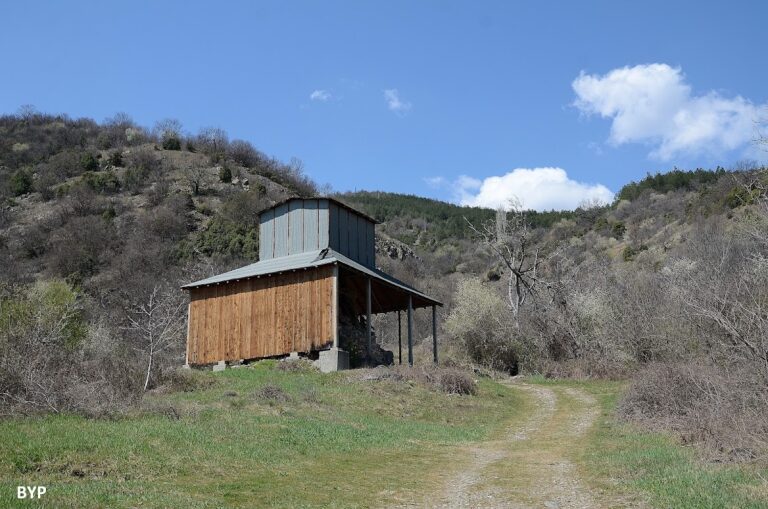
Most of these buildings deteriorated and were removed during the twentieth century. The church, part of the watermill, and an agricultural building survived. The church was designated a monument of national architectural and artistic importance in 1968 and received national cultural-object status in 1972. Full restoration took place between 2001 and 2007, including strengthening, conservation, and restoration work carried out from 2003 to 2007.
Remains
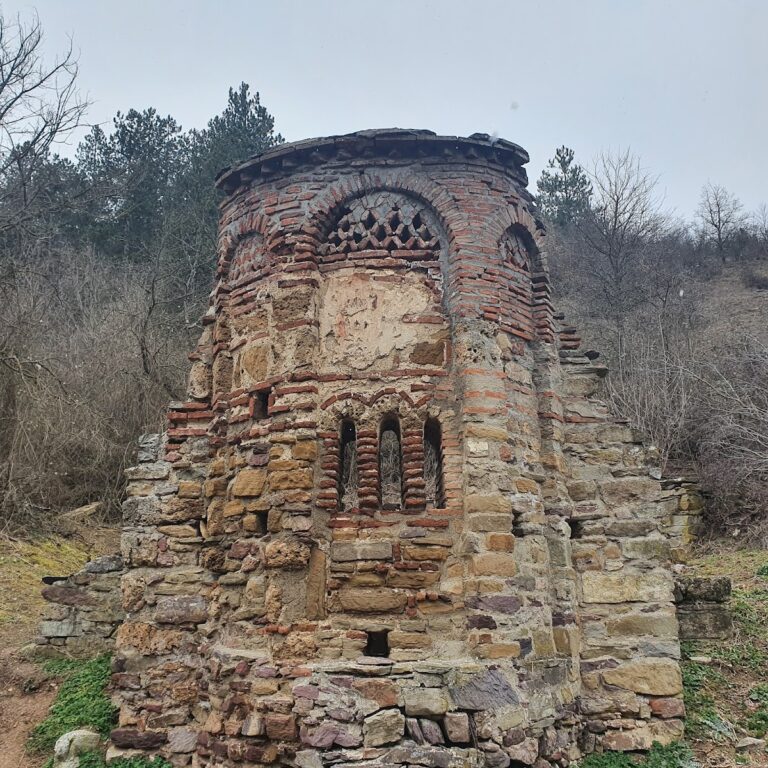
The surviving church stands about 3 to 4 kilometres northwest of Boboshevo, on the wooded northeastern slope of Boboshevski Ruen in the Vlahina Mountains, and about 16 kilometres southwest of Dupnitsa. It is a small, single-nave, domeless building partly set into the ground. The church measures 4.15 metres by 2.66 metres internally and reaches 5.50 metres in height. Its compact plan consists of the rectangular naos, the principal worship space, and an eastern apse.
Church structure
The naos has a semicylindrical barrel vault, three narrow openings for light, and a floor paved with stone slabs. At the east end, the apse is semicircular both inside and outside. It measures 1.38 metres in width and 0.70 metres in depth. A semicircular niche measuring 0.45 by 0.52 by 0.37 metres is set into the eastern wall to the left of the apse, while a smaller rectangular niche, measuring 0.20 by 0.20 by 0.25 metres, is set into the northern wall.
The original western entrance is 1.85 metres high and 1.25 metres wide. A narthex, or entrance vestibule, was added on the west in 1864. Its entrance is on the north, and it contains five round-arched windows, with two in each side wall and one in the west wall. The later arrangement places the portal on the northern side and makes the western wall of the original naos the partition between the narthex and the worship space.
Frescoes
Extensive wall paintings cover the naos and apse, while the narthex has a different treatment. The frescoes combine several artistic traditions and use animated figures, emotionally charged scenes, vivid faces, dark saturated colours, and numerous compositions containing several figures. Their completion in 1488 is associated with the Ohrid School, a tradition of Orthodox mural painting linked to the Ohrid region.
Three large medallions occupy the vault. The central one shows Christ Pantocrator surrounded by four angels, while smaller medallions present Moses, Aaron, Ezekiel, and other prophets. Below them, two horizontal zones contain scenes from the Christian narrative. The upper zone includes major feasts such as the Nativity, Baptism, and Crucifixion, while the lower zone depicts the Passion of Christ.
Additional medallions form a frieze along the northern and southern walls. They portray warrior saints, the Three Youths in the Fiery Furnace, and other figures. Full-length saints occupy the lower wall zones. The western wall of the naos contains a representation of the Dormition of the Virgin. Constantine and Helena and the Archangel Michael appear beside the doorway beneath this scene, while a niche above the entrance to the naos contains Saint Demetrius on horseback.
Furnishings and manuscript heritage
The iconostasis, the screen separating the sanctuary from the naos, was renewed in 1729, but its Royal Doors, the central doors leading toward the altar, date from the fifteenth century. The iconostasis and its icons are preserved in the Museum of Christian Art in the crypt of the Alexander Nevsky Cathedral in Sofia.
The Boboshevo Gospel of 1565 and other manuscripts connected with the monastery are also preserved in Sofia. They include material held by the Museum of Christian Art and the Ecclesiastical Historical Museum, extending the surviving record of the monastery beyond its architectural remains.
Nearby sites