Granitsa Monastery: A Bulgarian Orthodox Monastic Complex


Site at a Glance
- Rating
- 4.4
- Popularity
- Low
- Country
- Bulgaria
- Primary era
- Modern
- Eras represented
- Medieval, Modern
- Civilizations
- First Bulgarian Empire
- Site type
- Religious
- Remains
- Monastery
On this page6 sections
History
Granitsa Monastery is a Bulgarian Orthodox women’s monastery near Kyustendil, Bulgaria, dedicated to Saint Luke the Apostle and Evangelist. Its origins as a men’s monastery are generally placed, with some uncertainty, in the tenth century. Today it belongs to the Kyustendil spiritual district of the Sofia Diocese and continues to operate at its historic location.
Medieval Origins and Ottoman-era Abandonment
The monastery stood near the medieval Granitsa Fortress, built during the Second Bulgarian Empire, the Bulgarian state that existed from the late twelfth century until the Ottoman conquest. The fortress formed part of the defensive belt around Velbazhd, now Kyustendil, and guarded the road toward Shtip. This setting placed the monastery within a landscape shaped by both religious activity and medieval defense.
A local tradition connects the monastery with Ivan Rilski, also known as John of Rila, a tenth-century Bulgarian hermit and saint regarded as the patron of the Bulgarian people and founder of the Rila monastic tradition. According to this tradition, he lived briefly at Granitsa before entering the earlier religious center near Skrino village, the predecessor of the present Ruen Monastery.
During Ottoman rule, Granitsa Monastery was destroyed repeatedly and eventually abandoned. The site became known as Pustija Manastir, meaning “Deserted Monastery.” The period is also associated with Jakob, bishop of Krupnik, and his three sons, Joasaph, David, and Theophan. After the family was displaced from Velbazhd, they settled in Granitsa. Following Jakob’s widowhood, his sons entered the monastery and began the renovation of the abandoned and plundered Rila Monastery. In 1469, they organized the return of Ivan Rilski’s relics from Tarnovo to Rila Monastery.
Revival and Archaeological Discoveries
Granitsa Monastery was revived in 1948 at the historical site. The church, residential buildings, and ancillary structures were newly built, while excavation during the rebuilding uncovered foundations belonging to the earlier monastery complex. Two important coin hoards were also found in the grounds: several hundred fourteenth-century Venetian silver coins and billon coins, a low-grade silver alloy used for coinage, issued under the Byzantine emperors Alexios I Komnenos, Manuel I Komnenos, Andronikos I Komnenos, and Isaak II Angelos.
The monastery is designated a cultural monument. Its annual patronal feast, dedicated to Saint Luke the Evangelist, takes place on 18 October.
Remains
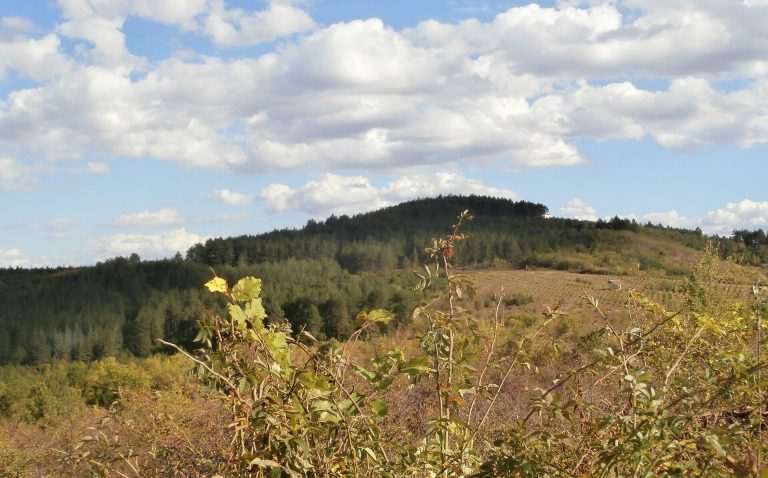
The present complex lies about 6 to 7 kilometers south of Kyustendil, in the Osogovo Mountains at the northern foothills and on the eastern slope of the Brezovski Rid ridge, southwest of Granitsa village. The historic site is known as Pustija Manastir. The buildings are arranged around a courtyard resembling an irregular trapezoid, whose base lies on the eastern side. The road to Granitsa borders the southern side, where the entrance gate and residential buildings stand. Walls enclose the courtyard to the west, north, and east, and their inner surfaces are partly decorated with frescoes.
Residential Buildings and Courtyard
The two-story residential buildings face the courtyard through wooden arcades and contain rooms for visitors and pilgrims. The courtyard has a park-like arrangement with pavilions, benches, and tables. South of the church apse, a fountain commemorates Joasaph, David, and Theophan, whose connection with the restoration of Rila Monastery is part of the site’s historical tradition.
Church and Bell Tower
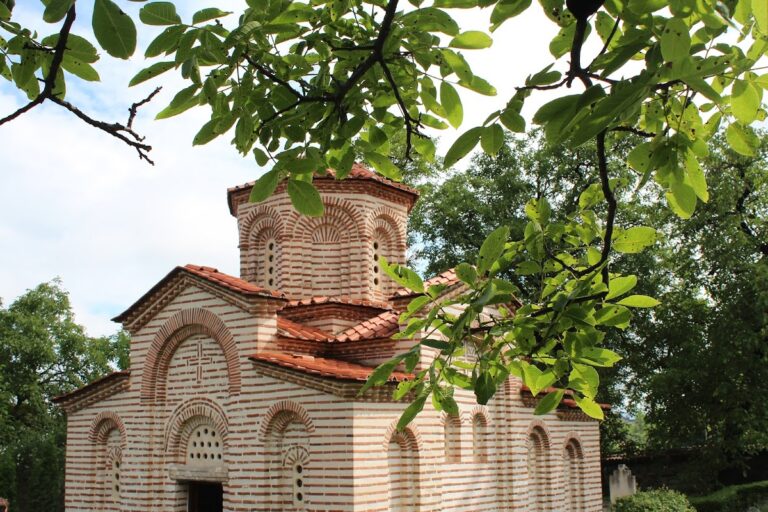
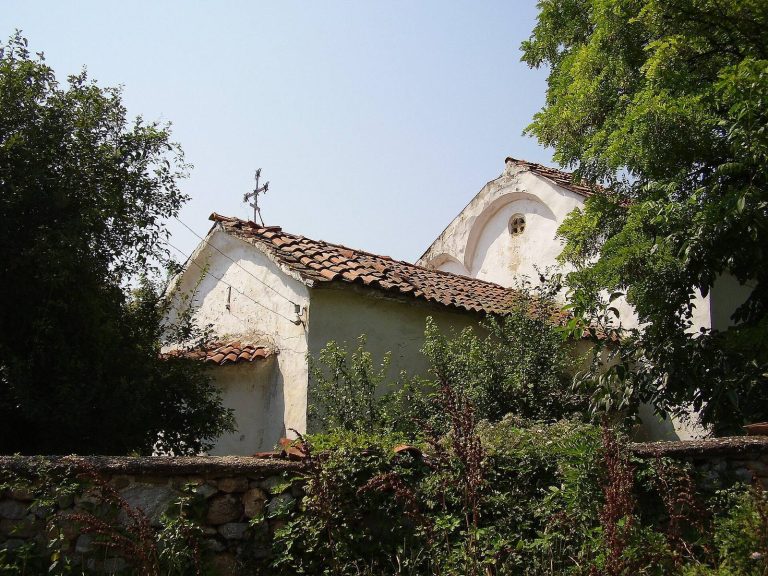
The Church of Saint Luke is a single-nave, single-apse, domeless building. Its apse is oriented east-northeast, while the rectangular naos, the main worship space in an Eastern Christian church, has three round-arched windows in both its northern and southern walls. The exterior is coated with white plaster, and the predominantly white interior is decorated with icons. Residents of neighboring villages donated the iconostasis, the screen separating the sanctuary from the main body of the church and typically carrying icons.
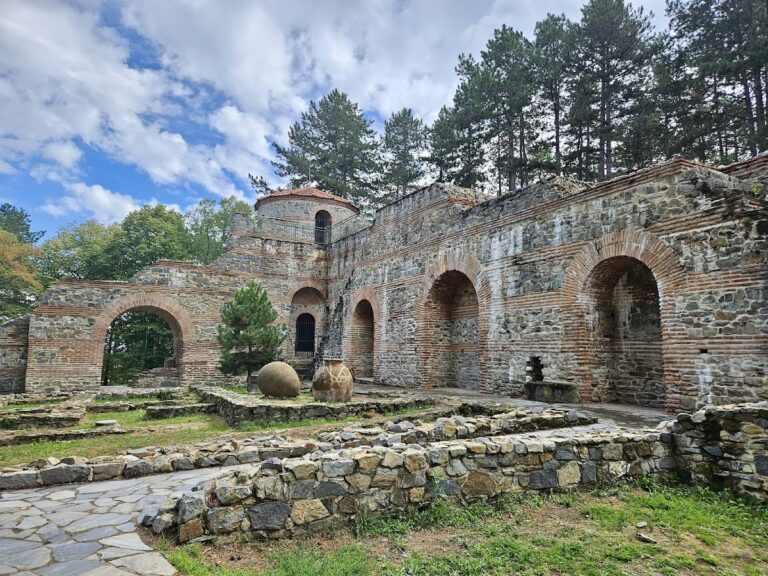
A six-sided bell tower rises above the western main entrance. Its front niche contains a fresco showing Saint Luke making the first image of the Virgin Mary with the Christ Child. Excavated foundations of the earlier monastery complex remain within the grounds, linking the rebuilt buildings with the site’s medieval and earlier religious history.