Lozen Monastery “Sveti Spas”: A Bulgarian Orthodox Monastery in Bulgaria


Site at a Glance
- Rating
- 4.8
- Popularity
- Low
- Country
- Bulgaria
- Primary era
- Modern
- Eras represented
- Medieval, Modern
- Civilizations
- Bulgarian, Ottoman
- Site type
- Religious
- Remains
- Monastery
On this page9 sections
History
Lozen Monastery “Sveti Spas” is a Bulgarian Orthodox monastery in Bulgaria, founded in the thirteenth century during the Second Bulgarian Empire, the Bulgarian state that lasted from the late twelfth century until the Ottoman conquest. Dedicated to the Holy Ascension, the Christian commemoration of Christ’s ascent into heaven, it is associated with Spasovden and is regarded as the easternmost monastic house of Sofia’s medieval Mala Sveta Gora, or “Little Holy Mountain,” a concentration of monasteries established around Sofia.
Foundation and destruction
The monastery was established in the thirteenth century as part of the religious landscape surrounding medieval Sofia. Its first known period ended in the late fourteenth century, when it was destroyed after the fall of Urvich Fortress and Sredets, the medieval name of Sofia, during the Ottoman conquest. The site remained abandoned through the fifteenth and sixteenth centuries.
Monastic life returned in the seventeenth century. Written records beginning in 1671 describe a monastery school led by Yakim of Sofia, whose pupils came from Sofia and nearby villages. From 1671 to 1694, the monastery also housed literary and calligraphic schools, making it a place of education and manuscript culture as well as worship.
The 1737 uprising
In 1737, the monastery became a centre of the uprising associated with the bishops of Sofia and Samokov. The revolt was suppressed in late July and early August. By order of Ali Pasha Kyupryulyuoglu, an Ottoman grand vizier and military commander, about 350 people from the Sofia region were executed, including citizens, priests, monks, villagers, and St Simeon of Samokov, the bishop of Samokov. The monastery was destroyed again after the suppression.
Rebuilding and national revival
The monastery was rebuilt on its earlier foundations in 1821, when the present Church of the Holy Ascension was constructed. The church was repainted in 1869 by the Samokov painter Nikola Obrazopisov, assisted by Hristaki Zahariev and Dimitar Hristov. Its murals contain an unusually large number of Bulgarian saints and historical figures for the Sofia region.
Local tradition describes Lozen Monastery as a centre and refuge of the Bulgarian national liberation movement, the nineteenth-century struggle to end Ottoman rule and establish an independent Bulgarian state. The tradition also holds that Vasil Levski, a leading revolutionary and organizer of that movement, stayed at the monastery. Around the time of Bulgaria’s Liberation in 1878, a school with several large rooms and a separate teacher’s room was built there. It continued operating until the beginning of the twentieth century.
The monastery was a men’s monastery until 1900, when it became a women’s convent. Under Abbess Mother Domenika, one residential wing, the monastic cells, and the two-storey guesthouse were restored, while work began on an earlier chapel dedicated to St Stephen the Archangel. Mother Domenika died in 2007. Mother Agathia was managing the monastery in March 2009 and died on 13 September 2020. The monastery remains an active women’s convent with daily services and is administered by Abbess Theodora.
Remains
Mountain setting and layout
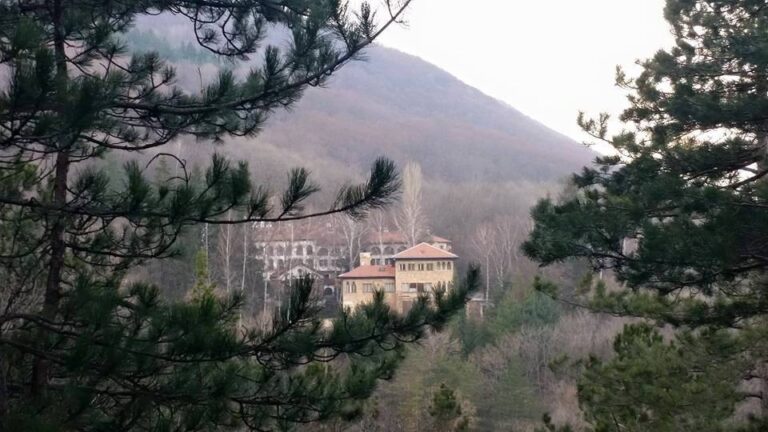
The monastery stands about 5 kilometres southeast of the former village of Dolni Lozen, now incorporated into the eastern part of Lozen, in the Lozen Mountains below Polovrak Peak, which rises to 1,182 metres. It occupies a natural terrace above the Sofia Valley and is surrounded by dense oak woodland. Several cold mountain springs lie nearby. Within the grounds, a flower-filled courtyard forms the central open space, while the terrace provides a broad view across the valley.
Church of the Holy Ascension
The Church of the Holy Ascension is a single-nave, single-apse building, meaning that it has one main worship space and one sanctuary end. It measures 7 by 14 metres and is crowned by three large domes. This arrangement is unusual in nineteenth-century Bulgarian religious architecture. The domes were built by Tsvyatko Todorov of Zhabliano village near Radomir, and they survive with their murals restored.
Murals and church furnishings
The church’s 1869 murals unite biblical scenes with portraits and images of Bulgarian and regional religious figures. They include Saints Cyril and Methodius, ninth-century Byzantine missionaries associated with the Christianization of the Slavs and the development of Slavic literary culture; St Michael the Warrior; Bishop Mark; John of Rila, Bulgaria’s principal patron saint; Euthymius of Tarnovo, a fourteenth-century Bulgarian patriarch and literary figure; Onuphrius of Gabrovo; Constantine of Sofia; St Petka; and St Nedelya. The paintings survive in relatively good condition and are distinguished by varied colours and accomplished execution.
A highly realistic donor portrait of Abbot Kiryak, dated 1868, is preserved inside the church. A donor portrait represents a patron or religious superior connected with the support or financing of a church. The church also contains an icon of St John Vladimir of Duklja, a Serbian prince who died in 1016 and was married to Kosara, the daughter of Tsar Samuel.
The restored old altar retains original icons dated between 1850 and 1890. The western exterior façade was once covered with frescoes, most of which have almost completely disappeared, leaving the surviving interior paintings as the principal body of mural decoration described at the church.
Monastic buildings and chapel
Several buildings around the church have been restored or reconstructed. They include one residential wing, the monastic cells, a two-storey guesthouse, and one of the former chapels. Restoration of the earlier chapel dedicated to St Stephen the Archangel was begun under Mother Domenika. Together, these buildings preserve the residential, communal, and religious functions of the women’s convent as it continues its monastic life.
Nearby sites