Fortifications of Heraklion: Venetian Defenses of Crete


Site at a Glance
- Rating
- 4.5
- Popularity
- Medium
- Country
- Greece
- Primary era
- Early Modern
- External website
- Open
- Eras represented
- Medieval, Early Modern, Modern
- Civilizations
- Byzantine, Greek, Venetian
- Site type
- Military
- Remains
- Wall
On this page15 sections
History
The Fortifications of Heraklion in Greece are a defensive complex whose earliest foundations belong to the Byzantine period and whose principal surviving form was created by the Republic of Venice during the Renaissance. They protected the settlement known as Candia under Venetian rule and helped make Heraklion one of the most heavily fortified cities in the Mediterranean.
Arab and Byzantine foundations
The first defenses at the site were probably built in the ninth or tenth century, during the Byzantine period. In 824, Andalusi Arab forces captured the city and established the Emirate of Crete, an Islamic state whose capital was the settlement that later became Heraklion. They called it Rabdh al-Khandaq, meaning “Trench Castle.”
The Arab defenses consisted of a wall made from unbaked bricks, a ditch, and broad earthen ramparts. The ditch could be filled with seawater within an hour. The bricks were strengthened with goat and pig hair, an unusual construction detail that formed part of the defensive system.
After several unsuccessful Byzantine attempts to recover Crete, the Byzantine emperor and military commander Nikephoros II Phokas captured the island in 961. The Arab defenses were razed, and a new fort called Rokka was built. Later Byzantine walls were constructed on the site of the earlier Arab defenses.
Genoese and Venetian rule
In 1206, forces of the Republic of Genoa under Enrico Pescatore and Alamanno da Costa captured Crete and began improving the defenses of Candia and other settlements. Venice began taking control of the island in 1209 and had secured it by 1217. From the early thirteenth century, Candia and the rest of Crete remained under Venetian control until the Ottoman conquest in 1669.
The Venetians initially retained and altered the Byzantine walls. After the fall of Constantinople in 1453, however, Ottoman expansion and the military use of gunpowder led Venice to construct a new defensive system. Work began in 1462 and continued for more than a century, following designs associated with the military architects Michele Sanmicheli and Giulio Savorgnan.
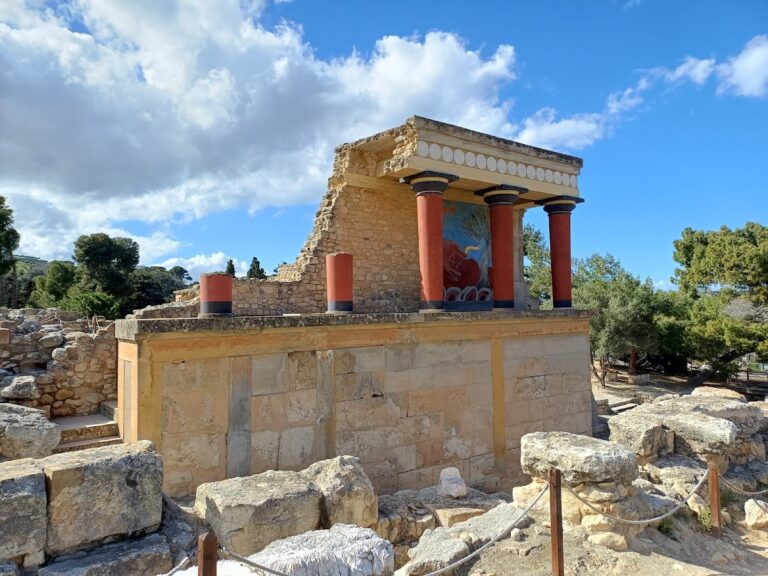
The project was financed by Venice, the local Jewish population, a religious community, and the Kingdom of Candia. Stone came from various quarries as well as from the ruins of the Minoan Palace of Knossos. Local inhabitants were required to work on the construction for one week each year without pay, bringing their animals to assist with the labor.
The initial layout has been proposed as a circle measuring exactly 1,000 Venetian passi, approximately 1,740 metres in diameter. This interpretation is based on the headpoints of the Sabbionara, Martinengo, and St Andrew bastions, but it remains a proposal rather than an established fact.
Ottoman conquest and later history
Venice strengthened the defenses over time with additional outer works and with the construction of Rocca al Mare, now called the Koules Fortress, at the harbour entrance. During the Fifth Ottoman–Venetian War, a series of conflicts over territory and maritime power in the eastern Mediterranean, the Ottoman fleet reached Crete on 23 June 1645. Canea fell in August of that year, and the Fortezza of Rethymno followed in 1646.
The Venetian garrison at Candia resisted the resulting siege for 21 years. The city surrendered to the Ottomans in 1669. The Venetians and most of the population were allowed to leave peacefully, preventing the city from being sacked. After taking control, the Ottomans repaired and maintained the fortifications and gave Turkish names to some of the bastions. The Martinengo Bastion, for example, became known as Giouksek Tabia.
The Ottomans also built Little Koules, a small fort on the landward side near the Koules Fortress. It was demolished in 1936 during the modernization of the city.
Damage, conservation, and protection
German aerial bombardment during the Battle of Crete in the Second World War damaged sections of the walls. The affected areas were later repaired. Some outer works were demolished after the war to make way for modern buildings, while proposals to demolish the entire city wall were not implemented.
Heraklion established a dedicated institution for restoring and maintaining the walls in 1989. Conservation work in 2004 strengthened 900 metres of the fortifications. The complex is recognized as an archaeological monument of Greece. Its walls remain largely intact and are regarded as among the best-preserved Venetian fortifications in Europe.
Remains
Land enceinte and outer defenses
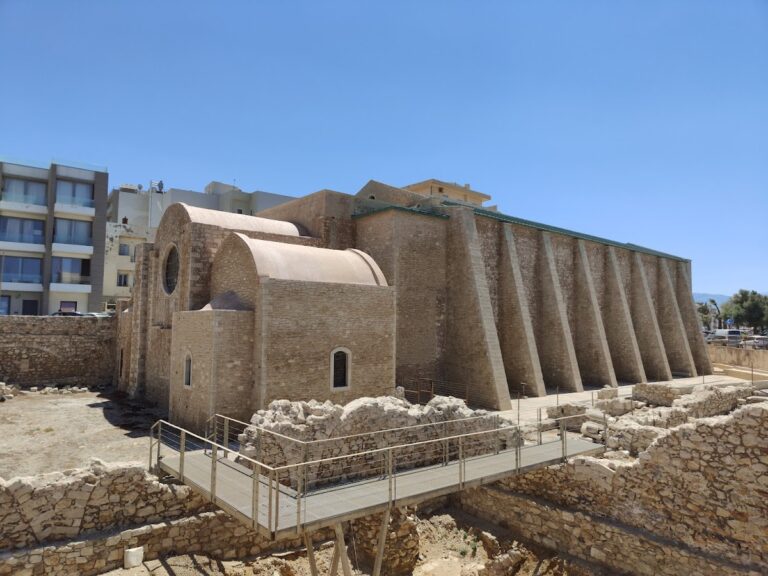
The Venetian enceinte, an enclosed defensive line surrounding a fortified place, forms a roughly triangular complex approximately 3 kilometres long. Its land front is organized around seven bastions: St Andrew at the northwestern corner, followed by Pantocrator, Bethlehem, Martinengo, Jesus, Vitturi, and Sabbionara. Some bastions carried cavaliers, which were raised gun platforms positioned behind or above the main bastion.
A deep, wide dry ditch surrounded the complex. Beyond the main walls stood additional defenses, including several ravelins, detached triangular outworks placed beyond a fortification line, as well as three hornworks and a crownwork. The land front remains intact, while the outer works and the Fort of St Demetrius were destroyed. The surviving walls bear damage from the Second World War and subsequent repairs.
Gates and passages
Principal gates
Four principal gates served the Venetian enclosure. The Molos Gate stood on the north, the Gate of St George, also called the Lazaretto Gate, on the east, the Jesus Gate or New Gate on the south, and the Pantocrator Gate on the west. Two of these four principal gates survive.
Military gates and Chania passage
The three military gates were the St Andrew Gate, the Sand Gate, and the Dermatas Gate. A passage beside the Pantocrator Gate, known as the Chania passage, was built in the 1920s and forms part of the later history of movement through the western defenses.
Harbour defenses and earlier walls
Koules Fortress
A separate defensive line extended along the harbour on the seaward side. The surviving Koules Fortress was originally called Rocca al Mare and protected the harbour entrance. It represents the principal surviving structure of the maritime defenses and complements the landward enclosure.
Fort of St Demetrius
The Fort of St Demetrius stood on the hill east of the city. It consisted of a small bastion and two demi-bastions, each a half-bastion with one complete flank and one face. The fort was destroyed.
Byzantine walls
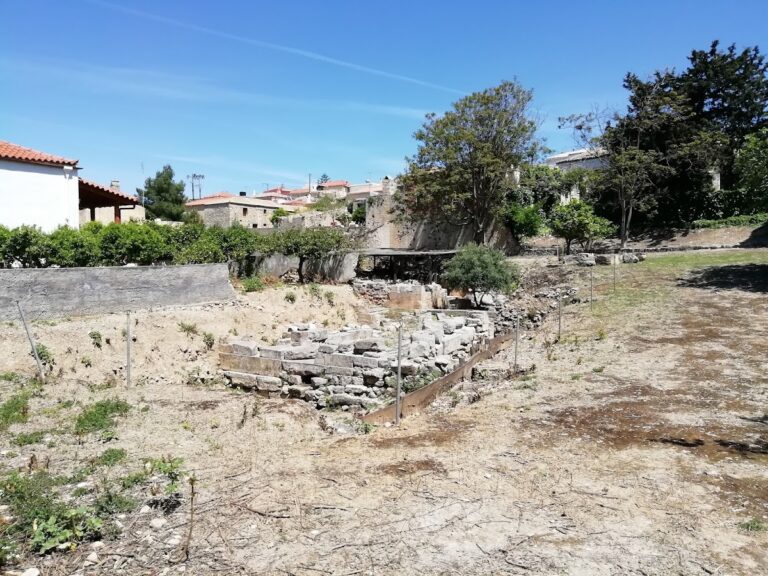
Remains of the Byzantine walls survive near Heraklion harbour. They belong to the earlier defensive history of the site, before the Venetian system reshaped the city’s land and harbour defenses.
Materials and construction
The Venetian walls were built with stone from various quarries and with material taken from the ruins of the Palace of Knossos. This reused material forms part of the surviving fabric of the fortifications and connects the later defensive complex with the earlier archaeological landscape of Crete.