Church of Saint Luke in Kotor: A Medieval Orthodox Church in Montenegro


Site at a Glance
- Rating
- 4.7
- Popularity
- Low
- Country
- Montenegro
- Primary era
- Medieval
- External website
- Open
- Eras represented
- Medieval, Early Modern
- Civilizations
- Serbian, Venetian
- Site type
- Religious
- Remains
- Church
On this page12 sections
History
The Church of Saint Luke in Kotor, Montenegro, is a medieval Orthodox church built in 1195 during the rule of the Serbian Nemanjic dynasty. Constructed in a Romanesque-Byzantine style with Byzantine and Gothic elements, it is one of the oldest churches in Kotor. Its foundation belonged to the period of Stefan Nemanja and his son Vukan, rulers named in a surviving inscription on the western facade.
Foundation under the Nemanjic dynasty
The western facade carries a ktetor inscription, identifying Mauro Kacafrangi and his wife, Bona, as the church’s founders or patrons. The inscription places the construction in the time of Stefan Nemanja, described as the grand župan, a high-ranking ruler in the medieval Serbian political tradition, and Vukan, identified as king of Duklja, Dalmatia, Travunia, Toplica, and Hvosno. The Nemanjic dynasty was a medieval Serbian ruling house that flourished from the late twelfth through the fourteenth centuries.
Venetian and later ecclesiastical administration
During Venetian rule in Kotor, Saint Luke’s was used as a Roman Catholic church. It returned to Orthodox worshippers in the mid-seventeenth century, although a Catholic altar remained on the south wall for a time. Orthodox liturgy and Catholic Mass were both celebrated in the church during this period.
A Venetian provveditore’s report from 1768 described Saint Luke’s as a Serbian church where services were held daily in Serbian. It also referred to the Orthodox population and the trustees associated with the church. Under Austrian rule, the church belonged to the Diocese of Dalmatia. Following the reorganization of church administration in 1870, it became part of the newly created Diocese of the Bay of Kotor.
The Diocese of the Bay of Kotor remained responsible for Saint Luke’s until 1931, when it was incorporated into the Metropolitanate of Montenegro and the Littoral of the Serbian Orthodox Church. Under Napoleonic rule in the early nineteenth century, the Catholic altars were removed from Kotor’s Orthodox churches, including Saint Luke’s. Since then, Saint Luke’s has functioned exclusively as an Orthodox church. It remains an active place of worship within the metropolitanate, and its liturgical feast is observed on October 18/31.
Survival and continued worship
The Chapel of Saint Spyridon the Wonderworker was added in the eighteenth century, and services continue to be held in both church spaces. Saint Luke’s was among the few buildings in Kotor to avoid major damage during the 1979 earthquake, allowing its historic fabric and religious use to continue.
Remains
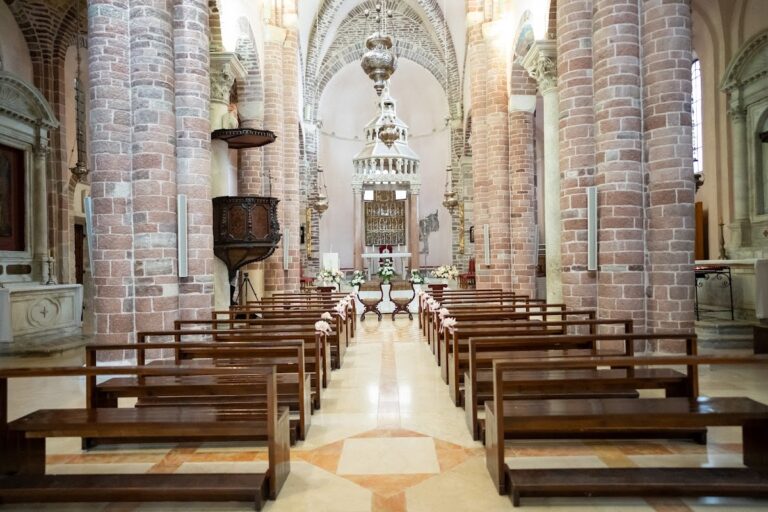
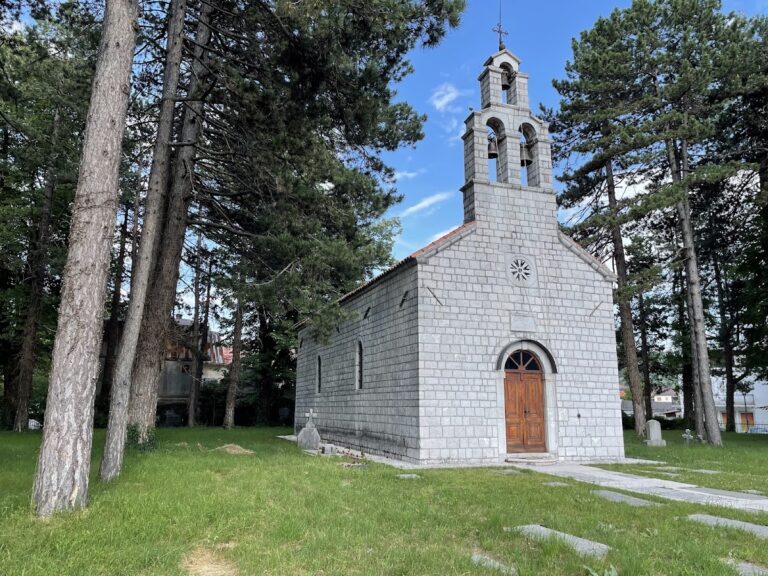
The surviving church is a compact, one-nave building whose inscribed-cross plan places the principal spaces in the form of a cross within a rectangular structure. A dome rises on a circular drum, the cylindrical support that lifts a dome above the main body of a building, while a semicircular apse forms the eastern end. A Baroque bell tower is incorporated into and crowns the front facade.
Church and chapel
Main church
The main structure preserves the medieval arrangement of a single nave, crossing, dome, and eastern apse. Its form combines Romanesque-Byzantine, Byzantine, and Gothic elements. The western facade retains the founder’s inscription, which links the surviving building to its 1195 foundation.
Chapel of Saint Spyridon
The Chapel of Saint Spyridon the Wonderworker was inserted along the northern side of the church in the eighteenth century. It forms a second worship space within the building, and liturgical services continue in both the chapel and the main church.
Paintings, furnishings, and burials
Frescoes and sacred objects
The church was decorated with frescoes soon after its construction. The earliest surviving fragments, dating from the turn of the twelfth and thirteenth centuries, remain on the south wall and depict Saint Catherine, Saint Sylvester, and Saint Barbara. Relics kept in the church include particles associated with Saint Luke, the Five Martyrs, and Saint Barbara.
Iconostases
The iconostasis, the decorated screen separating the sanctuary from the main worship space in an Eastern Christian church, is attributed to Dimitrije Daskal. A seventeenth-century painter, Daskal is identified as the founder of the Rafailovic school of painting in the Bay of Kotor. The church is also described as having two eighteenth-century iconostases.
Tomb slabs and cemetery
Seventeen tomb slabs form the church floor. A cemetery once surrounded the building, while burials continued inside until 1930. During the Austro-Hungarian period, the surrounding cemetery was moved outside the city.
Nearby sites