Church of the Virgin Mary, Queen of Angels and St. Ladislaus: Levoča’s Minorite Monastery Church


Site at a Glance
- Rating
- 4.8
- Popularity
- Very Low
- Country
- Slovakia
- Primary era
- Medieval
- Eras represented
- Medieval, Early Modern
- Civilizations
- Habsburg, Hungarian
- Site type
- Religious
- Remains
- Church
On this page12 sections
History
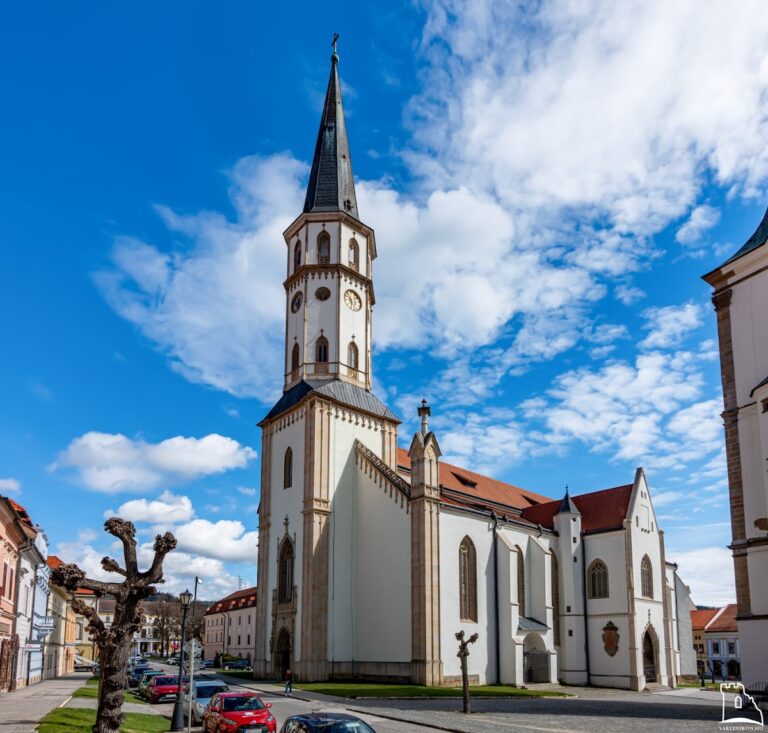
The Church of the Virgin Mary, Queen of Angels and St. Ladislaus is a Roman Catholic monastery church in Levoča, Slovakia. Built by the Minorites between about 1320 and 1380 in the Gothic period, it formed part of the Old Minorite Monastery and served a mendicant community whose charitable and religious work was directed especially toward the urban poor.
Foundation and medieval development
The origins of the monastery remain uncertain. An early nineteenth-century chronicle attributed the foundation of the Minorite convent of St. Ladislaus to Count Ladislav Dank in 1308, but the manuscript cited by the chronicle has not survived and the count does not appear in contemporary records. Another interpretation associates the foundation with Kokoš of Lomnica, sometimes identified as Gallus. He was reportedly required in 1307 to establish six monasteries as punishment for a killing. The surname Berzeviczi has also been attached to him inaccurately. Claims that the monastery existed before 1272 or in 1284 arose from later misreadings.
The first reliable written mention of the Levoča Minorite monastery dates from 1332. The Minorites, a branch of the Franciscan mendicant tradition, established their house in a more peripheral part of the town, consistent with their practice of ministering among poorer inhabitants. Construction of the church began with the presbytery, the area around the high altar reserved for the clergy, during the first half of the fourteenth century. After a change of master in the middle of the century, the presbytery was vaulted and the three-aisled nave was built. The church was completed in the late fourteenth century.
Reformation and Protestant administration
When the Reformation reached Levoča in 1544, the Minorites abandoned the church and monastery. The complex was then taken over by the Protestant, later Evangelical, community. A fire damaged the church in 1485, and repairs followed; further work had been carried out before 1522. These earlier interventions formed part of the building’s long medieval history before its later return to Catholic use.
Jesuit rebuilding
The complex returned to Catholic control in the early 1670s. Emperor Leopold I, a Habsburg ruler and king of Hungary whose reign lasted from 1658 to 1705, ordered the provost of Spiš Chapter to install Jesuits there. The Society of Jesus formally took possession in 1674 and began a major rebuilding of the monastery in 1677. The Jesuits, a Catholic order active in education and pastoral work, later established a Royal Gymnasium in the complex.
By the time of this transfer, the church was in poor condition, partly because its western section stood on unstable ground. The Jesuits re-vaulted the church in the Baroque style in 1694, introduced new interior furnishings, and added a roof turret to the previously towerless roof. The church’s original dedication to St. Ladislaus, the eleventh-century king of Hungary and a prominent medieval saint, was expanded during the Jesuit period to include the Virgin Mary, Queen of Angels.
Repairs and present administration
After the dissolution of the Jesuit order, the complex deteriorated and required renewed repairs. Further interventions took place in 1852–1858, 1908–1909, and 1938–1939. The church and monastery have formed part of the UNESCO World Heritage property “Levoča, Spiš Castle and the Associated Cultural Monuments” since its inscription in 2009. They have also been protected together with the medieval wall paintings as part of a Slovak national cultural monument since 1963.
Since 2021, the church and monastery spaces have formed part of the Spiš Museum in Levoča, within the Slovak National Museum network. The Spiš Diocese owns the church, while the Levoča parish and the museum administer it together. Occasional religious services continue to take place there. The building is also known as the Old Minorite Church, Minorite Church, former Franciscan Church, Jesuit Church, and Gymnasium Church. The popular name “Black Church” refers to the black-and-gold scheme of its interior furnishings.
Remains
The church stands beside Levoča’s western fortifications in the western part of the historic town, near the Polish Gate. Built of stone, it retains a Gothic exterior while its interior is predominantly Baroque. The monastery adjoins the church on the north side, creating a connected complex of sacred, communal, and educational spaces.
Church and monastery layout
The church follows a three-aisled arrangement formed during its fourteenth-century construction. Its presbytery was begun first, then vaulted after the mid-century change of master, while the nave completed the building in the late fourteenth century. The later Baroque re-vaulting altered the interior without removing the Gothic character of the exterior. A roof turret rises above the building, added during the Jesuit rebuilding.
The monastery contains an arcade cloister with fragments of fresco decoration, a former cloister garth, and a fountain. Medieval sacred art survives in both the church and the cloister, linking the enclosed monastic spaces with the religious decoration of the church.
Medieval wall paintings
A painted composition fills the tympanum, the field above a doorway, on the southern portal. It shows the crowned Madonna seated on a throne with the Christ Child and flanked by angels. On the north side, scenes depict the Death of the Virgin and the Coronation of the Virgin.
The sacristy, a room used for vestments and liturgical objects, contains a Crucifixion wall painting with an architectural motif representing the town’s fortifications. These paintings are regarded as an important milestone in medieval monumental painting associated with the urban environment of Slovakia.
Interior furnishings and surviving Gothic art
Baroque altars
The church’s Baroque altars and other furnishings are predominantly black and gold. They were made in the workshop of the sculptor Olaf Engelholm, who reportedly came to Levoča from Münster in Westphalia. Angel figures serve as caryatids, sculpted human forms used in place of columns or other supports, carrying heavy twisted columns.
Madonna and acts of mercy
Limited Gothic furnishings survive, including a Madonna dated to 1430 and wall paintings from the fourteenth and fifteenth centuries. On the north side of the nave, the cycle of the Seven Acts of Mercy presents traditional Christian works of charity directed toward bodily needs. It begins with Christ as the Man of Sorrows, blessing the acts of mercy and pointing with his left hand toward a chalice at his feet.
Six pictorial fields show sheltering the traveller, feeding the hungry, clothing the naked, visiting the imprisoned, visiting the sick while giving drink to the thirsty, and burying the dead. The cycle ends with the Holy Trinity, represented by God the Father, Christ, and the Holy Spirit as three seated male figures whose gestures communicate with one another.
Organ
The present organ has eleven registers distributed between one manual and a pedal. Július Guna’s organ workshop in Prešov built the instrument, which was installed in a seventeenth-century Baroque case by an unknown maker. It replaced an older organ made by Ludwig Mooser in the 1870s.
Nearby sites