Vojlovica Monastery: A Serbian Orthodox Monastic Complex in Serbia


Site at a Glance
- Rating
- 4.8
- Popularity
- Low
- Country
- Serbia
- Primary era
- Early Modern
- Eras represented
- Medieval, Early Modern, Modern
- Civilizations
- Habsburg
- Site type
- Religious
- Remains
- Monastery
On this page10 sections
History
Vojlovica Monastery is a Serbian Orthodox male monastery in Serbia, located in Vojlovica, a southeastern suburb of Pančevo, within the grounds of the Pančevo Oil Refinery. It belongs to the Banat Eparchy, an administrative diocese of the Serbian Orthodox Church, and has long served as an important spiritual center in this part of Banat.
Medieval origins and early records
Traditions place the monastery’s foundation either in 1383 or in 1405 and associate it with Stefan Lazarević, the Serbian ruler and despot who was the son of Prince Lazar. A despot was a high-ranking title of Byzantine origin used by Serbian rulers. An inscription from 1799 states that Stefan Lazarević renewed the monastery in 1405. The earliest reliable documentary reference dates from 1542 and records a community of 36 monks.
Another tradition connects the foundation with 46 missionary monks known as Sinaites, who moved from Serbian lands. This account may be associated with the remains of an older monastery of the same name at Veliko Vojlovce in southern Serbia. Its monks were said to have fled to Banat, linking the earlier foundation tradition with the monastery at Vojlovica.
Attacks, monastic recovery, and eighteenth-century change
The monastery repeatedly endured destruction, closure, burning, and the enslavement or killing of monks. Serbian Orthodox Patriarch Pajsije visited it in 1631. During the Ottoman attack of 1716, the monastery was burned and its old Serbian monastic privileges were destroyed. An 1800 chronicle records that Abbot Viktor died together with 19 monks.
Monk Mina escaped captivity, returned to Banat, and worked to restore the monastery. He became its abbot in 1730. The monastery was burned again during the Ottoman attack of 1738, creating another interruption in its religious and physical life.
The surrounding area was also associated with hajduks and smugglers during the eighteenth century. Authorities warned the monastery about its involvement with them. On 17 March 1743, troops enclosed Vojlovica with a human barrier, while Pančevo authorities later referred to the hajduk leader Andrija the Serb in connection with the monastery.
Land administration formed an important part of the monastery’s eighteenth-century history. A commission examining its holdings in 1755 left its existing possession unchanged. On 17 June 1765, military frontier engineers and surveyors redrew the boundaries, assigning the monastery 921 jutar of arable land and 14 motika of vineyards. The earlier holding had comprised 1,153 jutar and 711 square hvati, excluding floodland. The monastery also possessed a 51-motika vineyard on Vršac Hill and a share in a watermill on the Danube.
The estate supported the monastic community through cultivation, livestock, and commercial activities. It included an inn where the monastery’s remaining wine was sold, and the land and animals helped support the monks and 28 hired workers. The monastery also claimed longstanding rights to operate an inn and to fish. Archimandrite Konstantin of Studenica, who was engaged in writing, died at Vojlovica in 1767.
Rebuilding at the end of the eighteenth century
During the 1788 war, Abbot Nikanor and a brotherhood that had fled before the Ottoman advance returned and restored the monastery. They erected a residential building with cells on the forest side. Abbot Nikanor Stojanović died and was buried in the monastery courtyard in 1796.
Abbot Joanikije Miljković continued the rebuilding. In 1798 he constructed a long residential building with cells on the sunny side and enclosed the monastery complex with a brick wall. He also compiled and published a short history of the monastery in 1800. These works helped establish the form of the complex after the repeated destruction of the preceding century.
War, industrial development, and restoration
During the Second World War and the occupation of Yugoslavia, German forces imprisoned Serbian Patriarch Gavrilo Dožić and Nikolaj Velimirović, Bishop of Žiča, at Vojlovica. Dožić was the Serbian patriarch during the war, while Velimirović was a Serbian Orthodox bishop and theologian associated with the Diocese of Žiča.
The construction of the Pančevo Oil Refinery on monastery land in 1965 brought monastic life to an end. The monastery remained closed during the 1960s through the 1980s, after which monastic life resumed. The refinery and monastery subsequently continued in an unusual physical coexistence.
Reconstruction and restoration took place during the 1980s. Conservation work on the church revealed several layers of wall painting belonging to different construction and rebuilding phases, including a layer from the fifteenth or first half of the sixteenth century. Part of the refinery plot was agreed for return to the monastery in April 2012, and the roof of the monastery residence was renewed in 2016.
The monastery’s liturgical books and other valuable movable property, including icons, paintings, and the iconostasis, received cultural-monument protection through decisions issued in 1952 and 1968. Vojlovica was designated a cultural monument of exceptional importance in the 1990s.
Remains
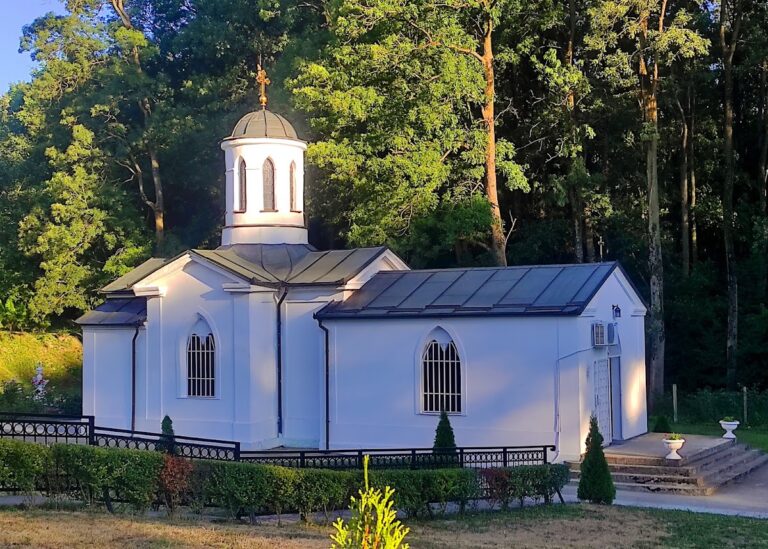
The monastery complex consists of the Church of the Holy Archangels Michael and Gabriel and a konak, a residential and service building for the monastic community. A grave marked with a Templar cross lies immediately south of the church. The complex also includes later residential construction, a brick enclosure wall, and a small chapel built over the monastery watermill.
Church architecture
The church is a single-nave brick building with a semicircular apse, the rounded end of the sanctuary, and rectangular choir spaces. An octagonal dome rises above the naos, the main worship space, while a blind dome stands above the original narthex, the entrance hall. A further narthex was added in 1752 during the abbacy of Pajsije Milutinović.
The church’s eighteenth-century construction history includes rebuilding phases in 1752 and 1791. In 1791, Abbot Nikanor erected a new church on the ruins of the earlier building. A tall Baroque bell tower was attached to the church and the newer narthex in 1836. Its design, together with a row of semicircular arches on small columns above the string course of Pajsije’s narthex, gives the building its Baroque appearance.
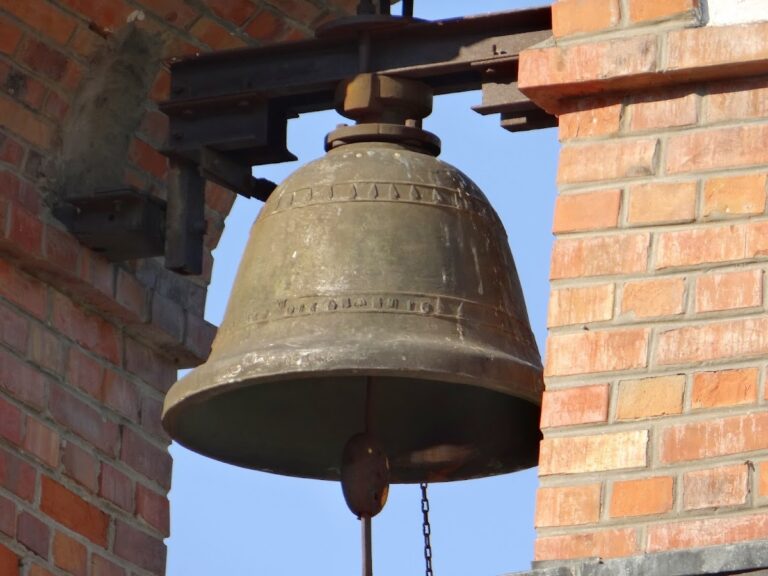
The present marble altar table dates from 1816. A bell weighing eight centi was donated in 1854 by Vikentije Kostić, a merchant from Pančevo. The eighteenth century also saw the painting of the church’s interior walls and the creation of a tall Baroque iconostasis, the screen separating the sanctuary from the nave and carrying icons. Its possible author was Aksentije, a painter from Pančevo.
Paintings and interior features
The gilded iconostasis contains approximately 30 icons depicting figures from the Old and New Testaments. The church also preserves a particularly valued miraculous icon of the Virgin Mary. In 1800, the relics of Gregory of Sinai were located to the right of the choir.
The wall paintings reflect successive construction and restoration phases. Beneath the oil painting executed in 1797 and 1798, conservation work in the early 1980s exposed two earlier layers. One dates from the fifteenth or first half of the sixteenth century, while the other belongs to the late seventeenth or early eighteenth century.
A younger layer was painted between 1730 and 1732 by David of Selenica. He also painted the church at Drača Monastery and the narthexes of Manasija Monastery, which is also known as Resava.
Residential buildings and watermill chapel
The monastery’s residential buildings, or konaks, were developed during the eighteenth-century rebuilding. One building with cells was erected on the forest side after the 1788 war, while Abbot Joanikije Miljković built a long residential structure on the sunny side in 1798. The complex was enclosed by a brick wall during the same period. A small chapel was built over the monastery watermill in 1890.
Manuscripts and treasury
Vojlovica preserves an old handwritten Service Book written by Radul in 1654, during the time of Wallachian Prince Ioan Matei and Ignatius, Metropolitan of Târgoviște. A protosynkellos, a senior monastic cleric, serving the metropolitan of Târgoviște donated the book to Vojlovica in 1672.
A Minej, a liturgical book arranged by the months of the ecclesiastical year, was signed at the monastery by the monk Kir Sava in 1567. Another record states that the monk Kozma wrote a Minej there in the same year at the order of Abbot Sava.
An inscription above the monastery doors dates from 1713 and records their donation by Captain Stojan Stefanović and a woman named Nasta Bošnjak, who was at the monastery. The treasury also contains a silver liturgical spoon from 1558 and a valuable liturgical object from 1717 associated with Hieromonk Nikanor.
Nearby sites