Church of St. George: A Byzantine Orthodox Church at Kurbinovo
Site at a Glance
- Rating
- 4.8
- Popularity
- Very Low
- Country
- North Macedonia
- Primary era
- Medieval
- External website
- Open
- Eras represented
- Medieval, Early Modern, Modern
- Civilizations
- Byzantine, Ottoman
- Site type
- Religious
- Remains
- Church
On this page15 sections
History
The Church of St. George is a twelfth-century Byzantine Orthodox church near Kurbinovo in North Macedonia, built between 1185 and 1190 and painted in the final phase of Komnenian art. Dedicated to George, the Christian martyr who was killed at Nicomedia in AD 303, it is associated with the Macedonian Orthodox Church-Ohrid Archbishopric and the Prespa-Pelagonia Diocese. Its frescoes and surviving architecture have made it an important monument in the study of medieval Byzantine painting in North Macedonia.
Foundation and Fresco Painting
Archaeological excavations indicate that the church originally stood within a settlement. That settlement was later abandoned or relocated, and its inhabitants moved to the present village of Kurbinovo in the late eighteenth century. The church grounds also served as Kurbinovo’s old village cemetery until 1921, linking the monument to the community long after the settlement around it had changed.
The beginning of the fresco work is dated precisely by an inscription on the eastern side of the altar. It records that painting began on 25 April 1191, during the reign of the Byzantine emperor Isaac II Angelos, who ruled from 1185 to 1195 and again from 1203 to 1204. Earlier publications had incorrectly placed the frescoes in the sixteenth century.
The circumstances of the foundation, the identity of the church’s founder, and the names of the painters are not known. A severely damaged ktetor composition on the western wall may have shown the founder and his family. A ktetor was the founder or principal donor of a church. The surviving clothing and footwear in the damaged composition suggest a connection with the secular aristocracy. Isaac II Angelos and his wife, Margaret of Hungary, have been proposed among the figures, while a third figure may be John X Kamateros, Archbishop of Ohrid. The fourth figure remains unidentified.
At least three artists worked on the frescoes. The most accomplished painter created the monumental images of Christ and George and the upper frescoes on the eastern wall. Other painters decorated the side walls, western wall, lower eastern wall, and part of the northern wall. They are generally considered to have been local artists. The leading painter may also have worked at the Church of Cosmas and Damian at Kastoria, whose frescoes are dated to 1180.
Late Komnenian Painting
The paintings belong to the Komnenian Renaissance, the later phase of Byzantine art associated with refined monumental compositions, expressive drapery, and elongated human figures. The term Macedonian Renaissance is also used for medieval Christian artistic production in Macedonia. At Kurbinovo, Byzantine conventions combine with local characteristics. The figures are often elongated and muscular, their drapery can be complex and partly translucent, and their facial expressions are comparatively restrained. At the same time, the compositions show increasingly dynamic departures from strict symmetry.
The church was abandoned in the seventeenth century. A restoration in the nineteenth century followed a fire shortly before the middle of that century, which particularly damaged the southern wall and destroyed or brought down the porch. The restoration of 1847 substantially altered the building and its decoration. Work changed the upper walls and frescoes, added a western porch, blocked or altered the side doors, inserted two rectangular windows into the southern wall, and replaced the original iconostasis. Frescoes on the western facade were also covered or replaced.
Conservation and Protection
Further conservation took place during the first half of the twentieth century. The later western porch was removed, although traces of it remained on the facade. Mid-twentieth-century work removed the roof, raised the walls by about 50 centimetres, renewed the floor levels, and cleaned and restored the frescoes. The original rider saints on the western facade were uncovered again.
Most of the interior paintings have lost some of their colour intensity. The eastern-wall frescoes are comparatively well preserved, while humidity severely damaged the saints on the southern wall. The northern-wall paintings benefited from the protection of the adjoining slope. The Church of St. George is legally protected as a cultural monument of North Macedonia. A fragment of the Archangel Gabriel fresco, known as the Angel of Kurbinovo, appears on the reverse of the Macedonian 50-denar banknote.
Remains
Building and Exterior
Single-Nave Church
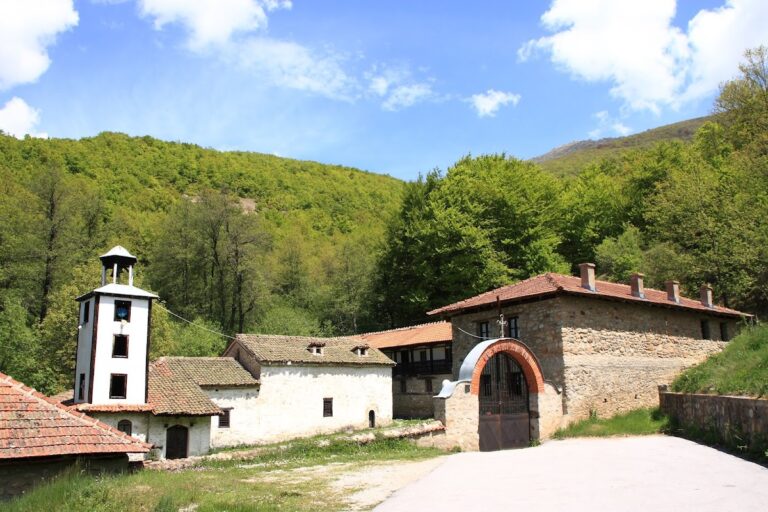
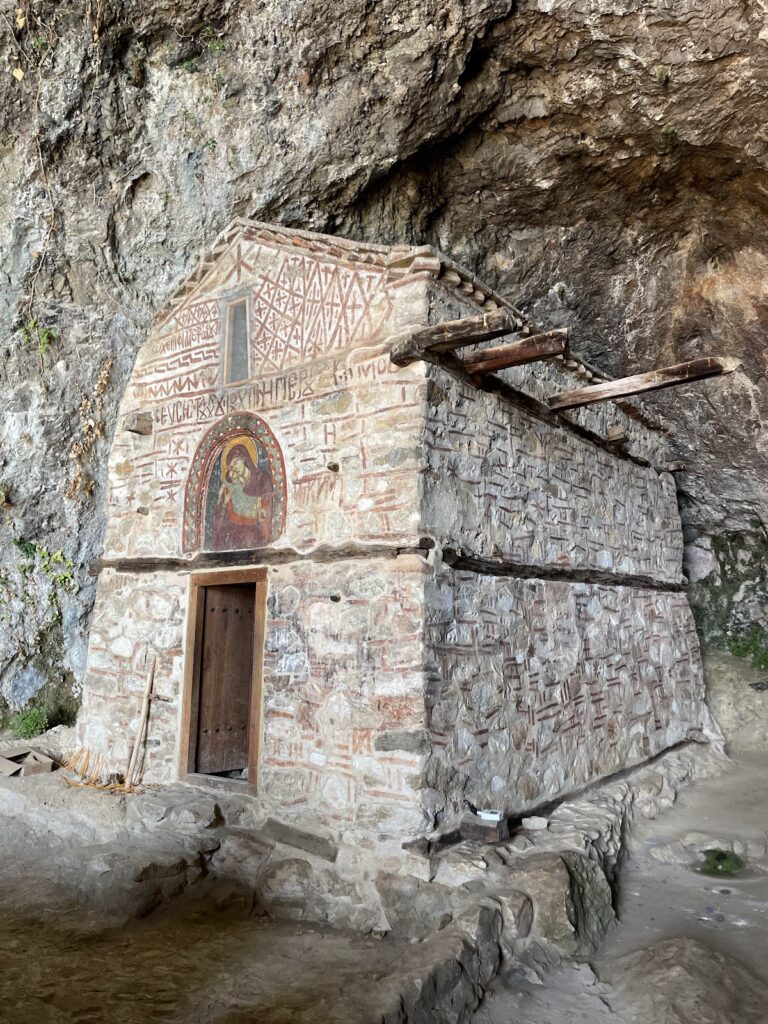
The church is a simple single-nave building with a rectangular nave, a semicircular eastern apse, and a gabled roof rather than a dome. It measures approximately 15 to 17 metres in length and about 7 metres in width, making it one of the largest single-nave hall churches in North Macedonia. The walls are built mainly from roughly hewn stone set in mortar. Brick appears irregularly around the windows, lunettes, and apse.
The upper two-thirds of the eastern wall contain two horizontal rows of brickwork resembling the Byzantine cloisonne technique, in which brick and masonry form a patterned surface. The masonry below is comparatively rough. The facades were originally plastered and painted, giving the exterior a richer finish. A protective roof structure has been installed above the present roof.
Sanctuary and Side Recesses
The apse contains the altar at its centre. The bema, or raised sanctuary area in front of the altar, stands two steps above the floor, and a monolithic cubic altar is placed before the apse. Two rectangular niches beside the apse function as the prothesis and diakonikon, the side spaces used for preparing the Eucharistic elements and for other liturgical functions.
Two additional rectangular recesses are set into the side walls. The southern recess is lower than the northern one and has been partly blocked with brick. The principal entrance opens in the west, while each side wall has an additional door. Since the northern side adjoins a slope, its door is positioned almost at window level. All three entrances are crowned by lunettes and two archivolts, or arched decorative bands.
Windows and Exterior Paintings
Two round-arched windows pierce each of the upper northern and southern walls. Another pair lights the apse, and a further opening is set in the eastern gable. Two rectangular windows were cut into the southern wall during the nineteenth-century restoration. The church has no western narthex, or entrance hall. The later porch changed the western facade before its removal.
Frescoes originally covered both the interior and exterior. On the western facade, painted imitation brickwork rose to the level of the door lintel. Similar decoration appeared on the lower apse and on the first archivolt of the southern doorway. The external paintings are generally badly faded, although the western entrance lunette retains comparatively well-preserved haloed rider saints carrying shields and spears.
Fragments of richly dressed figures survive above the rider saints, and a two-line inscription appears on the first archivolt. The painting in the northern lunette has been lost, but its geometric and floral archivolt decoration remains well preserved. The southern lunette combines imitation brickwork with a Deesis, an image of Christ accompanied by intercessory figures, including George the Victorious. Faint smaller figures survive beside the doorway.
Interior Fresco Program
Registers and Standing Saints
The interior frescoes are arranged in three to five registers. The lowest register imitates marble, while the register above it contains standing saints. Some of these figures also appear above the doors. The groups include Panteleimon, Cosmas, and Damian. Constantine the Great and his mother Helena are painted on the southern wall.
The western wall includes female saints such as Thecla of Iconium, Paraskeva of Serbia, Theodora of Rome, Barbara of Heliopolis, Kyriake of Nicomedia, and Catherine of Alexandria. Euphrosyne of Alexandria and Saint Anne are regarded as among the oldest representations in the church. Clement, Cyril, Methodius, Onuphrius, and Ephrosyn are represented on the northern wall.
Christological Cycle
The Christological cycle begins with the Annunciation. The archangel Gabriel appears on the northern side of the apse arch, while Mary is shown on the southern side. The southern wall continues with the Visitation, the Nativity, the Presentation, the Baptism, and the Raising of Lazarus.
The western wall contains the Entry into Jerusalem and the Transfiguration. Above the western doorway, the Dormition of the Virgin interrupts the sequence. On the northern wall are the Crucifixion, the Deposition, the Entombment, the women at the tomb, and the Descent into Hades. The cycle concludes with the Ascension on the upper eastern wall. Pentecost appears opposite it, and a broad Theophany occupies the wall below.
Monumental Figures and Prophets
Monumental images of Christ and George the Victorious occupy two registers opposite one another. Approximately thirty prophets holding scrolls fill the upper registers of the side walls. Because the church has no dome, these prophets were placed on the upper side walls rather than on a drum beneath a dome.
Apse and Eucharistic Imagery
The conch of the apse contains the enthroned Virgin and Child, flanked by the archangels Michael and Gabriel. Beneath them, eight Church Fathers move toward the infant Christ lying on the altar as a ritual offering. This unusual Eucharistic composition is regarded as an early, and possibly the first, representation of its type in Byzantine art.
The altar area preserves the image known as Melismos, a Eucharistic scene in which the infant Christ is represented as the sacrificial Lamb. The Church Fathers participate in the liturgical offering by venerating Christ. On the eastern wall, the Annunciation places Gabriel to the north and the Virgin to the south. The southern altar area includes Methodius of Thessalonica, Cyril of Thessalonica, and Cyril of Alexandria.
Later Painted Additions
The southern wall preserves scenes from the life of George that date from the fourteenth century, although their dating has been disputed. A depiction of Demetrius on horseback above the northern door does not belong to the original fresco program and is dated to the late sixteenth or early seventeenth century. The southern facade paintings, apart from those in the lunette, have likewise been assigned either to a later period or to the fourteenth century.
Much of the marble imitation between the altar and the southern door has disappeared. The surviving western and southern facade paintings retain areas in which the original decorative treatment can still be seen, particularly in the lower portions. Together with the interior cycle, these remains preserve the successive layers of decoration and alteration that shaped the church after its twelfth-century construction.
Nearby sites