Jeni Mosque: An Ottoman Mosque in Bitola, North Macedonia
Site at a Glance
- Popularity
- Medium
- Country
- North Macedonia
- Primary era
- Early Modern
- Eras represented
- Medieval, Early Modern, Modern
- Civilizations
- Ottoman
- Site type
- Religious
- Remains
- Mosque
On this page12 sections
History
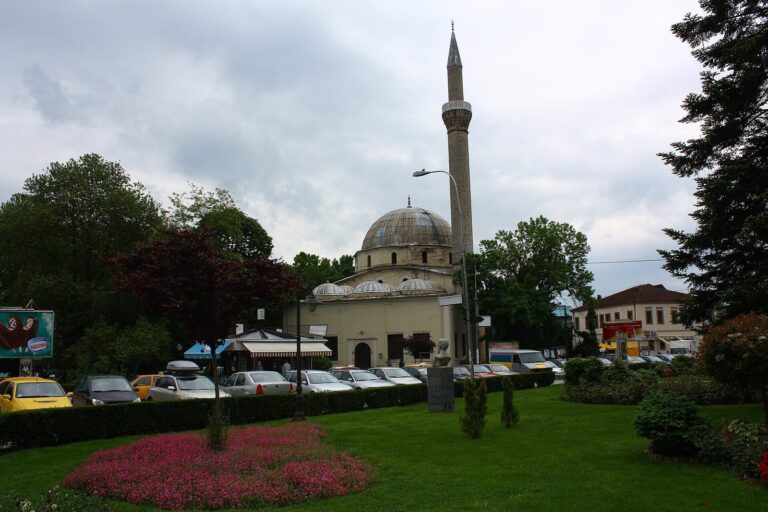
The Jeni Mosque, also known as the Yeni Mosque and the Kadı Mahmud Çelebi Mosque, is a sixteenth-century Ottoman mosque on Bitola’s central square in North Macedonia. Its design bridges early and classical Ottoman styles. Commissioned during the Ottoman Empire, a state centered in Anatolia that ruled parts of southeastern Europe, it was built during Sultan Suleiman I’s reign (1520-1566). The construction date is uncertain: a chronogram, an inscription whose letters encode a date, recorded in 1661 gives 1565, while recalculations suggest 1558-59 or 1553-54.
Foundation and Ottoman use
Mahmud Effendi, Bitola’s qadi, or judge in an Islamic legal system, commissioned the mosque on a site occupied by an earlier mosque or Christian religious buildings. He established a waqf, a religious endowment whose property or income supports a designated purpose, to maintain it. Its endowed properties included shops, houses, warehouses and inns. Mahmud Effendi also founded a nearby madrasa, an institution for religious teaching.
The mosque served Sunni Muslims and was affiliated with the Bitola muftiate, the local body concerned with Muslim religious affairs. A small cemetery surrounded it, and Halil Baba, a mystic of the Bektashi Sufi order, was buried there. In 1589, a court dispute concerned Christians living nearby and interfering with Muslim worship. Their relocation may have marked a boundary between the two religious communities.
The Ottoman traveler and writer Evliya Çelebi described the building in 1661 as Mahmud Effendi’s mosque. A court decision from 1829 records Hafiz Halil Effendi taking over as imam, or leader of communal prayers, after Molla Ismail. The change indicates that the mosque continued to serve Muslim worshippers during Ottoman rule.
Regional traditions gave the building other names and associations. Mehmed Tevfik, folklorist Marko Cepenkov and chronicler Jovan Hadži Vasiljević recorded the name Horseshoe Mosque and a story that Saint George’s horse left horseshoe marks on its wall. A related legend, recorded by Hadži Vasiljević, says that a church dedicated to Saint George near the former Pekmez market became the mosque. The name Chain-Well Mosque refers to a former well where a chain was used to draw water.
Renovation and later history
A marble inscription above the entrance records renovation in 1890-91. The north porch was rebuilt and enlarged as part of this work. The mosque ceased to function as a place of worship in 1943. In 1950, surrounding buildings and the cemetery were removed, and the site was laid out as a park with a fountain. The mosque became a gallery for contemporary graphic art and was designated a cultural monument during the 1950s.
Archaeological excavations began in 2003 under Tome Janakievski and continued from 2004 to 2008 under Gordana Filipovska-Lazarevska. The institute responsible for cultural-monument protection proposed presenting the building as a monument to both Christian and Islamic history.
Remains
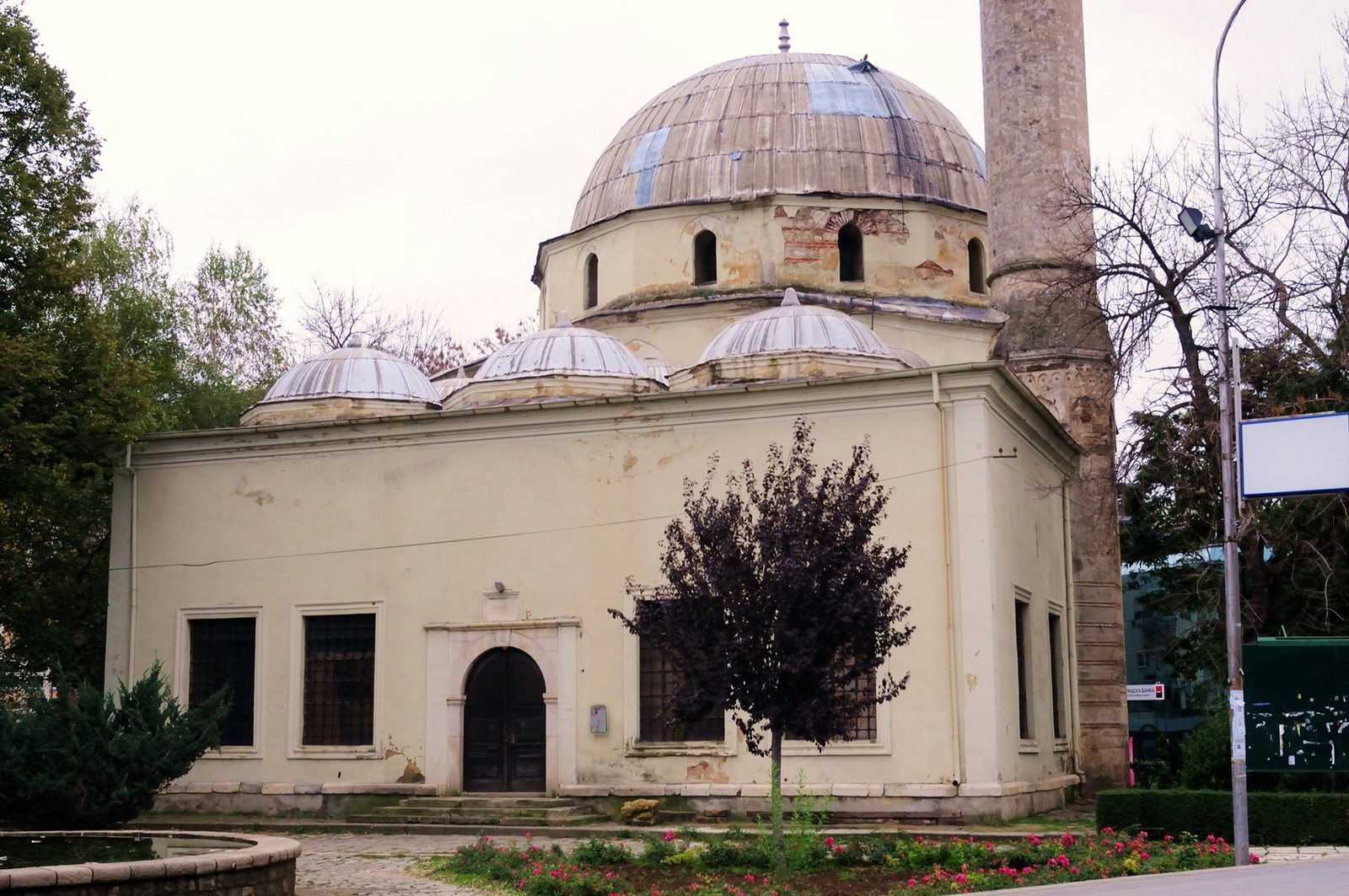
The mosque stands on Bitola’s central square on the right bank of the Dragor River, near the clock tower and the Church of Saint Demetrius. The Great Bridge connects the square with the Bezisten, the bazaar, the Ishak Çelebi Mosque and former administrative buildings. A city park surrounds the mosque, with a fountain preserved in its grounds. The building has a square plan and stone walls built in alternating courses of squared stone and brick.
The mosque
Prayer hall and dome
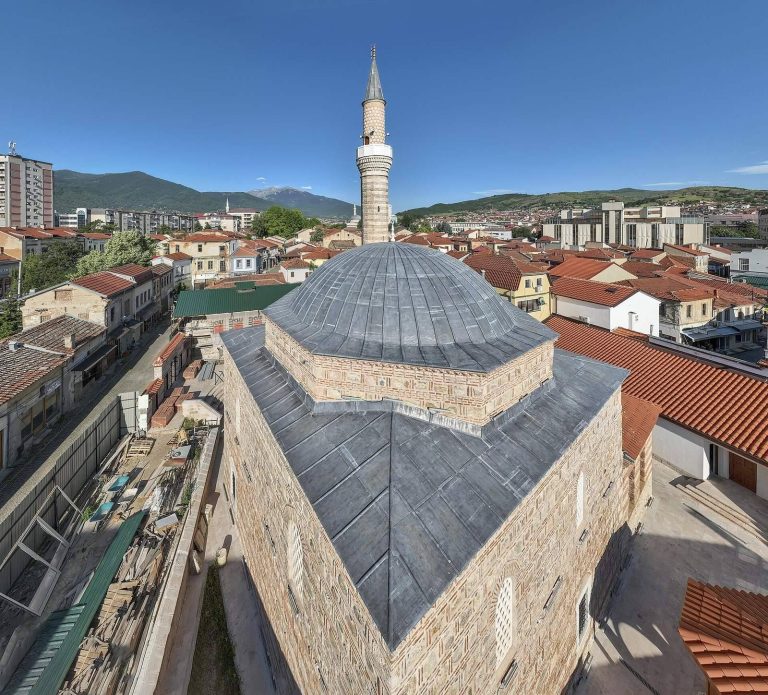
The prayer hall is a square measuring 12.78 metres on each side. Its dome rises 19 metres above the floor and rests on an eight-sided drum, the raised structure that supports it. Squinches, angled supports that transfer a dome’s weight to a square room, carry the dome’s load to the hall’s corners. The minaret, the mosque’s tower, stands approximately 40 metres high. Four rows of large windows illuminate the prayer hall.
Porch and exterior
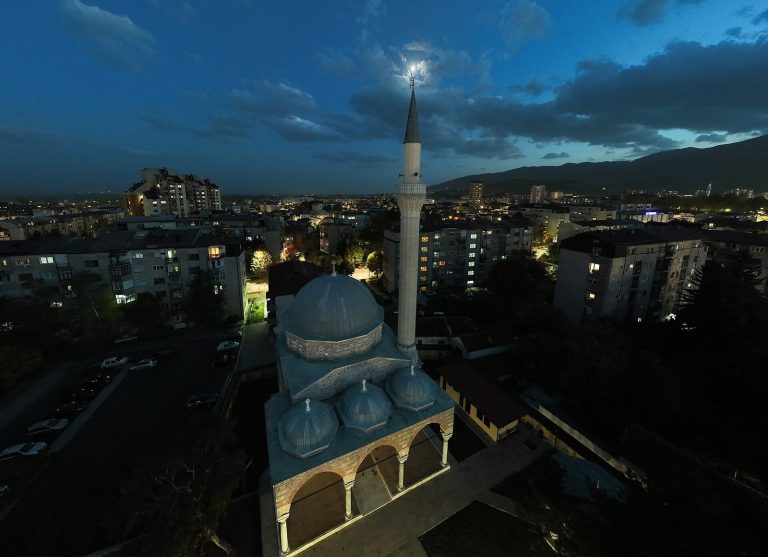
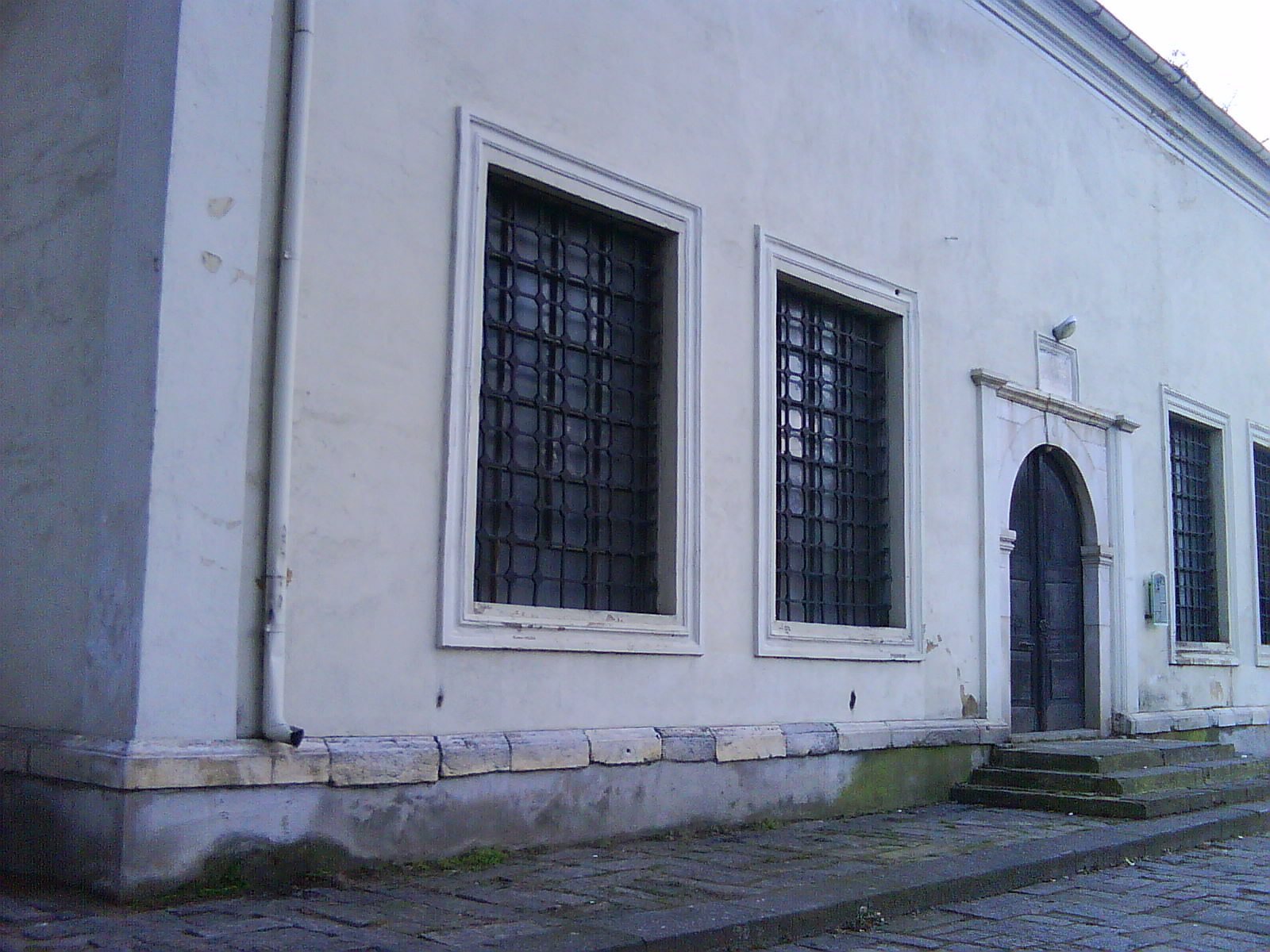
The porch measures 14.20 by 10 metres and has two rows of three domes. It was enclosed, probably during the nineteenth century, creating a broad double porch with bays roofed by blind domes, solid domed vaults visible from outside. Its 1890-91 renovation included rebuilding and enlarging the north porch. Marble columns support the porch, and their capitals have two different decorative designs. The mosque’s stone has a yellower hue than that of the Ishak Çelebi Mosque, whose design it resembles; that mosque was built 45 years earlier.
Interior decoration and furnishings
Paintings in earth colours once covered the dome’s interior, the squinches, the prayer-direction wall and the other walls of the prayer hall. Made using al secco, a technique for painting on dry plaster, they included scenes of the afterlife and images of holy places in the Kütahya style, an artistic tradition associated with the Anatolian city of Kütahya. An unidentified Italian painter overpainted them with city views in the early twentieth century. Vines, other plant forms, rosettes and calligraphic inscriptions with Quranic passages and sayings attributed to the first caliphs also decorate the main space.
The mihrab, a niche marking the direction of prayer, has geometric stalactite ornament, while similar forms decorate the squinches. A marble minbar, or raised pulpit, bears raised arabesque designs. A wooden preacher’s balcony is reached through a passage in the wall near the minaret. Heavy double-leaf doors separate the hall from the porch. Their upper sections have carved octagonal rosettes and text from Quranic chapter 112, Al-Ikhlas, which affirms God’s oneness.
Tiles and reused stonework
Glazed earthenware, or faience, tiles frame the entrance around the balcony and doorway. Each measures 25 by 25.5 centimetres and has cobalt and turquoise decoration on a white ground. They are attributed to a sixteenth-century Iznik workshop, and the mosque’s Iznik tile decoration is unique in North Macedonia. Related tiles are noted at the Yeni Mosque in Komotini; tiles on the minaret are comparable in type to decoration on the Pasha Bey tomb in Skopje, dated to 1438. Marble architectural pieces were reused during renovation. Inscribed tombstone slabs, with their lettering chiselled away, were also reused as paving.
Earlier buildings and excavation finds
Churches and mosque foundations
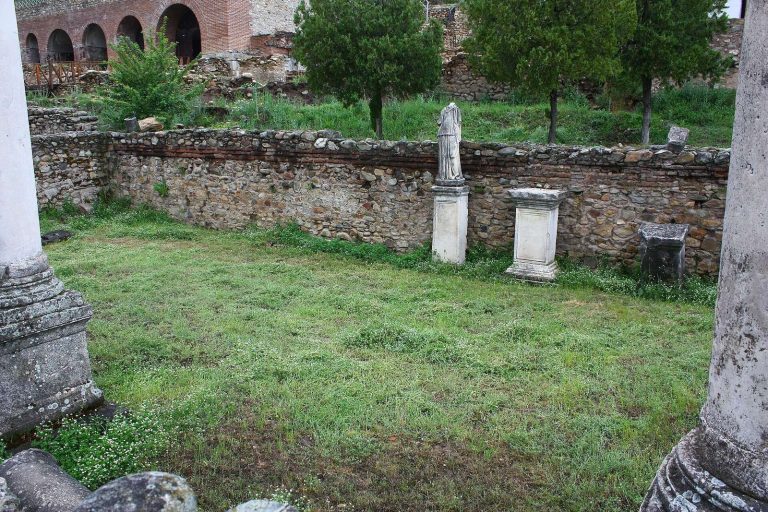
Below and around the mosque are remains of three earlier Christian churches, dated to the seventh, eleventh and thirteenth to fourteenth centuries, as well as foundations of an earlier mosque beneath the porch. The oldest church is thought to have been dedicated to Saint George. The latest church was demolished before the mosque was built, though the reason for its demolition is unknown.
Excavations revealed a medieval wall, traces of frescoes, eight burials, coins and pottery, all dated to the twelfth century. In 2008, excavators also uncovered a wall belonging to a basilica, a church commonly organized around a central nave and side aisles. That autumn they exposed the eastern part of a medieval church within the mosque’s prayer hall. It included a polygonal apse and two rooms associated with Christian worship beside the sanctuary. Foundations extend beyond the mosque’s masonry, indicating that the church was larger, and many fragments of frescoes were found.
Objects from the excavations
Finds included a rectangular medallion worn on the chest, with gilded images of Saints Nicholas and Basil on one side and Saints Theodore Tiron and George on the other. Gordana Filipovska-Lazarevska attributed it to Constantinople and dated it to the eleventh century. Two silver rings were recovered; one, dated to the ninth century, shows the Virgin Mary holding Jesus. Two eleventh-century lead seals bear, respectively, a bust of Saint George and a bust of the Virgin and Child. Other recovered objects date to the fourteenth century. The former chain-operated well that supplied water to the mosque no longer survives.