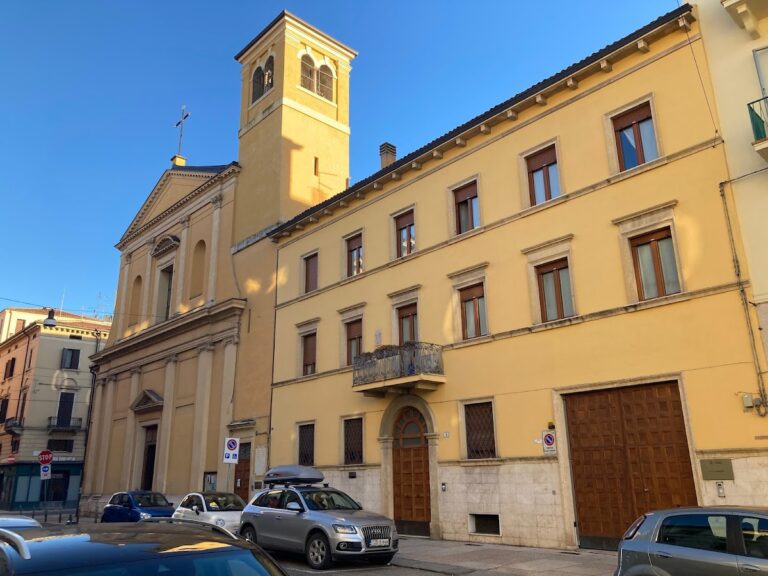
Palazzo Bottagisio: A Gothic Noble Residence in Verona


Site at a Glance
- Rating
- 5
- Popularity
- Very Low
- Country
- Italy
- Primary era
- Medieval
- Eras represented
- Medieval, Early Modern, Modern
- Civilizations
- Venetian
- Site type
- Domestic
- Remains
- Elite Residence
On this page8 sections
History
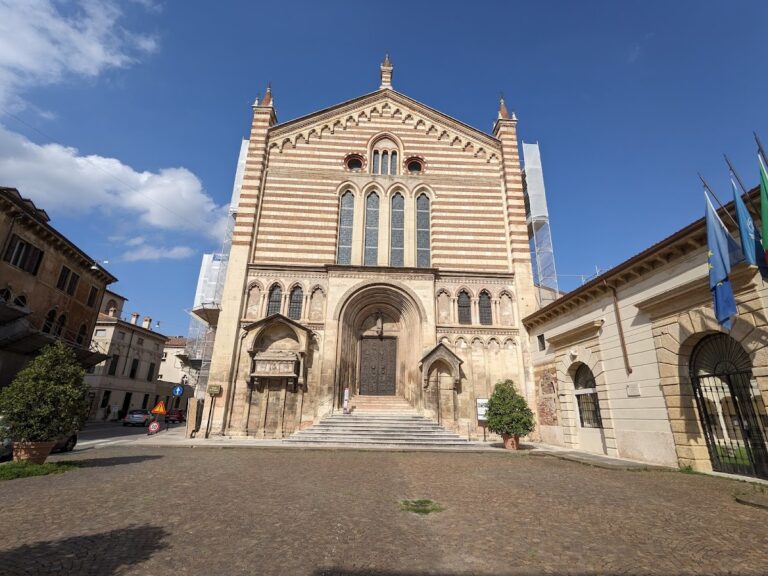
Palazzo Bottagisio is a fifteenth-century Gothic residence in Verona, Italy, built for a branch of the Boldieri family. It stands in the historic center at the junction of Stradone San Fermo and Via Leoni, along the ancient north-south axis of the Roman city. The palace is also known as Palazzo Boldieri and Palazzo Boldieri Malaspina.
The Boldieri residence
The Boldieri had moved from Ghedi to Verona between the fourteenth and fifteenth centuries. Their early work as knife-makers, followed by their activity as goldsmiths, helped them acquire the wealth needed to purchase the Scaligeri palace called Palazzo dell’Aquila and build a new Gothic residence.
By around the sixteenth century, the family had concentrated its household in Palazzo dell’Aquila and began leasing the newer palace. The first known tenant was Astorre Baglioni, a general of light cavalry. Baglioni later founded the Filotimi Academy, an educational and cultural institution that occupied the palace before moving to Bergamo in 1566.
The Malaspina period
In 1610, the Boldieri sold the building to a branch of the Malaspina family for 5,000 ducats, a widely used European monetary unit. The new owners found the palace in poor condition and undertook extensive repairs and restoration, after which it again served as a noble residence.
The property was probably enlarged during the Malaspina period. A valuation made in 1693 placed the complex at about 10,000 ducats and included an additional building with a portico and shops. Marquis Ippolito Malaspina added a statue of Truth to the garden. In later decades, an external staircase was demolished and replaced by a monumental staircase inside the palace.
Nineteenth-century changes
In the nineteenth century, the Malaspina family moved to Vicenza and sold the palace to Giovanni Angerer, a brewer and property owner. Angerer planned to replace the Gothic building with a larger, classicizing structure. Architect Francesco Ronzani presented the proposal to Verona’s Municipal Ornamental Commission on 3 September 1860, and a building permit followed, but the replacement was never built.
The palace received stylistic restorations during the nineteenth century. Ownership later passed first to the Trezza family and then to the Bottagisio family, whose name is now most commonly used for the building. Palazzo Bottagisio remains in use.
Remains
Exterior and courtyard
The palace occupies a corner plot with two principal elevations, one facing Stradone San Fermo and the other Via Leoni. Although the building has undergone extensive changes, its facade retains fifteenth-century Gothic windows made from red Verona marble, probably quarried at Sant’Ambrogio di Valpolicella.
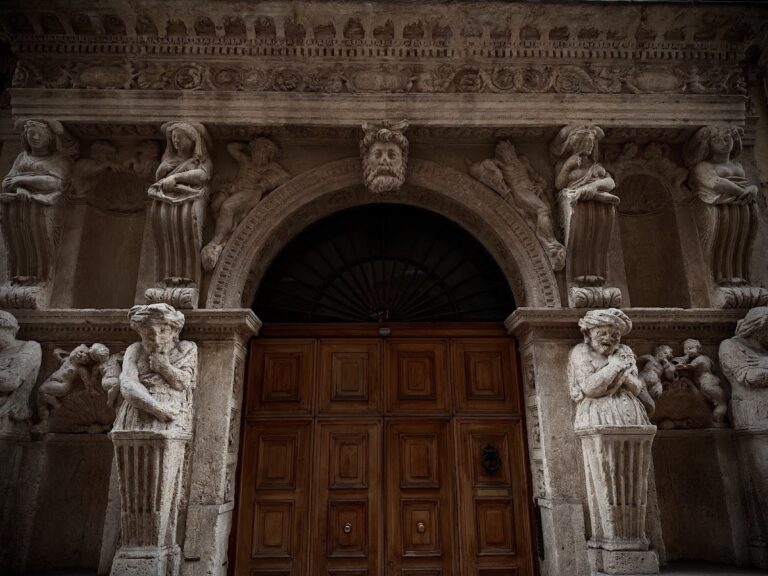
The original structure had two levels. Its upper floor contained a loggia, an open-sided gallery, overlooking a large internal courtyard. The courtyard could be reached by a monumental staircase that no longer survives. The principal entrance portal was probably replaced during the nineteenth-century restoration. It now opens into a spacious atrium connected with the courtyard through a loggia.
Garden and courtyard termination
The courtyard was once considerably deeper than it is today and ended in a large Baroque niche. This recess shelters the allegorical statue of Truth, attributed to the artist Francesco Filippini, and forms the termination of the original courtyard.
The present courtyard is divided into two smaller sections by a transverse building set on a loggia opposite the original fifteenth-century loggia. The garden statue and its niche belong to the period of Malaspina ownership, linking the surviving courtyard arrangement with the family’s alterations to the palace.
Monumental staircase
The interior monumental staircase was built after the external stairway was removed and lies to the right of the atrium. Its entrance is marked by a large statue of Mars, the Roman god associated with war. Putti, decorative childlike figures common in Renaissance and Baroque art, adorn the balustrade.
The staircase ceiling carries a painting of Jupiter and Apollo, attributed to Ludovico Dorigny. Jupiter was associated with supreme authority and the sky, while Apollo was linked with music, prophecy, healing, and the arts.
Nearby sites