Šrajbarski Turn Castle: A Renaissance Castle in Slovenia


Site at a Glance
- Rating
- 3.6
- Popularity
- Very Low
- Country
- Slovenia
- Primary era
- Early Modern
- Eras represented
- Early Modern
- Civilizations
- Habsburg, Holy Roman Empire
- Site type
- Military
- Remains
- Castle
On this page6 sections
History
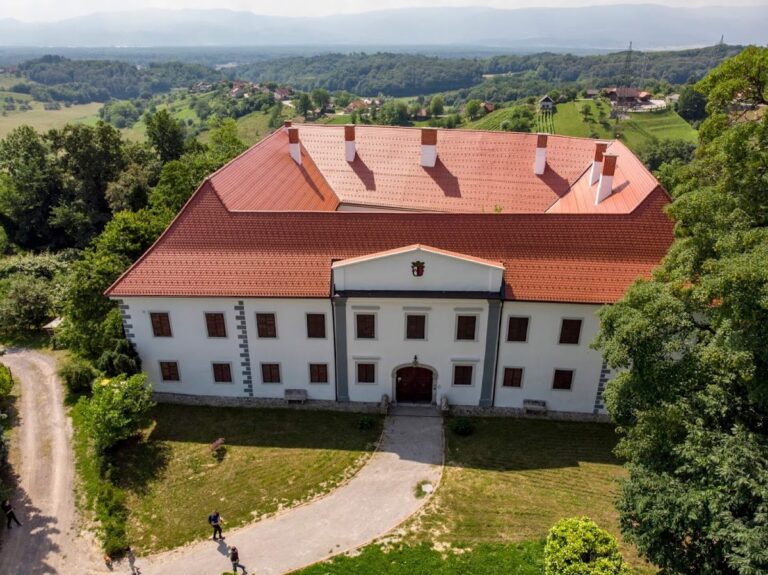
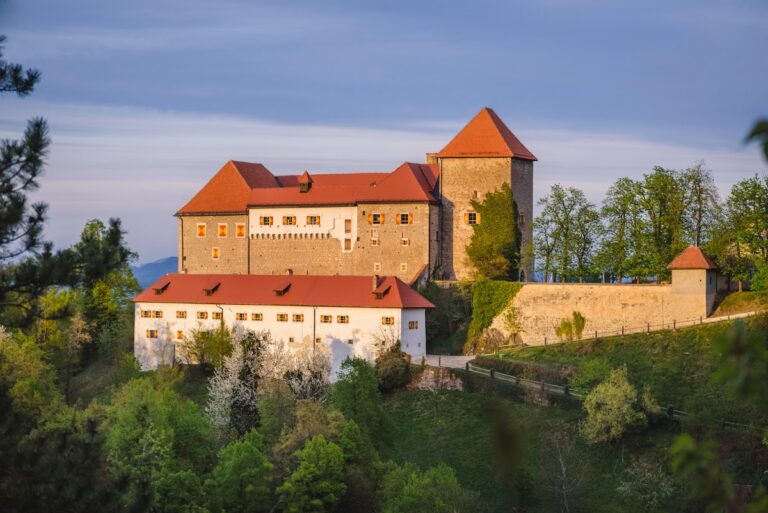
Šrajbarski Turn Castle, also known as Leskovec Castle, is a fifteenth-century castle in Slovenia, located north of Leskovec pri Krškem. Its present form developed chiefly during the second quarter of the sixteenth century, when the medieval site was reshaped as a centrally organized fortified residence.
Medieval Origins and the 1515 Revolt
Two manors on the site were first recorded in 1436. At that time, they were held by Baron Johann Dürrer von der Dur alongside the Counts of Celje, a powerful medieval and early-modern noble dynasty in the region. The manors were later sold to the Counts of Celje.
In 1515, peasant rebels captured and looted the castle. The attack formed part of a wider uprising against feudal obligations and authority. The castle was subsequently redesigned during the sixteenth century, and its present form was substantially complete by the middle of that century.
Changing Ownership and Later Development
After the Counts of Celje, Šrajbarski Turn passed through several owners. Baron Johann Baptist von Valvasor held it in 1581, followed by the Counts of Moscon. The House of Auersperg, another prominent Central European aristocratic family, owned the castle from 1653 to 1903. Later owners included Baron von Gagern and Dr. Trenz.
The castle was redesigned again during the eighteenth century. Its name refers to Turn, a word meaning “tower” that is ultimately related to the Latin turris and a Greek term for a fortified settlement. Because several Slovenian castles are called Turn, the epithet Šrajbarski Turn distinguishes this one from the others. The origin of that epithet is unknown, although it may be connected with an early owner.
In 1999, the Government of Slovenia declared Šrajbarski Turn Castle and its surrounding grounds a cultural monument of national importance.
Remains
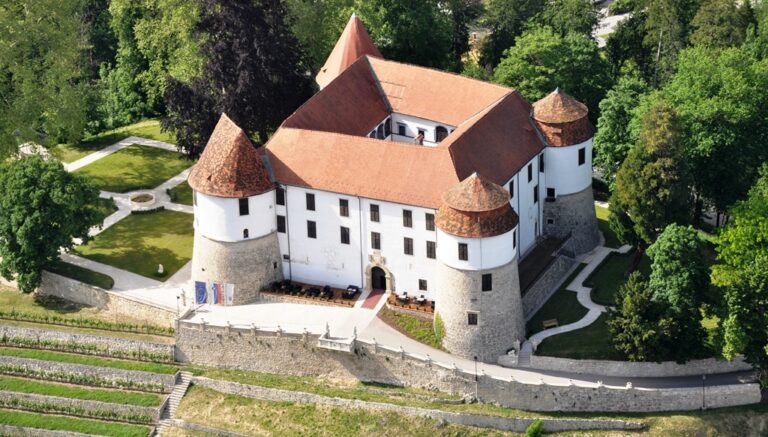
The castle has a rectangular inner courtyard enclosed by four residential wings. Corner towers reinforce the building, reflecting its centrally organized defensive architecture. The courtyard forms the principal architectural feature of the complex and is bordered by covered walkways made from successive arches, a design known as an arcaded courtyard.
Castle Courtyard and Heraldic Features
Above the main gate is a relief bearing the coat of arms of the Auersperg-Falkenhayn family, linking the entrance to the period of Auersperg ownership. The courtyard wall carries the arms of the noble Khysl family. Together, these heraldic elements preserve evidence of the aristocratic families associated with the castle.
Castle Park
The castle park dates from the seventeenth century and has a Renaissance design, a style that revived classical forms and proportions in European architecture. It contains a monument to Alfonz Paulin, a Slovenian botanist who lived from 1853 to 1942 and was the son of the castle warder.