Palazzo Pompei: A Renaissance Palace and Natural History Museum in Verona


Site at a Glance
- Rating
- 4.4
- Popularity
- Medium
- Country
- Italy
- Primary era
- Early Modern
- External website
- Open
- Eras represented
- Early Modern
- Civilizations
- Venetian
- Site type
- Domestic
- Remains
- Elite Residence
On this page7 sections
History
Palazzo Pompei is a Renaissance palace in Verona, Italy, designed by the Veronese architect Michele Sanmicheli and probably completed between 1535 and 1540. The Renaissance was a European cultural and architectural period that revived classical Greek and Roman forms, proportions, and architectural orders. Commissioned by the Lavezzola family, the palace became the last of three Renaissance palaces in Verona associated with Sanmicheli, following Palazzo Bevilacqua and Palazzo Canossa.
From the Lavezzola family to the Pompeis
The Pompei family acquired the palace in 1579 and retained it for more than two centuries. It later became the residence of Alessandro Pompei, a prominent Veronese scholar of Neoclassical architecture. Neoclassicism revived and reinterpreted ancient Greek and Roman architecture, and Alessandro’s association with the palace connected its Renaissance design with later architectural debate.
In the early 1830s, Alessandro and Giulio Pompei gave the palace to the Municipality of Verona after the family line became extinct. The municipality also acquired the adjoining Palazzo Carlotti. The palace’s composition influenced later Neoclassical and Neorenaissance architecture, which drew on Renaissance forms in subsequent periods.
Architectural influence and civic use
Palazzo Pompei’s façade served as a model for the Picture Gallery in Dresden, built by the German architect Gottfried Semper between 1847 and 1855. Semper, whose work helped shape historicist and Neorenaissance architecture, followed the same example for the Museum of Natural History and the Museum of Art History in Vienna. In 1754, the Prussian architect Carl Ludwig Hildebrandt built a palace in central Potsdam modeled on Palazzo Pompei and gave it the same name. That building was destroyed in 1945 and reconstructed in 2016 using three surviving original mascarons, sculpted ornamental faces used as architectural decoration.
Extensive restoration around the turn of the twentieth century adapted Palazzo Pompei for Verona’s Civic Museum of Natural History. The former owners’ art collection, which included a painting by Albrecht Dürer, was transferred to the Castelvecchio Museum. Dürer was a German Renaissance painter, printmaker, and theorist. Alessandro Pompei also created two large panels displaying carefully classified stones and marbles taken from the Verona area, but these works were later lost. Palazzo Pompei now accommodates the Civic Museum of Natural History.
Remains
Façade and classical design
The palace stands beside the Adige on Lungadige Porta Vittoria. Its imposing two-level façade combines a heavily treated lower storey with a more openly articulated upper level. The ground floor is faced with rusticated masonry, whose blocks have roughened surfaces and deeply recessed joints. A balustrade separates it from the piano nobile, the principal residential floor of an Italian palace, which incorporates the Doric order, the simplest of the main classical orders.
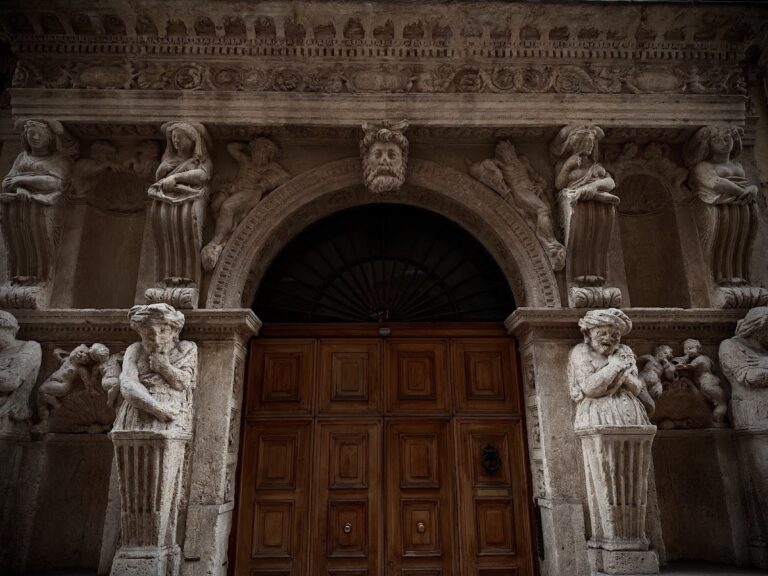
Two corner piers frame the upper storey, while eight fluted columns divide its broad composition. Seven large arched windows open between the columns. Each window has a balustrade, and a mascaron occupies its keystone. Above them, a tall cornice is decorated with triglyphs, vertically grooved blocks in a classical frieze. The cornice is unusual because the triglyphs lack an upper finishing molding.
Courtyard and circulation
Inside, a central axis divides the plan into two nearly symmetrical parts. A square courtyard occupies the middle and is enclosed on all four sides by a colonnade. An entrance vestibule provides access to the courtyard, while a monumental staircase on the vestibule’s left leads to the piano nobile. These elements preserve the palace’s ordered relationship between entrance, central court, and principal floor.
Civic Museum facilities and collections
The palace contains the Civic Museum of Natural History’s exhibition route, comprising more than fifteen exhibition rooms as well as a library, laboratories, storage areas, and administrative offices. The collections include fossilized plants and animals from the Monte Bolca area, mineralogical and petrographic material, taxidermied mammals and birds, amphibians, reptiles, insects, and paleontological specimens. Prehistoric and Bronze Age objects from the Lake Garda region are also held within the museum’s collections.