Palais Porcia: A Renaissance Palace and Government Residence in Vienna


Site at a Glance
- Rating
- 4.7
- Popularity
- Very Low
- Country
- Austria
- Primary era
- Early Modern
- Eras represented
- Classical, Medieval, Early Modern, Modern
- Civilizations
- Habsburg, Holy Roman Empire, Roman
- Site type
- Domestic
- Remains
- Elite Residence
On this page11 sections
History
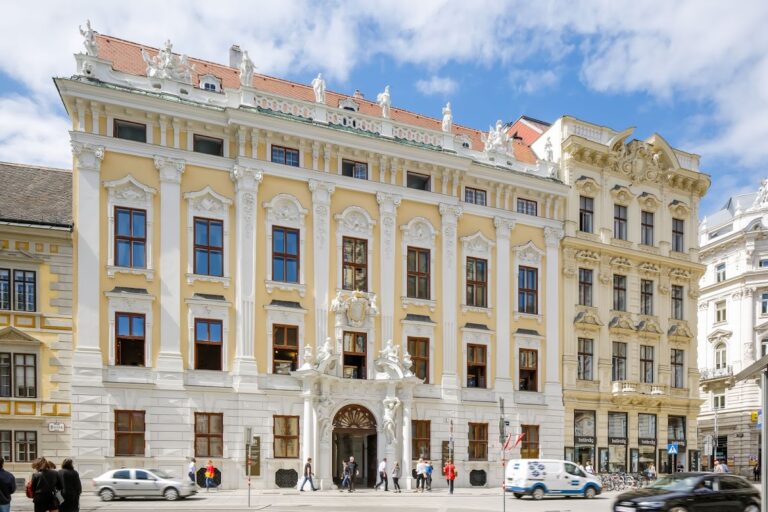
Palais Porcia is a Renaissance palace in Vienna, Austria, whose present aristocratic residence emerged in the sixteenth century above foundations dating to the Roman period. It stands in the western part of the Innere Stadt on Herrengasse, between Palais Kinsky and Palais Trautmansdorff and opposite Palais Harrach. The building is one of Vienna’s oldest surviving palaces and one of the few whose design was shaped by Renaissance influence.
Medieval foundations and Renaissance rebuilding
The first documented stone buildings on the site appeared in the fifteenth century. In the 1530s, the existing residences passed to Count Gabriel von Salamanca-Ortenburg, a Spanish count and general treasurer of the future Emperor Ferdinand I. He commissioned their reconstruction as a Renaissance palace. The work was completed in 1546, after his death.
The project joined older medieval structures with arcades to create a single aristocratic residence and gave the building a fashionable Renaissance facade. The Renaissance was a European movement that revived classical forms and proportions, and it became influential in Vienna during the sixteenth century.
Family ownership and changing styles
In 1592 the property passed to the Hofkirchen and Losenstein families, who retained it until 1627. Extensive alterations were carried out under Hans Wilhelm von Losenstein and Georg Andreas Freiherr von Hofkirchen and his wife, Margarete von Losenstein. A major remodelling in 1602 added early Baroque details to the original facade. Baroque architecture generally favored more elaborate movement and ornament than the Renaissance.
In 1627 the palace passed to Count Wratislav zu Fürstenberg, and in 1643 to the Jörger von Tollet family. During the 1660s it came to Count Johann Karl von Porcia, whose family gave the building its present name. Johann Karl was the son and heir of Johann-Ferdinand von Porcia, who became a prince of the Holy Roman Empire after 1662. The empire was a central European political complex whose senior ruler was an elected emperor, and a princely title within it represented high aristocratic status.
The palace survived the fire of 1683 that destroyed buildings around the nearby Freyung, a historic square in Vienna’s Innere Stadt. The Porcia family disposed of the property during the 1720s. It then passed to the statesman Bartholomäus von Tinti, who also owned Schallaburg.
State ownership and public use
In 1750, the imperial court of Maria Theresa of Austria acquired Palais Porcia, making it state property. Maria Theresa was the Habsburg ruler whose court purchased the palace. It remained state property at least through 2010 and later accommodated public institutions, including the Administrative Court, the Court of Audit, and the State School Board for Lower Austria.
These uses repeatedly changed the interior. In 1883, it was completely rebuilt for use as a courthouse. The Administrative Library of the Ministry of the Interior, founded in 1849, moved into Palais Porcia in 1925 after earlier relocations from ministry offices on Wipplingerstrasse to Marc-Aurel-Strasse in 1897 and Hoher Markt in 1898.
Since the establishment of the First Austrian Republic, the library has remained a branch of the Federal Chancellery, Austria’s central government office for coordinating federal administration. It holds reference materials on Austrian laws and regulations and houses the Chancellery’s information-technology centre. From 2000 it progressively took over and digitized collections from federal ministries, and in 2006 it became Austria’s principal uplink gateway to SourceOECD as an Austrian OECD depository. The last general renovation took place between 1991 and 1997, and the palace is protected as an Austrian historic monument.
Remains
Palais Porcia retains a relatively simple Renaissance arrangement formed by the integration of medieval structures with arcades. Its Renaissance facade was later modified with Baroque and Rococo elements, while the interior and circulation spaces reflect repeated adaptation for court, administrative, and library use.
Facade and courtyard
Herrengasse facade
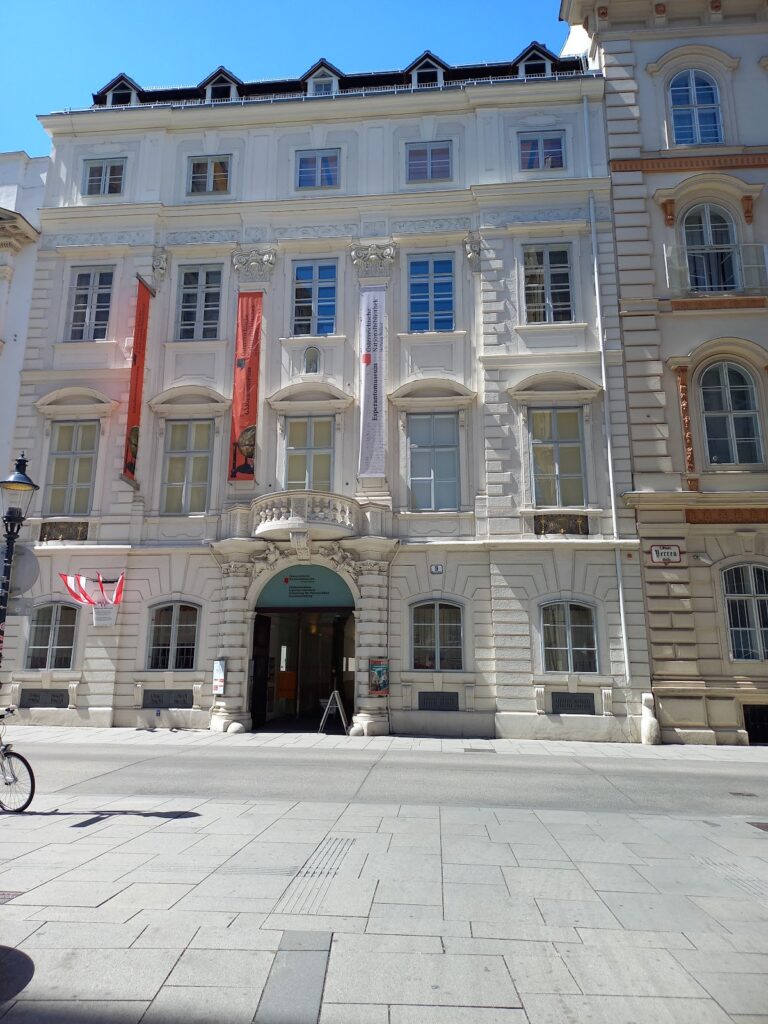
The facade facing Herrengasse presents the palace’s Renaissance character together with later Baroque and Rococo changes. A Habsburg coat of arms decorates its exterior. The front wing contains a large staircase, and the building’s present external form preserves the combination of earlier fabric and later stylistic remodelling.
Inner courtyard arcade
The inner courtyard retains an early Renaissance arcade. At the centre of the arcade are the coats of arms of Georg Andreas Freiherr von Hofkirchen and Margarete von Losenstein, linking the surviving architectural feature to the ownership and alterations of the late sixteenth and early seventeenth centuries.
Staircases and institutional interior
Ornate spiral staircase
The first courtyard contains an ornate spiral staircase with steps carved from Kaiserstein, a durable limestone historically quarried at Kaisersteinbruch. The staircase is one of the palace’s surviving interior architectural features.
Reconstructed interior
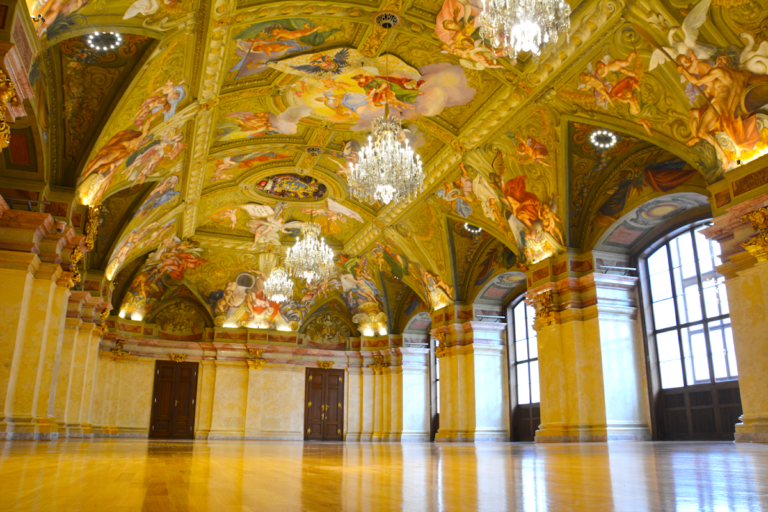
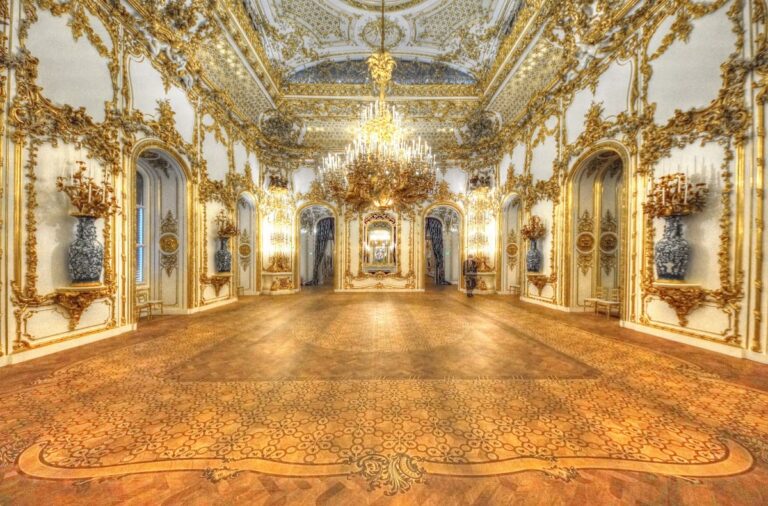
The palace’s interior was repeatedly altered for public institutional purposes and was completely reconstructed in 1883 for courthouse use. It was remodelled again before the Administrative Library moved into the building in 1925, followed by the general renovation of 1991 to 1997. As of 2010, the building housed the Administrative Library of the Austrian Federal Chancellery and the Chancellery’s information-technology centre.
Nearby sites