Palais Caprara-Geymüller: A Baroque Palace in Vienna


Site at a Glance
- Rating
- 4.8
- Popularity
- Very Low
- Country
- Austria
- Primary era
- Early Modern
- Eras represented
- Early Modern, Modern
- Civilizations
- Habsburg, Holy Roman Empire
- Site type
- Domestic
- Remains
- Elite Residence
On this page7 sections
History
Palais Caprara-Geymüller is a Baroque palace in Vienna, Austria, completed in 1698 for Field Marshal Count Enea Silvio von Caprara. Its design by the Bolognese architect Domenico Egidio Rossi followed contemporary Italian aristocratic-palace architecture, making the building one of Vienna’s oldest Baroque structures.
Construction and Caprara ownership
In 1687, Caprara, an aristocratic military commander in imperial service, purchased a house on the site at Wallnerstraße 8 and soon demolished it. He then commissioned Rossi to create a new palace. The building underwent structural changes in the early eighteenth century, including the installation of two Atlas statues in Eggenburg stone at the entrance. The Caprara family retained the property for almost a century.
Changes of ownership and the Geymüller period
Carl, Prince of Liechtenstein, acquired the palace in 1796, and it passed to Baron Wimmer the following year. In 1798, the French envoy Jean Baptiste Bernadotte rented the building. When he displayed the French tricolour during a celebration on 13 April, the act provoked popular unrest, and he was forced to leave Austria later that year.
Johann Heinrich and Johann Jakob Geymüller bought the palace at the end of 1798. The building thereafter became known as Palais Caprara-Geymüller. The brothers, members of Vienna’s affluent commercial elite, commissioned a redesign of the interiors in the Empire style, an early nineteenth-century neoclassical style associated with formal symmetry, monumental decoration, and imperial imagery.
Public and modern uses
After the financial collapse of the Geymüller bank, the palace was sold to the Barons Pouthon in 1897 and to the state of Lower Austria in 1905. Lower Austria opened a state museum there in early 1912. The building also accommodated the consular department of the British Embassy.
The present owner, a real-estate company, carried out a general renovation under the architect Alois Machatschek between 1986 and 1988. The palace served as the premises of the Syrian Embassy until 2000. Since 2001, it has housed the Vienna Stock Exchange and associated companies. Bronner Online AG moved into the building in April 2007, followed by the Austrian branch of Thomson Financial in October of the same year.
Remains
Exterior and entrance
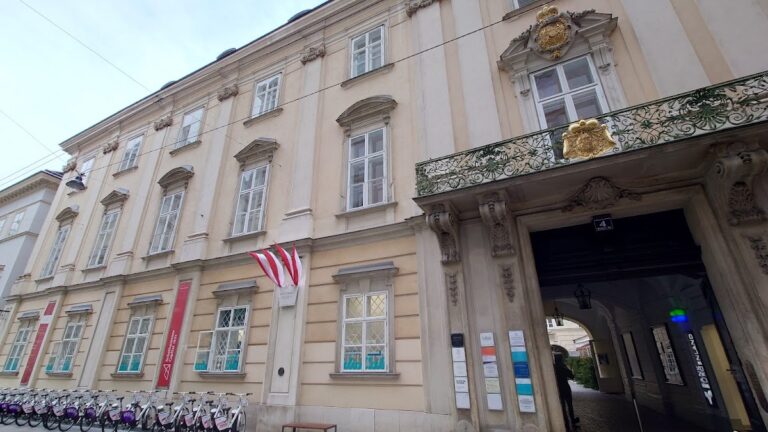
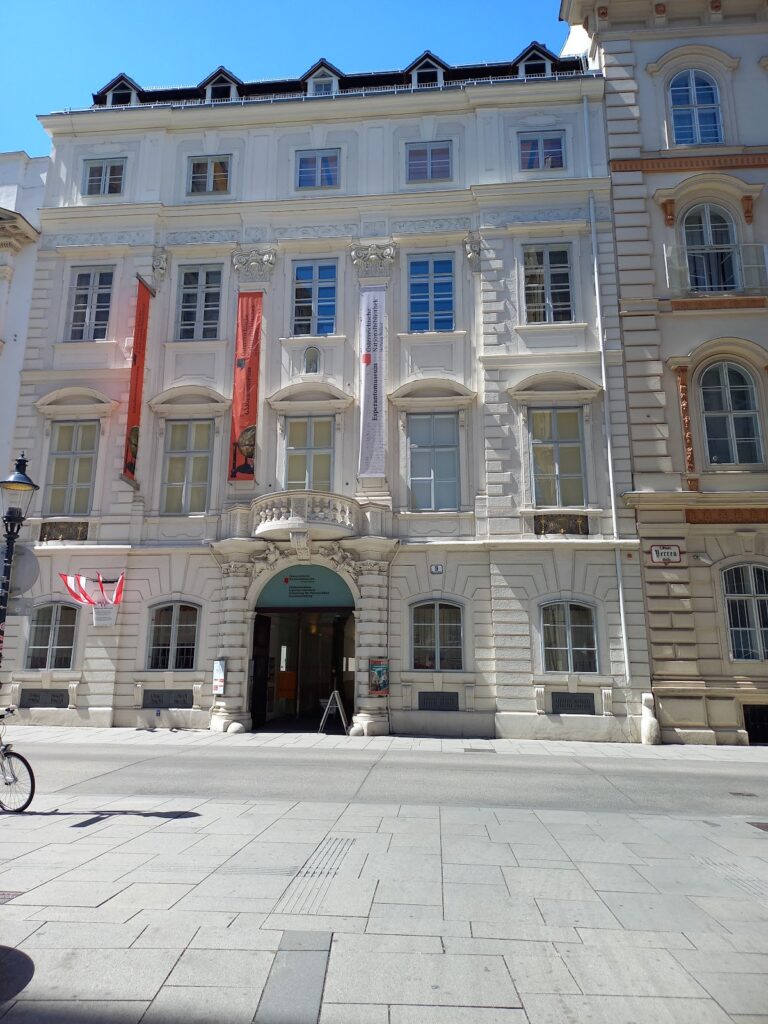
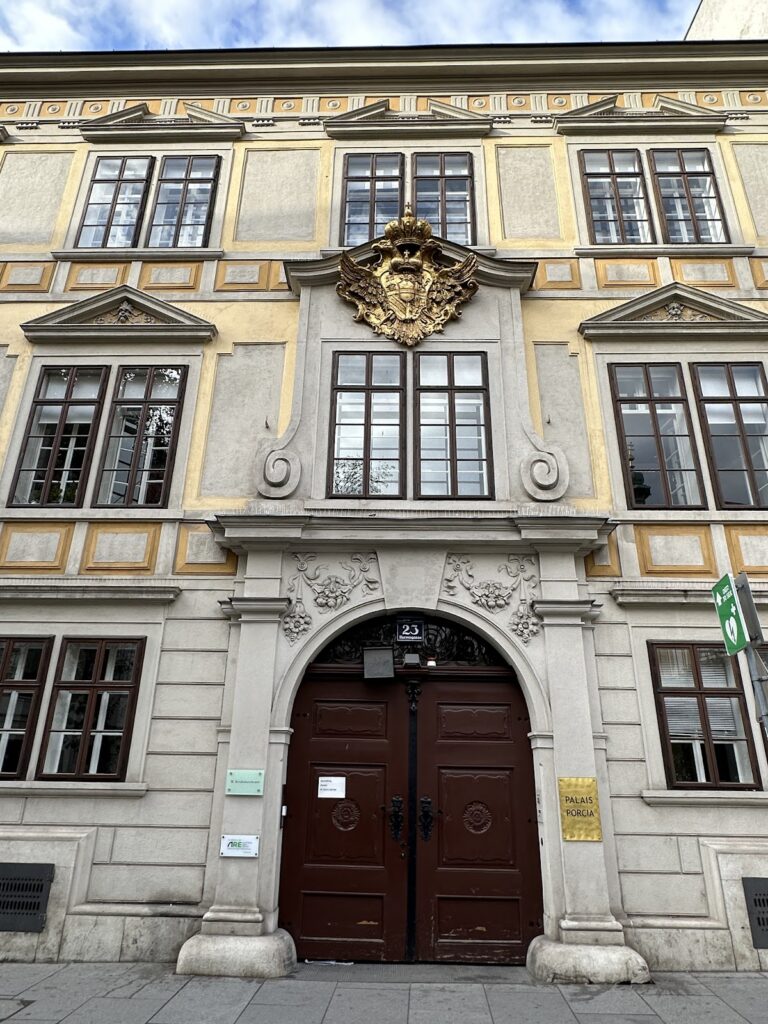
Palais Caprara-Geymüller has an atypical Baroque form for Vienna, although its massive appearance was considered to integrate successfully into the cityscape. The facade is arranged around a five-axis central projection flanked by two two-axis side projections. Cornices above the storeys provide horizontal articulation, while the windows of the piano nobile, the principal ceremonial floor above the ground level, alternate between triangular pediments and round arches. This strict separation of the storeys reflects the building’s Italian architectural model.
Hard Kaiserstein, a durable stone quarried at Kaisersteinbruch, was used for the entrance portal, cornices, steps, and other architectural elements. Two Atlas statues flank the entrance gate and support the balcony above it. An Atlas is a male figure used as an architectural support, often carrying a balcony or similar structure. The statues are made of Eggenburg stone.
Interior spaces
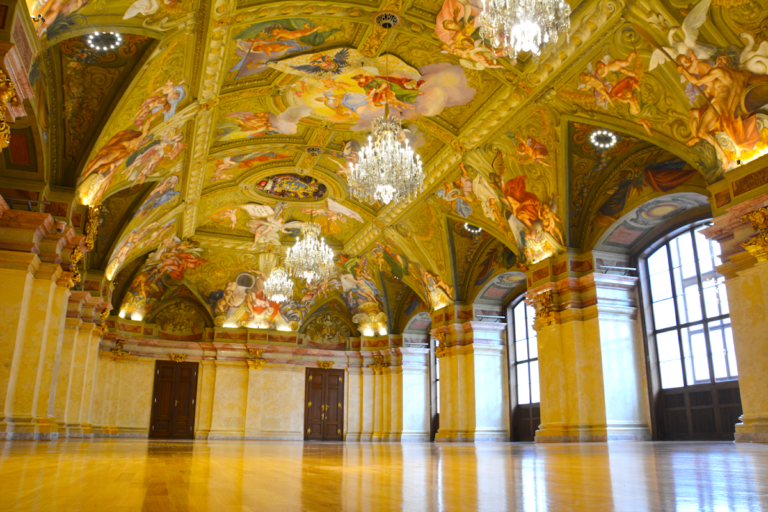
The entrance hall is a broad transverse columned space. From it, a three-arm staircase rises to the first floor. The former ballroom once extended across the entire length of the building. It is now subdivided, and restoration revealed that its walls had been almost completely covered with architectural paintings.
Only two rooms retain the palace’s high-quality Empire-style interior furnishings: the Geymüller Salon and the Pompeian Room. The Pompeian Room is now held in the Wien Museum, while the Geymüller Salon remains one of the surviving interiors associated with the palace.