Manor House in Bełcząc: A Classicist Estate Residence in Poland


Site at a Glance
- Rating
- 4.7
- Popularity
- Very Low
- Country
- Poland
- Primary era
- Modern
- Eras represented
- Modern
- Civilizations
- Russian
- Site type
- Domestic
- Remains
- Manor House
On this page7 sections
History
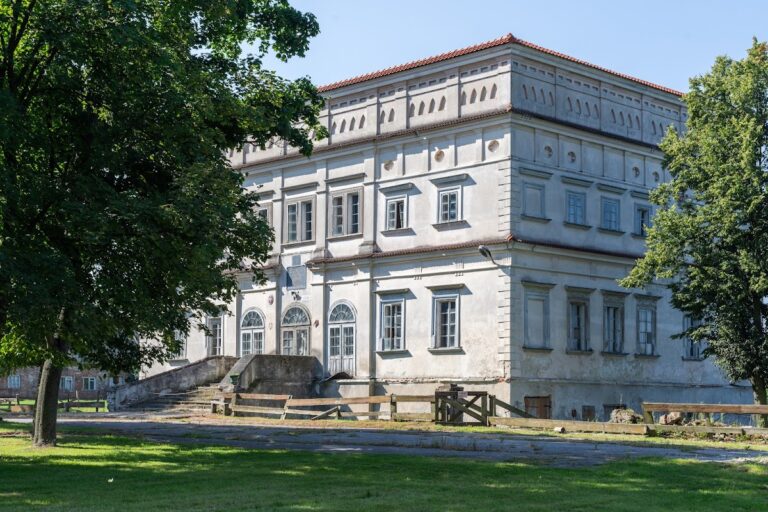
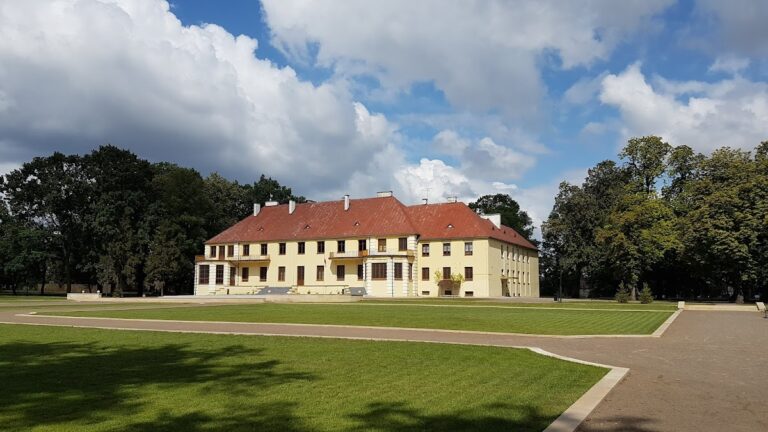
The manor house in Bełcząc, Poland, is a Classicist residence built at the turn of the nineteenth and twentieth centuries during the period of the Raczyński family. It formed part of a manorial farm estate whose origins reach back to the sixteenth century and stands in the western part of the settlement.
The Earlier Estate
A manorial farm estate existed at Bełcząc in the sixteenth century. In the early nineteenth century, Aleksandra Radziwiłłowa, née Stecki, a Polish noblewoman of the Radziwiłł family, rebuilt the estate according to plans by the German agronomist Thaer. A manager’s manor was probably positioned between the farm buildings and the garden, on one of the garden’s axes. Before 1880, a brick brewery was constructed south of this earlier manor.
The Raczyński Manor
A new manor and a group of farm buildings were erected at the turn of the nineteenth and twentieth centuries, when the estate belonged to the Raczyński family. The new residence stood northeast of the earlier manor. The former farm-building area later contained four-family workers’ houses, a form of housing provided for agricultural laborers.
During the interwar period, a small extension with a cellar was added to the manor. Szafrański and Michalski leased the estate during the 1920s and 1930s. The Second World War brought another change of use: German units were quartered in the building. In July 1944, Soviet forces burned the cowshed and barn, and from August 1944 until the end of 1945 the manor housed a Soviet military driving school.
Postwar Uses and Protection
After the occupation, the building contained a shop and a dairy run by the local cooperative until 1950. During this period, the manor and park progressively deteriorated. After 1950, the building was used as a primary school. The workers’ houses and most of the farm buildings were demolished during the 1950s.
The manor was renovated around 1968, when a cowshed, utility building, toilet, and refuse shed were erected nearby. A further renovation was completed in 2019. The building is entered in the heritage register of the Lublin Voivodeship as A/1285; it was previously registered as A/193 on 7 October 1991.
Remains
The Manor House
The single-storey, plastered brick manor occupies a rectangular plan in the western part of Bełcząc, with its roof ridge running parallel to the road. Its Classicist design uses flat vertical strips at the corners, while the front elevation has nine bays and the rear elevation eight. A half-hipped roof, whose sloping end sections are shorter than those of a fully hipped roof, is covered with galvanized sheet metal. Its rafter structure includes collar beams and a double standing queen-post frame with braces.
Porches mark both the front and rear elevations. The front porch rests on two pairs of Tuscan columns, a plain classical type with smooth shafts and simple capitals, while the rear porch is supported by two columns. A rectangular extension is attached to the northern side. Inside, the rooms follow a two-bay arrangement, with doorways aligned in an enfilade, a sequence of rooms forming a continuous view through their entrances. A corridor runs between the two bays in the northern part. The rooms have wooden ceilings, while the cellars contain barrel vaults and groin vaults. The original interior furnishings have not survived.
Garden and Estate Features
A former watercourse crossed the garden before being converted into a ditch connected with fishponds east of the farm. During the interwar period, a swimming pool was dug in the western part of the gardens, and the park was enclosed by a wooden fence. The tree stands later deteriorated, the pool dried up, and a school sports field was laid out in the northwestern part of the park.