Zografou Monastery: A Bulgarian Orthodox Monastery on Mount Athos


Site at a Glance
- Rating
- 4.9
- Popularity
- Low
- Country
- Greece
- Primary era
- Early Modern
- External website
- Open
- Eras represented
- Medieval, Early Modern
- Civilizations
- Bulgarian, Ottoman, Principality of Moldavia
- Site type
- Religious
- Remains
- Fortified Monastery
On this page18 sections
History
Zografou Monastery, officially the Monastery of Saint George Zograf, is a Bulgarian Orthodox monastery on Mount Athos in Greece, founded in the Byzantine period and traditionally dated to 919. Dedicated to Saint George, it holds ninth place in the hierarchy of the twenty principal Athonite monasteries. It is a stavropegic institution, meaning that it answers directly to the Ecumenical Patriarchate rather than to the local metropolitan.
Foundation and early Bulgarian identity
Monastic tradition attributes the foundation to three brothers from Ohrid, Moses, Aaron, and John, who became monks during the reign of Byzantine Emperor Leo VI. They first lived in separate cells before creating a common monastery. The earliest documentary mention of Zografou dates to 980. The Athonite typikon, or monastic rule, of 972 bears the signature of Georgios the Painter, probably the leader of the community that later developed into Zografou, although the document does not identify him as an abbot.
The monastery’s name comes from a tradition associated with its foundation. After the brothers failed to agree on a patron saint, they left a wooden panel blank. An image of Saint George was said to have appeared on it overnight, leading to the dedication of the church and the epithet Zograf, meaning “painter.” The official name therefore combines the saint’s name with this traditional account of the miraculous image.
The community became predominantly Bulgarian by the thirteenth century. Bulgarian monks are explicitly mentioned from 1169, and they later formed the majority, although Greeks, Serbs, Russians, Vlachs, and Ukrainians also joined the monastery. The brotherhood was described as exclusively Bulgarian by 1845, and Bulgarian monks from Hilandar entered the community after 1896.
Attacks, destruction, and medieval patronage
On 10 October 1276, twenty-six monks and laymen were burned in the monastery tower after opposing the proposed union of the Orthodox and Catholic churches associated with the Second Council of Lyon. The attack is attributed in monastic tradition to Latin or Catalan crusaders. The date is commemorated as the feast of the Zografou martyrs.
The Catalan Company, a mercenary force active in the eastern Mediterranean, plundered and devastated Zografou between 1307 and 1309. The monastery was burned in 1308. Recovery followed with assistance from Bulgarian rulers, Byzantine emperors of the Palaiologan dynasty, and other rulers of southeastern Europe. Ivan Alexander of Bulgaria became a ktitor, a founder or major benefactor, in 1342. The monastery also received support from Andronikos II, Michael IX, and John V Palaiologos.
During the Second Bulgarian Empire, the medieval Bulgarian state that flourished from the late twelfth century until the Ottoman conquest, Zografou received donations from Ivan Alexander and possibly from Ivan Asen II and Kaliman I Asen. These benefactions, together with Byzantine support, gave the monastery lands and villages in several parts of Macedonia, especially along the lower Struma River.
Ottoman rule and Moldavian support
The Athonite monasteries submitted voluntarily to Ottoman rule in 1387 and 1424. Their estates and communities therefore passed through the Ottoman conquest while paying an annual tax. Zografou prospered during the late fifteenth century under the patronage of Stephen the Great, the ruler of Moldavia and a major supporter of Orthodox institutions.
Stephen financed the monastery’s former refectory in 1495 and the narthex, or entrance vestibule, of the older principal church in 1502. He also paid for a harbor building in 1475 and supported later construction and restoration. His son Bogdan III added a defensive tower to the harbor building in 1517. Other Moldavian rulers, including Alexander, Elijah I, Stephen II, Peter Rares, Peter the Lame, Jeremiah Movila, Vasile Lupu, and Antiochus Cantemir, also made donations.
Zografou became stavropegic in 1521, placing it directly under the Patriarchate of Constantinople instead of the metropolitan of Thessaloniki. In 1568, Sultan Selim II ordered the confiscation of church properties throughout the Ottoman Empire. Zografou had to buy back its estates with assistance from Roxandra, the widow of Moldavian prince Alexander Lapușneanu.
The monastery received the Moldavian monasteries of Dobrovat in 1651 and Capriani in 1698. Capriani and its dependent lands provided income until 1813, when the property was taken after Bessarabia became part of the Russian Empire in 1812. From the seventeenth and eighteenth centuries, Zografite monks periodically travelled to Russia to seek financial help. In 1818, Anatoly and Haji Vikenty went to Saint Petersburg to request the return of Capriani. Emperor Nicholas I restored the Bessarabian property on 6 March 1837 and granted the monastery 500,000 rubles.
Reorganization and modern changes
After the Greek uprising of 1821, Ottoman troops occupied the Athonite monasteries until 1830. Albanian troops stationed at Zografou harassed and extorted the brotherhood, compelling the monks to pawn or sell manuscripts, valuables, and ornaments from miraculous icons. The monastery restored its communal organization on 23 April 1849 after abandoning it around 1800. Under this system, which remains in force, the monks hold no private property, use the monastery’s possessions collectively, and elect their abbot.
Zografou lost capital deposited in a Saint Petersburg bank during the First World War. Its Russian and Romanian properties had already been nationalized in 1863 and 1864, while the Greek government confiscated its estates in northern Greece in 1923 to settle refugees from Asia Minor. King Boris III of Bulgaria donated properties in Sofia and Plovdiv and established the Zografou Ephoria in 1926. An ephoria is an administrative body responsible for institutional property and affairs. By the beginning of the twenty-first century, its holdings included the Bavarian House and another building in Sofia, a building in Plovdiv, and land and forest near the village of German.
Zografou was associated with Bulgarian religious and literary figures including Theodosius of Tarnovo, Euthymius of Tarnovo before his election as patriarch, Cosmas Zografite, and Pimen Zografite. Paisius of Hilandar completed his Slavo-Bulgarian History at the monastery in 1762. The Ukrainian church writer Ivan Vyshensky lived there around 1610, and Moldavian visitors came in 1503, 1532, and 1640 to copy books unavailable in their homeland.
A fire destroyed the southern wing on 21 December 1976. Documentation, conservation, and restoration work continued in phases from 1980 to 2000, with restoration of the southern wing under way from 1997 according to a project by Hristo Ganchev, Angelmir Angelov, and Ivan Velikov. In 1988, Zografou became part of the UNESCO World Heritage property covering the medieval monuments of Mount Athos. A digitization project for the archives and manuscripts began on a small scale in 2014, followed by a ten-year cooperation agreement with Sofia University in 2017 to develop a digital Zograf archive.
In 1985, Bulgaria’s State Security service removed Paisius’s manuscript from the monastery in an operation known as Marathon. Bulgarian President Petar Stoyanov returned the original in 1998. The monastery commemorates Saint George on 23 April and the Zografou martyrs on 10 October. A 2009 record listed 21 monks and 10 novices, while other descriptions give a community of approximately 37 monks, characterized as Bulgarian in origin.
Remains
Mountain setting and fortified enclosure
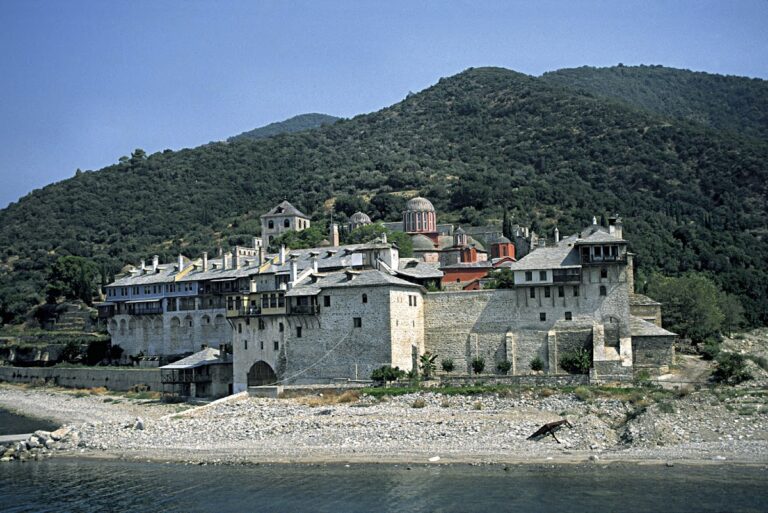
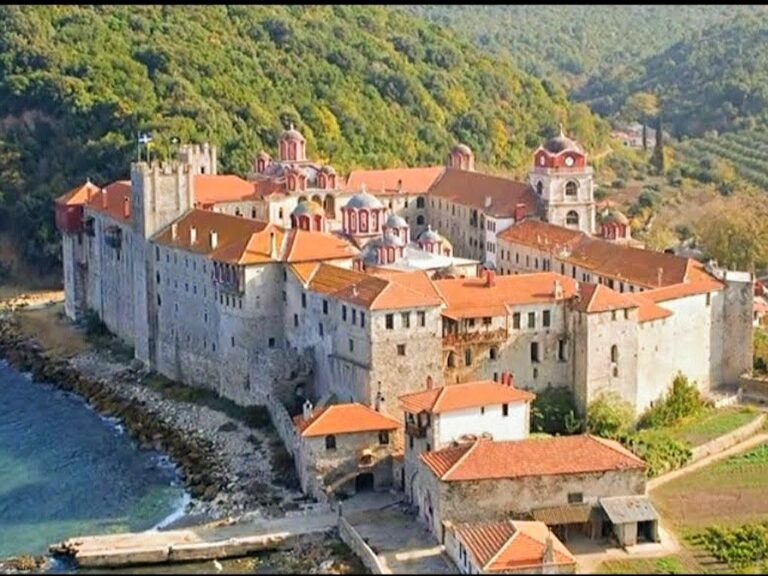
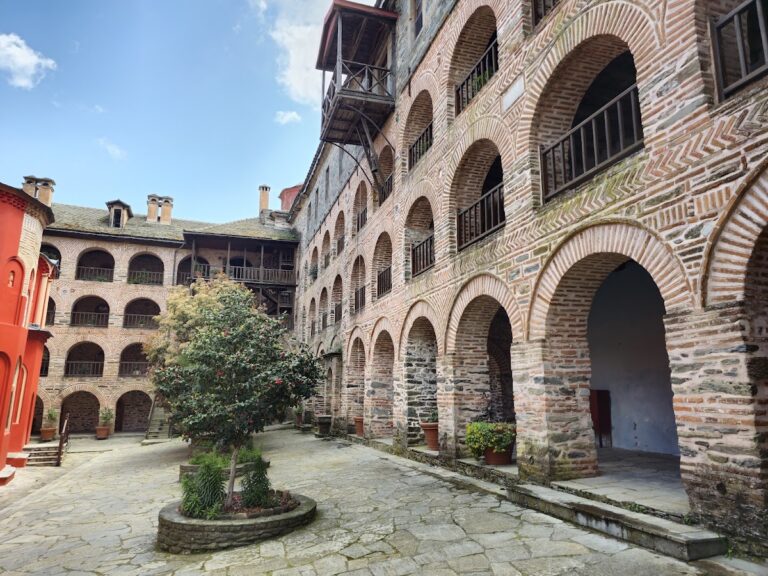
Zografou is the northernmost Athonite monastery, positioned on the southwestern side of Mount Athos at approximately 152 metres above sea level. It stands on a mountain slope above the ravine of the Zografitikos Lakos stream. The complex takes the form of a fortified quadrangle, with residential and service wings enclosing a courtyard. Much of the visible fabric reflects rebuilding and expansion during the eighteenth and nineteenth centuries.
Southern and eastern wings
The southern wing probably dates from the beginning of the eighteenth century. The eastern wing, known as the Bansko quarter, was built in 1758, largely through the patronage of Haji Valcho of Bansko. Together, these ranges form part of the residential and working enclosure that surrounds the central courtyard.
Northern and western wings
The northern wing was constructed between 1860 and 1865. The western wing completed the quadrangle. Its northern third dates from 1883, while its central section contains a new refectory built between 1893 and 1895. The Church of Saints Cyril and Methodius rises above this refectory, linking the later residential complex with the monastery’s Bulgarian religious identity.
Churches and chapels
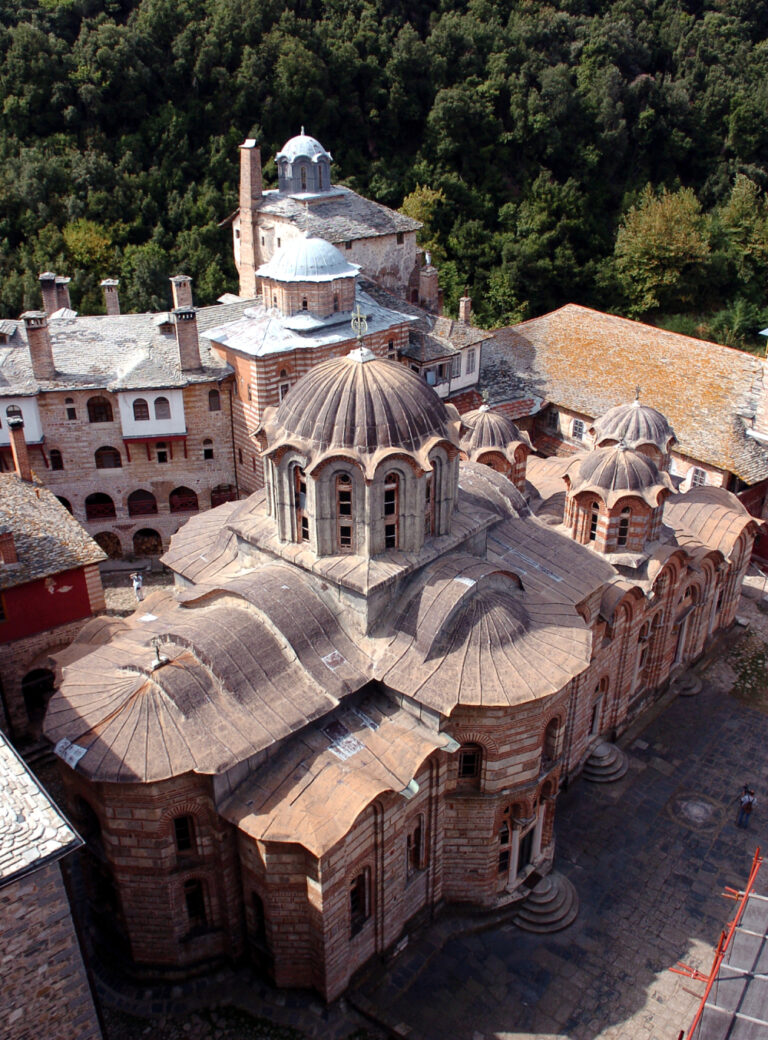
The enclosure contains three churches and six chapels, while eight additional chapels stand outside it. Their wall paintings include Bulgarian saints such as John of Rila, Cyril and Methodius, and Naum of Ohrid. The principal church is the Church of Saint George, built in 1801. Its interior includes wall paintings from 1817 and a carved wooden iconostasis made in 1834.
Church of the Dormition
The small Church of the Dormition of the Virgin was built in 1764. It forms part of the monastery’s group of churches and chapels dating from the period when the enclosure was being expanded and rebuilt.
Wing chapels
The residential wings contain the eighteenth-century chapels of Saint Demetrius and the Transfiguration. The Chapel of the Nativity of Saint John the Baptist was painted in 1768, and the Transfiguration chapel received renewed wall paintings in 1869. The nineteenth-century chapels are dedicated to Saint Cosmas Zografite, the Holy Archangels, and the Twenty-Six Zografou Martyrs.
External churches
The cemetery Church of the Annunciation of the Virgin was built in 1773 outside the main enclosure. A smaller Church of Saint George, dating from around 1849, marks the place where tradition says that one of the monastery’s Saint George icons stopped when it arrived.
Courtyard structures and harbor
The clock tower and belfry were first built in the eighteenth century and enlarged in 1810 and 1896. A fountain made in 1783 stands in the courtyard, together with a monument to the Zografou martyrs erected in 1873. A covered holy-water installation was built there in 1899.
Earlier buildings and later replacements
Stephen the Great funded the former refectory in 1495 and the narthex of the former principal church in 1502. Later buildings replaced both structures, while their dates and patronage remain part of the monastery’s architectural history.
Harbor buildings
The harbor retains a building erected in 1475 as a shelter for ships. Bogdan III added its defensive tower in 1517. The harbor was plundered in 1644, apparently by western European pirates, and its buildings appear to have been damaged by a major earthquake in 1797.
Library and manuscript collection
The library holds several hundred Greek and Slavonic manuscripts and more than 8,000 printed books. Among its manuscripts are the eleventh-century Zograf Leaves, the decorated Radomir Psalter, the Dragan Menologion, the Laloev Apostle of 1359, the Bratan Menologion, two service books associated with Euthymius, the Zograf Commemorative Book, Ivan Alexander’s Zograf Charter of 1342, and the Vitosha Charter.
The collection also preserves the draft of Paisius of Hilandar’s Slavo-Bulgarian History, completed in 1762, along with other manuscripts and archival documents. The Zograf Gospel, an important Old Church Slavonic Gospel manuscript, was discovered at the monastery in 1843. It was given to Tsar Alexander II in 1860 and is now held by the Russian National Library in Saint Petersburg. The manuscripts, charters, icons, wall paintings, and commemorative monuments together preserve evidence of Zografou’s Bulgarian religious, literary, and institutional history.
Saint George images and commemorative traditions
Several traditions concern miraculous images of Saint George. One identifies the principal image with the panel that received the saint’s likeness at the foundation of the monastery. Another connects it with an image formerly kept at Phanuel in Palestine, which was said to have disappeared after the Arab conquest and later reappeared at Zografou. A silver covering made in Saint Petersburg in 1837 gives a foundation date of 898 and attributes the first construction to three descendants of Justinian the Great. These details belong to the inscription’s tradition and differ from the monastery’s foundation tradition dating to 919.
A second Saint George icon is traditionally said to have arrived by sea from Arabia. It was believed to have appeared first at the harbor of Vatopedi before moving to Zografou. Its silver covering, dated 1822, records donations from Slavic-Bulgarian merchants based in Odessa. Another silver inscription, made in Saint Petersburg in 1838, connects the image with Stephen the Great’s appearance at the monastery in 1484 and with his subsequent renewal of the foundation.
A further tradition links a Saint George image with Stephen’s victory over the Ottomans. In the story, Saint George appeared to the Moldavian ruler in a dream, promised victory, and instructed him to restore the neglected monastery and send the icon there.
The image associated with the Akathist miracle is a wall painting in the altar area of the principal church rather than a separate movable icon. Tradition says that it appeared before an unnamed hermit reciting the Akathist hymn, an Orthodox devotional poem, and later warned the monastery of a papal attack. The episode was represented in a copper engraving made at Karyes in 1834. Another wall painting in the principal church is associated with Saint Cosmas Zografite, who was said to have received instructions from an image of the Virgin to withdraw into solitude and silence.