Palazzo della Pilotta: A Farnese Ducal Complex in Parma


Site at a Glance
- Rating
- 4.6
- Popularity
- Medium
- Country
- Italy
- Primary era
- Early Modern
- External website
- Open
- Eras represented
- Medieval, Early Modern
- Civilizations
- Unclassified
- Site type
- Civic
- Remains
- Palace
On this page13 sections
History
Palazzo della Pilotta, also known as La Pilotta, is a Renaissance building complex in Parma, Italy, developed under the Farnese dukes from around 1580. Built between Piazzale della Pace and the Parma River, it was intended to provide the service buildings and cultural spaces supporting the ducal residence. Its name recalls pelota, a traditional ball game of Basque origin played by Spanish soldiers in the Courtyard of the Guazzatoio.
Visconti and Farnese foundations
Parma came under the rule of the Visconti family in 1346. This Milanese ruling dynasty was responsible for the construction of the Rocchetta Viscontea beside the Parma River, a defensive tower that protected the city entrance from the bridge. Traces of the tower remain visible along the riverbank and form an earlier layer of the site’s history.
Around 1580, during the final years of Ottavio Farnese’s rule, work began around the Corridore, a long connecting passage supported on pillars. The passage linked the Rocchetta Viscontea with the ducal palace, at a time when the court occupied buildings that were largely temporary. Giovanni Boscoli, an artist from Tuscany, is the only participant in this phase whose involvement is documented. The wider project is probably attributable to Francesco Paciotto, a military architect whom Ottavio invited to Parma in 1580.
Expansion under Ranuccio I
In 1602, Ranuccio I Farnese entrusted the building campaign to Simone Moschino, an architect and sculptor. Construction continued until 1611, when the complex remained incomplete. The planned façade toward what is now Piazza Ghiaia was not built, leaving the architectural ensemble with an unfinished appearance.
The project was conceived as an extensive support centre for the ducal residence. Its proposed facilities included a large hall later transformed into the Teatro Farnese, stables, mule stables, carriage facilities, accommodation for grooms, a riding ground, a wardrobe, an Academy hall, and galleries enclosing the courtyards. The Dominican church of San Pietro Martire stood within the first courtyard and remained there during the original building campaign.
Later transformations and wartime damage
After the decline of the Farnese family, Filippo I of Bourbon helped revive parts of the complex. During the transfer of Farnese possessions, Charles I of Bourbon, later Charles III of Spain, moved Farnese assets and collections from Parma and Rome to Naples. These transfers altered the relationship between the Pilotta and the ducal collections that had helped define its purpose.
In the second half of the nineteenth century, the Teatro Reinach was built on the former site of San Pietro Martire and opened in 1871. It became the Teatro Paganini in 1939. An air raid in May 1944 almost completely destroyed the theatre and damaged parts of the Pilotta. The theatre was later demolished, while the former Palazzo Ducale, also severely damaged in the raid, was demolished after the war.
Modern civic and cultural role
Between 1986 and 2001, the area of Piazzale della Pace was redeveloped after a prolonged planning process directed by the Swiss architect Mario Botta. The work created a large garden and a fountain following the perimeter of the former church of San Pietro Martire. Today the complex belongs to Italy’s Ministry of Culture and, since 2016, has formed part of Italy’s museum institutions with special autonomy. From 1 June 2024, the Antica Spezieria di San Giovanni, Torrechiara Castle, and the Lugagnano Archaeological Park and Veleia Antiquarium also came under the Pilotta complex.
The present institution brings together the National Archaeological Museum of Parma, the National Gallery of Parma, the Teatro Farnese, the Biblioteca Palatina, the Bodonian Museum, and the Paolo Toschi State Art School. The Biblioteca Palatina is Parma’s historic Palatine Library, while the Bodonian Museum preserves the work and legacy of the printer and typographer Giambattista Bodoni.
Remains
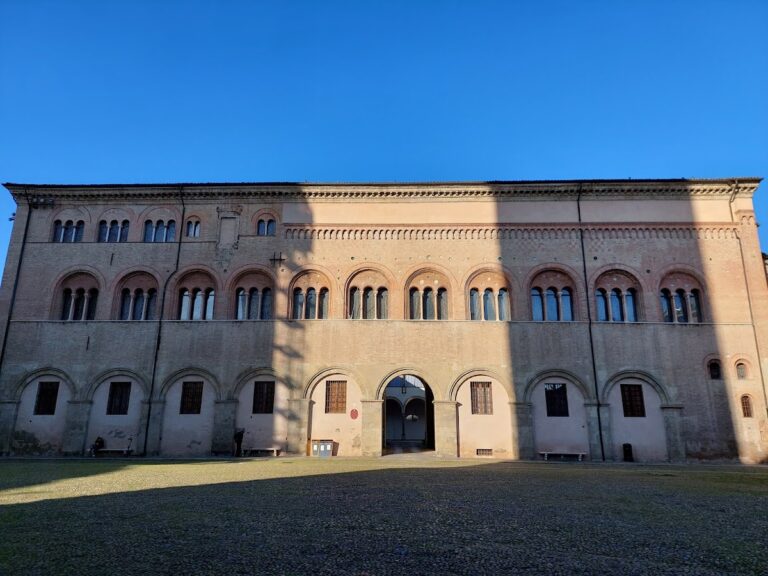
The Pilotta occupies the space between Piazzale della Pace and the Lungoparma, with its Renaissance layout organized around the Corridore, a long linear passage carried on pillars. Three courtyards structure the ensemble: the Courtyard of San Pietro Martire, now generally called the Courtyard of the Pilotta; the Courtyard of the Guazzatoio, originally the pelota courtyard; and the Courtyard of the Rocchetta. Characteristic vaulted arcades and pedestrian paths from Via Garibaldi toward the palace form part of the surviving architectural setting.
Courtyards and principal structures
Courtyard of the Pilotta
The Courtyard of San Pietro Martire, now known as the Courtyard of the Pilotta, occupies the area associated with the Dominican church that stood within the first courtyard. The original building plan incorporated the church site into the larger complex, while the later Teatro Reinach and Teatro Paganini occupied the same location before their destruction and demolition.
Courtyard of the Guazzatoio
The Courtyard of the Guazzatoio takes its name from the pelota game played there by Spanish soldiers. It is one of the three principal courtyards around which the complex is arranged and is enclosed by the Pilotta’s characteristic arcaded construction.
Courtyard of the Rocchetta
The Courtyard of the Rocchetta preserves the name of the earlier Rocchetta Viscontea, whose remains stand beside the Parma River. The surviving traces of the defensive tower connect the Renaissance ducal complex with the Visconti fortification that protected the city entrance from the bridge.
Former church site and surrounding features
San Pietro Martire site
Piazzale della Pace now contains a garden and a fountain laid out along the perimeter of San Pietro Martire. This treatment marks the former church footprint within the redeveloped urban space and relates it to the first courtyard of the Pilotta.
Piazzale della Pace and monuments
The area around the complex includes Piazzale della Pace, a large grass-covered urban space used as a meeting place. Associated features include the Monument to Giuseppe Verdi and the Monument to the Partisan. Together with the garden and fountain, they form part of the civic landscape surrounding the surviving palace complex.
Nearby sites