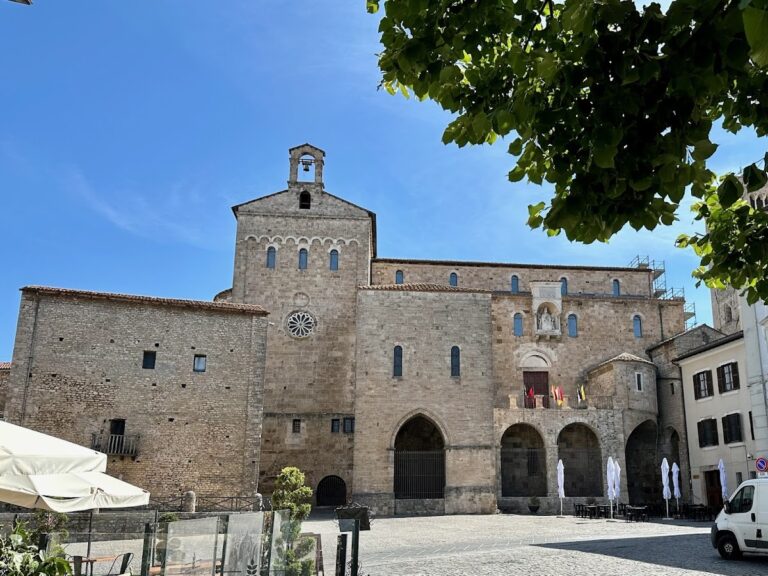
Ferentino Cathedral: A Roman Catholic Co-Cathedral in Italy


Site at a Glance
- Rating
- 4.7
- Popularity
- Low
- Country
- Italy
- Primary era
- Medieval
- External website
- Open
- Eras represented
- Medieval, Modern
- Civilizations
- Papal States
- Site type
- Religious
- Remains
- Cathedral
On this page18 sections
History
Ferentino Cathedral is a Roman Catholic cathedral in Ferentino, Italy, dedicated to Saints John and Paul, the second-century Roman martyrs. It stands on the ancient acropolis above the remains of a Roman temple. The medieval church was begun in the ninth century and its present structure was completed in the twelfth century, with a plain Romanesque facade and later alterations that reflect its long religious history.
Foundation and Medieval Renewal
The first church on the acropolis was built during the pontificate of Pope Paschal I, whose period in office lasted from 817 to 824. Construction began in the ninth century. At the beginning of the twelfth century, Bishop Agostino of Ferentino undertook extensive renewal and internal refurbishment, establishing the main form of the building that survives today.
After these works, the relics of Saint Ambrose, a second-century Roman martyr and the patron saint of Ferentino, were solemnly transferred to the cathedral on 29 December 1108. A longstanding tradition places the cathedral’s dedication on 13 June 1108, in the presence of Pope Paschal II. Since the eighteenth century, the liturgical feast of the dedication has been celebrated on 23 October.
Episcopal and Modern History
Ferentino Cathedral formerly served as the episcopal seat of the Diocese of Ferentino. Since 1986, it has been a co-cathedral of the Diocese of Frosinone-Veroli-Ferentino, and it remains an active Roman Catholic place of worship.
Baroque restoration altered the medieval interior and removed several Romanesque elements, including the iconostasis, a screen separating the sanctuary from the nave, and the ambo, a raised structure used for scripture readings or preaching. At the beginning of the twentieth century, restoration included a reliquary chapel beneath the high altar for the relics of Saint Ambrose.
The cathedral also preserves a bishop’s throne, or cathedra, the ceremonial seat that gives a cathedral its institutional name. Its association with the presence of Popes Paschal II, Innocent III, Honorius III, Alexander III, Gregory XVI, Pius IX, and Paul VI connects the building with a long succession of papal visits.
Remains
Facade and Medieval Structure
Romanesque Facade
The cathedral’s plain Romanesque facade has a stepped roofline and three doors, with the central entrance larger than the two at its sides. Each doorway is topped by a semicircular lunette, while an upper window is flanked by two small columns. The central lunette contains a fresco of the Virgin Hodegetria, an image in which the Virgin presents the Christ Child, accompanied by Saints John and Paul.
Nave and Apse
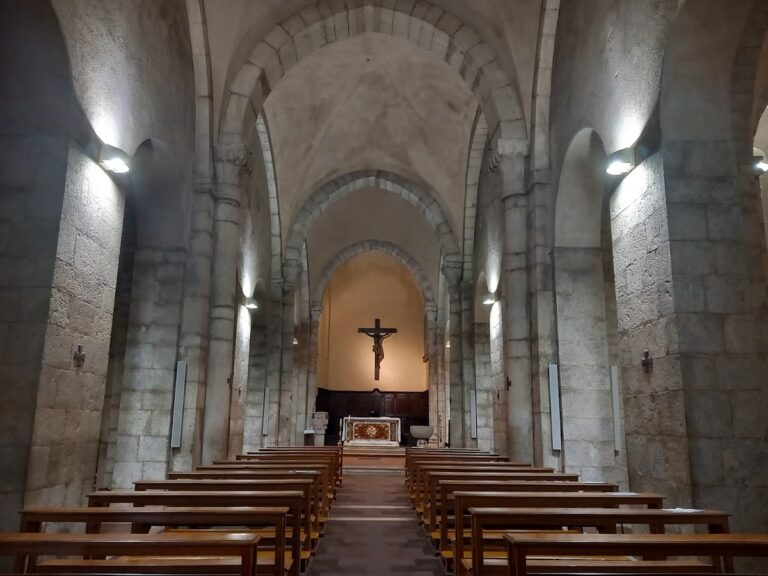
Inside, three aisles lead toward an apse and are separated by arcades beneath trussed roofs. Roman columns from the fourth century were reused in the medieval building as spolia, architectural elements taken from an earlier structure. The arrangement preserves a physical connection between the cathedral and the older buildings of the acropolis.
Presbytery and Liturgical Furnishings
Cosmatesque Pavement
The raised presbytery is enclosed by a Cosmatesque balustrade, while the pavement dates from the beginning of the thirteenth century, around 1203. Cosmatesque work uses pieces of colored stone and glass arranged in geometric patterns. The pavement is attributed to Jacobi magistri romani.
High Altar and Ciborium
The high altar is covered by a ciborium, a canopy erected over a Christian altar, dating from 1228 to 1240. Four columns support it, and an inscription on the inner side of the entablature names its maker as Trudo de Trivio, a medieval artist associated with ecclesiastical furnishings.
Paschal Candle Column
Beside the ciborium stands a twisted column for the Paschal candle, made during the same period. It originally stood beside the ambo before that raised preaching structure was dismantled during the Baroque restorations.
Apse and Interior Decoration
Apse Paintings and Bishop’s Throne
The bishop’s throne stands at the center of the apse. The apse basin shows Christ Pantocrator, the image of Christ as the all-powerful ruler, in glory. Paintings on the apse walls depict Saints John, Paul, Ambrose, and Redento, an early local bishop. Eugenio Cisterna produced this interior decoration in 1904.
Nave Medallions
Fourteen medallions depicting local saints are set into the walls of the central nave beneath the windows. Together with the apse paintings, they form part of the cathedral’s early twentieth-century interior decoration.
Sacristy and Preserved Works
Ninth-Century Ciborium
The sacristy preserves the ciborium from the original ninth-century cathedral. Its decorative elements recall those of the Basilica of Sant’Apollinare in Classe at Ravenna, providing a surviving link to the building’s earliest church phase.
Columns and Paintings
The cathedral contains serpentine columns attributed to Vassalletto and a canvas of the Madonna del Parto attributed to Carlo Dolci, the seventeenth-century Florentine painter.
Silver Statues
Among the preserved works are a sixteenth-century silver equestrian statue of Saint Ambrose, made by the goldsmith Fantino Taglietti, and sixteenth-century silver statues of Saints Peter and Paul. The latter are attributed to followers of Benvenuto Cellini, the Florentine sculptor and goldsmith.