Duomo of Gubbio: The Gothic Cathedral of Gubbio


Site at a Glance
- Rating
- 4.7
- Popularity
- Low
- Country
- Italy
- Primary era
- Medieval
- Eras represented
- Medieval, Early Modern, Modern
- Civilizations
- Papal States
- Site type
- Religious
- Remains
- Cathedral
On this page11 sections
History
The Duomo of Gubbio is the principal Roman Catholic church of Gubbio, Italy, and the cathedral seat of the Diocese of Gubbio. Dedicated to Saints Mariano and James, martyrs of Lambaesis in ancient Numidia, it is a Gothic cathedral developed from an earlier Romanesque building that stood on the site before the year 1000.
Foundation and Medieval Development
Construction of the present cathedral began around 1190–1194 on land granted by Bishop Bentivoglio. The design is attributed to Giovanni da Gubbio. Its essential structure was completed in 1229, after which the building was enlarged in 1336. Work continued through the middle of the fourteenth century, with completion conventionally dated to 1350.
The facade was completed during the episcopate of Pietro Gabrielli, bishop of Gubbio from 1326 to 1345. Gabrielli was buried in a niche on the inner side of the facade. On 25 April 1366, Bishop Giovanni da Morlacca consecrated the high altar, an important act in the cathedral’s medieval development.
Later Alterations and Restoration
The cathedral was remodeled during the sixteenth century. Its pavement was installed during the episcopate of Federico Fregoso, and further changes took place in the eighteenth century. During the Baroque period, leading families in Gubbio endowed numerous side altars, adding new furnishings to the medieval church.
Between 1913 and 1918, restoration removed Renaissance and Baroque additions, including the twenty Baroque altars. The work aimed to recover the cathedral’s Gothic character, which remains dominant on the exterior. Restoration also brought to light a Gothic tomb, two stone statues of saints, and the original altar. The cathedral remains an active Roman Catholic cathedral, while the adjacent Diocesan Museum preserves works of art from Gubbio and its diocese.
Remains
The Duomo is a Gothic church with a single nave and a Latin-cross plan with a transept, the cross-arm crossing the church’s main axis. Ten large transverse pointed arches, formed by two curving sides meeting at an apex, organize the interior. Above them is a trussed roof, supported by an interconnected structural framework. The church ends in a rectangular choir with an apse, the terminal space beyond the choir.
Exterior and Medieval Structure
Facade
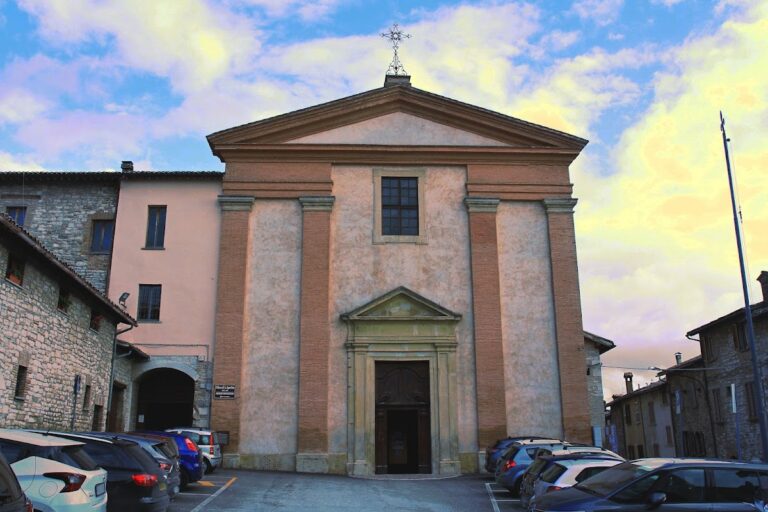
The exterior retains its original Gothic appearance while incorporating earlier Romanesque elements. The facade has a pointed-arch portal and a large window above it. Five thirteenth-century bas-reliefs surround the window, showing the symbols of the four Evangelists and the Agnus Dei. A robust medieval bell tower stands beside the cathedral.
Altar and Tomb Discoveries
The original altar is a Roman-period sarcophagus, a stone coffin, later embellished in the Middle Ages with small columns of pink marble. The sarcophagus contains the relics of Saints Mariano and James, the cathedral’s patron saints. Restoration also revealed a Gothic tomb and two stone statues depicting saints.
Interior Decoration and Chapels
Choir and Chapels
Augusto Stoppoloni decorated the apse, triumphal arch, and some side chapels between 1916 and 1918. A small group of the original interior frescoes survives. A fourteenth-century wooden Crucifix is positioned above the altar.
The cathedral’s Renaissance paintings include Madonna and Child among Saints and Angels by Sinibaldo Ibi, dated 1507, and Giuliano Presutti’s Adoration of the Shepherds, dated 1521. Presutti and Timoteo Viti jointly produced Glory of Magdalene in 1521. Other works include Dono Doni’s Pietà, an independent painted interpretation of Michelangelo’s composition, and canvases by Benedetto Nucci and Virginio Nucci, including Madonna and Child with Saints. Works are also associated with Francesco Allegrini, Luca Maffei, Giacomo Maffei, and Eusebio da San Giorgio.
Chapel of the Sacrament
The Baroque Chapel of the Sacrament opens from the right side of the nave. Bishop Alessandro Sperelli requested its construction. Francesco Allegrini decorated it with frescoes executed between 1652 and 1654, and Antonio Gherardi contributed a painting of the Nativity of the Virgin.
Musical and Liturgical Furnishings
Two organs dating from the sixteenth century remain in the cathedral. Together with the sarcophagus altar, the medieval Crucifix, the paintings, and the chapel decoration, they reflect the successive Gothic, Renaissance, and Baroque phases preserved within the building.