Saint Nicholas Cathedral in Kalisz: A Medieval Church and Diocese Cathedral in Poland


Site at a Glance
- Rating
- 4.7
- Popularity
- Low
- Country
- Poland
- Primary era
- Medieval
- External website
- Open
- Eras represented
- Medieval, Early Modern, Modern
- Civilizations
- Kingdom of Poland
- Site type
- Religious
- Remains
- Cathedral
On this page9 sections
History
Saint Nicholas Cathedral in Kalisz is a Roman Catholic church in Poland dedicated to Saint Nicholas of Myra, the fourth-century Christian bishop traditionally associated with charity and gift-giving. Construction began after 1250 and before 1257, in the medieval Gothic period, and continued until the turn of the fourteenth and fifteenth centuries. Duke Bolesław the Pious, a thirteenth-century Piast ruler of Greater Poland, founded the church with his wife, Duchess Jolenta.
Medieval foundation and expansion
During Bolesław’s lifetime, work advanced on the presbytery, the two-bay sacristy, and a flat-roofed annex that served as a princely gallery. A Bohemian workshop probably completed the presbytery and sacristy at the end of the thirteenth century, during the lifetime of Przemysł II, a later Piast ruler. The church’s western tower was built in the middle of the fourteenth century, after which work continued on the three-aisled body of the church. This expansion is tentatively associated with King Casimir the Great, who placed the church in the care of the Canons Regular of the Lateran, a Catholic order whose members follow a rule traditionally linked with Saint Augustine.
In 1441, Archbishop Wincenty Kot of Gniezno raised the church to the status of a collegiate church, meaning that it was served by a chapter of canons rather than governed by a bishop as a cathedral. The Lateran canons remained in Kalisz until 1810. In 1448, they built a Gothic convent beside the church. A covered passage connected the convent and church from 1538 until 1822.
Fire, rebuilding, and Baroque transformation
A fire in 1609 led to extensive rebuilding between 1612 and 1639 under the architect Albin Fontana. This work introduced barrel vaults decorated with stucco in the Lublin-Kalisz type and reshaped the interior’s appearance. A Baroque high altar was installed in 1662. In 1706, a fire in the roof caused the tall church tower to collapse, adding another major destructive episode to the building’s history.
The church became a cathedral of the Diocese of Cuiavia-Kalisz in 1818 and again functioned as a diocesan church in 1822. Andrzej Wołłowicz, the first Bishop of Kalisz, made his formal entry into the church on 4 July 1819. Renovation between 1869 and 1876 brought a new Neo-Gothic upper termination to the tower, designed by Franciszek Tournelle, and added a Neo-Gothic funerary chapel beside it.
Modern changes and continuing religious role
Around 1895, the former sacristy and chapter house were converted into the Chapel of Our Lady of Consolation, also known as the Chapel “Under the Eagles.” During the partitions of Poland, Russian authorities ordered part of its decoration to be painted over. The decoration was recreated in 1932, after Poland regained independence.
In 1973, the church lost a painting of the Deposition associated with Peter Paul Rubens’s workshop. The official explanation at the time stated that the painting had burned during a fire on the night of 13–14 December. Another interpretation held that the fire had been deliberately started to conceal a theft. In 1992, Pope John Paul II raised the church to cathedral status for the newly established Diocese of Kalisz, with which it remains affiliated. Relics of Saint Faustina Kowalska, the Polish nun associated with the Divine Mercy devotion, were brought to the cathedral on Divine Mercy Sunday in 2016.
The cathedral also preserves connections with notable figures from Polish history. Stanisław Kobierzycki is buried there, while Adam Asnyk and Mieczysław Smorawiński were baptized in the church. Maria Konopnicka was married there. The cathedral is a registered monument in Poland.
Remains
Gothic church and tower
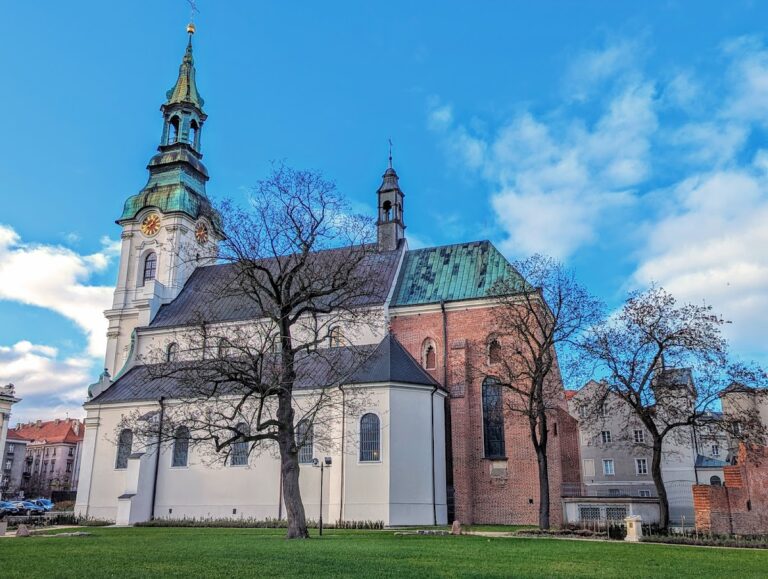
The cathedral is built primarily of brick and combines Gothic, Baroque, and Neo-Gothic elements. Its Gothic body forms a four-bay, three-aisled hall, a plan in which the central nave and side aisles have broadly similar heights and create a unified interior space. At the western end stands a single tower. Its spire includes flying buttresses, while the upper termination was rebuilt in the Neo-Gothic style during the nineteenth-century renovation.
The early complex included a two-bay sacristy and a flat-roofed annex used as a princely gallery. The former Gothic convent of the Lateran canons survives in the church courtyard. It served as the residence of the diocesan bishop until 2014, preserving the physical relationship between the medieval church and the community that once occupied the adjacent convent.
Interior furnishings and paintings
The church contains thirteen altars, including the Baroque high altar built in 1662. The rebuilding of 1612–1639 also gave the interior its barrel vaults with stucco decoration. The presbytery, the area surrounding the high altar, contains paintings by Włodzimierz Tetmajer, who also designed the stained glass in the main nave. Other presbytery paintings, dated 1905, were made by S. Rudziński, S. Jasiński, and B. Wiśniewski.
The lost Deposition had been dated to 1615–1617 and associated with the workshop of Peter Paul Rubens, the leading Flemish Baroque painter. It was purchased in Antwerp in 1620 and brought to Kalisz in 1621 by the royal envoy Piotr Żeromski. The painting hung above an altar and is now represented in the cathedral by a copy of the original.
Chapel of Our Lady of Consolation
The Chapel of Our Lady of Consolation occupies the former sacristy and chapter house, the meeting room of a religious or clerical community. Its walls carry Piast eagles and figures of Polish saints and blessed persons. The stained glass includes images of Our Lady of Czestochowa and Our Lady of Ostra Brama. The chapel also contains the painting Allegory of Dead Poland and a scene showing Duchess Jolenta with Bolesław the Pious. Włodzimierz Tetmajer created the chapel’s stained glass and painted architectural decoration, known as polychrome, in 1909.
Organ and bells
The cathedral organ was assembled in Poznań by Jan Drozdowicz from components of various origins. It has 22 stops, two manuals, and a pedal, with electro-pneumatic action. Three cast-steel bells hang in the tower. Cast in Bochum in 1910 or 1912, they bear largely illegible inscriptions and are named Teresa, Florian, and Nicholas.
Until the Second World War, the tower held an almost four-ton bell dedicated to Saint Nicholas. The bell had been cast at the Czerniewicz foundry near Warsaw. It was dismantled and taken away during wartime operations, then found irreparably damaged in a scrapyard in Wrocław. After its return to Kalisz, it was placed between the church and the parish house.