Sées Cathedral: A Gothic Cathedral in France


Site at a Glance
- Rating
- 4.5
- Popularity
- Low
- Country
- France
- Primary era
- Medieval
- External website
- Open
- Eras represented
- Medieval, Modern
- Civilizations
- French
- Site type
- Religious
- Remains
- Cathedral
On this page21 sections
History
Sées Cathedral is a Gothic Roman Catholic cathedral in Sées, France, dedicated to the Assumption of the Virgin Mary and Saints Gervasius and Protasius. Most of the present building was constructed from 1210 onward, and the cathedral became the seat of the Diocese of Séez. Pope Pius IX raised it to the status of a minor basilica, a papal honor granted to churches of particular religious or historical importance, on 7 March 1871.
Origins and early rebuilding
Tradition attributes the first cathedral at Sées to Saint Latuin, regarded as the town’s first bishop, around AD 440. It was probably a small episcopal church dedicated to the Virgin Mary. A separate church dedicated to the martyr saints Gervasius and Protasius may have served the laity. The two dedications are generally understood as the result of a later union, although the form of the earliest cathedral group remains uncertain.
The church of Gervasius and Protasius occupied the eastern part of the present cathedral and may have stood on the site of a pagan temple identified during nineteenth-century excavations. Remains of the thirteenth-century church of Notre-Dame-du-Vivier, south of the cathedral, may also relate to this early episcopal group. The Carolingian cathedral was destroyed during Viking incursions, dated either to 878 or to 910. Around 986, Bishop Azon the Venerable rebuilt it with stone taken from the city’s fortifications.
Fire and the eleventh-century cathedral
In 1048, Guillaume Soreng and his three sons, supporters of Guillaume II Talvas, seized Sées and occupied the cathedral. They used the building as a refuge, stable, and brothel. Bishop Yves de Bellême besieged them. When the men withdrew into a tower, Yves ordered nearby houses to be burned, but the fire spread to the cathedral and largely destroyed it.
The church received a new roof and was rededicated on 2 January 1050, but its weakened walls soon collapsed. Pope Leo IX reprimanded Yves de Bellême, who then undertook a more ambitious restoration. He raised funds in Apulia and Constantinople and returned with a substantial sum and a relic of the True Cross, said to have been presented by an emperor.
Construction of a new cathedral began around 1053. Yves de Bellême died before it was finished, and the building was consecrated on 21 March 1126 during the episcopate of Jean de Neuville. In 1174, during the conflicts between Henry II and Louis VII, the cathedral was burned again.
The Gothic rebuilding
The principal rebuilding began around 1210. The choir, chapels, and transept were started in the third quarter of the thirteenth century and completed at the beginning of the fourteenth. An epitaph in the choir names Jean de Bernières, bishop from 1278 to 1293, as the builder. Bishop Philippe Le Boulenger consecrated the completed cathedral on 27 September 1310.
The building suffered further damage during the Hundred Years’ War, the prolonged conflicts between the English and French monarchies from the fourteenth to the fifteenth century, including attacks in 1353 and 1375. It was also damaged during the sixteenth-century Wars of Religion, the conflicts between Catholics and Protestants in France. After profanation and rehabilitation, the cathedral was reconsecrated in 1494.
Later repairs and nineteenth-century restoration
Sixteenth-century consolidation shortened the nave by one bay and added two buttresses to support the unstable west façade. The cathedral’s condition deteriorated further in the eighteenth century. Bishop Jacques Lallement closed it to worshippers in 1740, and the central crossing tower, which threatened to collapse, was demolished. In 1780, Bishop Jean-Baptiste du Plessis d’Argentré commissioned Joseph Brousseau to restore the cathedral and rebuild the episcopal palace. During the French Revolution, sculptures in the central portal’s tympanum were mutilated.
A major consolidation campaign began in 1817, when Jean-Antoine Alavoine enclosed the façade within a massive reinforcing structure. Delarue and Dedaux continued the work, rebuilding the nave buttresses in two campaigns. The northern buttresses were treated from 1832 to 1838 and the southern ones from 1844 to 1850. They also rebuilt the southern tower’s spire after the model of the northern tower.
Victor Ruprich-Robert directed the restoration from 1849. Excavations linked the cathedral’s instability to successive layers of rubble and foundations from earlier rebuilding, including remains of a Gallo-Roman building, ashes associated with the first cathedral, debris from the second, and burned and destroyed material. The transept façades were rebuilt because of their poor condition. The southern arm was completed in 1856, while work on the northern arm resumed in 1869.
The eighteenth-century sacristy was demolished, and Ruprich-Robert dismantled and completely rebuilt the choir on foundations reaching as much as eight metres deep. Medieval stones were reassembled with great fidelity. The axial chapel was lengthened by one bay, and sixteenth- and eighteenth-century additions were removed. Victor Petitgrand completed the choir reconstruction after Ruprich-Robert’s death. The western spires were then balanced, although the northern one had originally been higher. They were restored again in 1978. Slightly more than half of the cathedral’s exterior facing dates from the nineteenth century, despite the age of its structural fabric.
Sées Cathedral has been protected as a French historic monument, a legally protected heritage designation, since 1875.
Organ, bells, and recent additions
The first organ was commissioned after Bishop Louis-François Néel de Christot arrived in the diocese. Claude Parisot contracted to build it on 12 January 1743, and completed it as a 29-stop instrument with four manuals and a pedalboard. After repairs in 1812 and relocation to a new gallery in 1816, Louis and Robert Damiens modified it. The instrument was inaugurated on 18 March 1869.
Aristide Cavaillé-Coll built a replacement organ between 1881 and 1883. It had 32 stops and 40 ranks on three manuals and a pedalboard. Charles Mutin restored it in 1910, and Pleyel carried out further work in 1937. Louis Benoist and Pierre Sarélot enlarged it from 32 to 38 stops between 1969 and 1972, followed by another restoration from 2005 to 2009.
Three new bells were blessed by Bishop Jacques Habert on 27 September 2015. They were cast by the Cornille-Havard foundry and engraved by Marc-Antoine Orellana; one is associated with Saint Latuin. Yannick Robert created the cathedral sculpture L’Ange de la Cathédrale on the forecourt in May 2013. It was given to the Diocese of Sées and blessed by Bishop Habert on 5 July 2013.
Remains
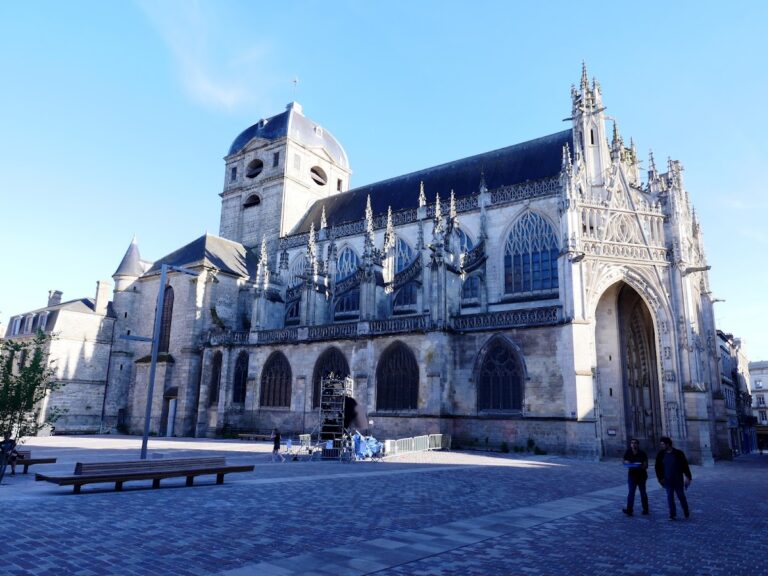
Sées Cathedral is a Latin-cross Gothic building measuring 83.6 metres in length. Its nave is 9.10 metres wide, or 21.55 metres including the aisles. The nave vault rises 24 metres, the aisle vaults reach 12 metres, and the western towers stand approximately 70 metres high. The surviving structure combines a Norman-influenced nave, a Rayonnant Gothic transept, and a choir whose style is more closely related to French Gothic architecture.
West front and nave
West façade
The west façade is framed by two pointed spires and pierced by three portals. The lateral portals support the spires. The central portal retains fragments of a tympanum, the sculpted field above an entrance, showing Christ crowning the Virgin, figures around the Virgin on her deathbed, and her Assumption. The original sculpture was not preserved intact after mutilation during the French Revolution.
Nave and crossing
The six-bay nave has aisles and follows Norman architectural vocabulary. Its interior elevation is arranged in three levels: pointed great arcades, a triforium, which is an arcaded gallery above the main arcade, and an upper window level with a circulation gallery. Polylobes flanked by trefoils decorate the spandrels of the great arcades. The triforium carries a row of trilobed arches, while four-leaf motifs in squares and alternating foliage decorate its balustrade and the upper level.
The clustered crossing piers carry the upper columns and are carved with animal, vegetal, and human-head motifs. Rib vaults cover the interior. The nave’s buttresses belong partly to the nineteenth-century rebuilding campaigns that stabilized the structure and shortened the medieval nave by one bay.
Transepts and chapels
Transept structure
The transept is asymmetrical and belongs to the Rayonnant Gothic mode, a thirteenth-century style known for elaborate tracery, large glazed openings, and radiating geometric patterns. Its southern arm has two bays. The northern arm has three bays and an aisle connected with the ambulatory, the passage that runs around the choir and gives access to radiating chapels.
Southern transept
The southern rose window is designed as a wheel, representing a constantly changing world. Christ occupies its centre, the twelve Apostles surround him, and the twenty-four Elders of the Apocalypse appear beyond them. A glazed gallery below contains ten figures from the Old Testament.
The southern transept also contains Le Beau Dieu de Sées, a white-marble bust of Christ attributed to the workshop of Bernini, and Notre-Dame de Sées, a fourteenth-century marble statue. Both stand beside the Well of the Work, which was restored in the nineteenth century.
Northern transept
The northern rose is predominantly blue and takes the form of a snow crystal or star. Christ on the cross occupies its centre. Six medallions around him depict appearances of the resurrected Jesus at the tomb, with the holy women, with Mary Magdalene, with Saint Thomas, on the road to Emmaus, and at the breaking of bread. Saints and bishops of the Diocese of Séez appear in the glazed gallery below.
The northern transept contains a Louis XIV altar from the Cordeliers convent at Sées, an eighteenth-century lectern, and two praying sculptures by Étienne Leroux representing Bishops Charles-Frédéric Rousselet and François-Marie Trégaro. A chapel reached from this arm houses relics of Saint Latuin.
Choir and ambulatory
Choir and stained glass
The choir consists of two bays and a five-sided apse. It is surrounded by an ambulatory opening onto five radiating chapels. The choir and ambulatory retain stained glass from the fourteenth and fifteenth centuries, while the choir triforium is glazed. Their arrangement preserves a medieval layer within a choir reconstructed during the nineteenth-century restoration.
Radiating chapels
From north to south, the chapels are dedicated to Saint Nicholas, Saint Godegrand, the Blessed Sacrament and Notre-Dame-des-Champs, Saint Augustine, and Saint Mary Magdalene. A window in the Saint-Godegrand Chapel depicts Godegrand with his sister, Saint Opportune, and the chapel contains a modern statue of Saint Thérèse of Lisieux.
The Saint Mary Magdalene Chapel contains the tombs of Bishops Claude Bardel, Octave Pasquet, and André Pioger. Bardel is represented by a recumbent effigy.
Choir furnishings
The eighteenth-century choir arrangement placed the altar at the end of the choir and the canons’ stalls in the crossing and first nave bay. In 1786, Bishop du Plessis d’Argentré moved a new high altar to the crossing. Its two bas-reliefs show the Entombment of Christ on the nave side and the discovery of Saints Gervasius and Protasius on the rear-choir side.
The rear choir contains 72 carved stalls. Ruprich-Robert removed them in 1870 for restoration, and they were reinstalled in 1931 during the episcopate of Octave Pasquet.
Organ and bells
Historic organ
The organ stands behind the older 1743 case made by Jacques Chapelain, a cabinetmaker from Argentan. It incorporates the instrument built by Aristide Cavaillé-Coll between 1881 and 1883. The present organ has 38 stops on three manual keyboards and a pedalboard, with mechanical action, in which physical linkages connect the keys and stops to the mechanism. Its successive restorations and enlargement preserve and modify an installation that combines eighteenth- and nineteenth-century elements.
The organ case has been protected as a historic monument since 1976. A stop is an organ register controlling pipes of a particular tone, while a rank is a complete series of pipes within a stop. These elements help explain the instrument’s surviving specifications without separating its musical history from its physical setting.
New bells
The three bells made at the Cornille-Havard foundry in Villedieu-les-Poêles-Rouffigny bear engravings by Marc-Antoine Orellana. One of them is associated with Saint Latuin, linking the modern bell ensemble with the cathedral’s traditional early history.
Nearby sites