Castle of the Piasts of Koźle: A Medieval Ducal Residence in Poland


Site at a Glance
- Rating
- 4.2
- Popularity
- Very Low
- Country
- Poland
- Primary era
- Medieval
- External website
- Open
- Eras represented
- Medieval, Early Modern, Modern
- Civilizations
- German, Habsburg, Holy Roman Empire, Kingdom of Prussia
- Site type
- Military
- Remains
- Castle
On this page11 sections
History
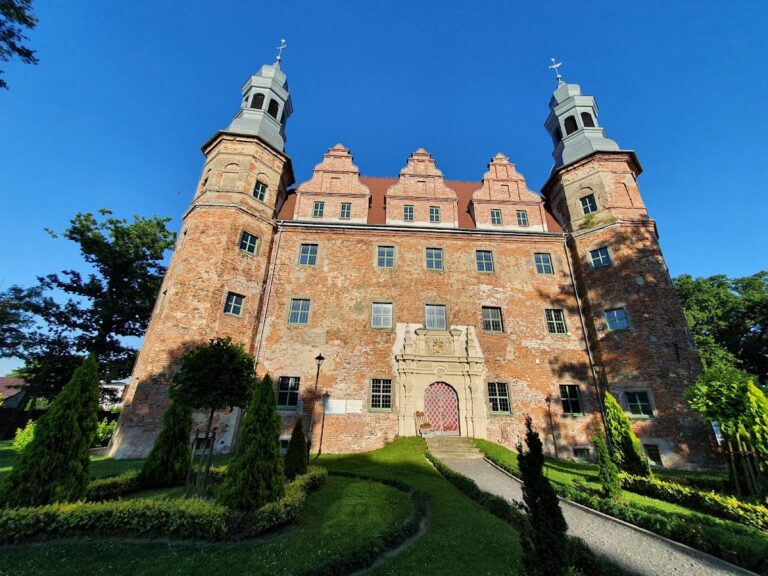
The Castle of the Piasts of Koźle is a medieval castle in Kędzierzyn-Koźle, Poland, probably founded around 1222 under Kazimierz I of Opole. Its earliest form was a Late Romanesque residence, and the castle later became a ducal seat when Koźle served as the capital of the independent Duchy of Koźle. The remains preserve several stages in the development of a Piast stronghold, from its medieval foundation through Renaissance rebuilding and later military use.
Foundation and Piast rule
The castle was probably established at the same time as the town, whose foundation is associated with Kazimierz I of Opole. A fortified settlement may have existed elsewhere before the castle was built. The first known castellan, a medieval official who administered a castle and its surrounding territory, was Naczesław, recorded between 1222 and 1230.
The castle acquired a greater political and military role during the early fourteenth century. Władysław had ruled the duchy independently from 1303, and Koźle became the capital of the independent Duchy of Koźle between 1312 and 1335. During this period the castle was enlarged to serve as a ducal residence and to accommodate the military retinue mentioned in 1283. The Piasts were the medieval ruling dynasty associated with the formation of the Polish state and several Silesian duchies.
Rebuilding and military reuse
A major Renaissance rebuilding was carried out between 1558 and 1562. This work changed the residential part of the complex by creating buildings along its southern and western sides. A 1578 inventory describes the castle as surrounded by two moats, indicating that its defensive organization remained an important feature after the rebuilding.
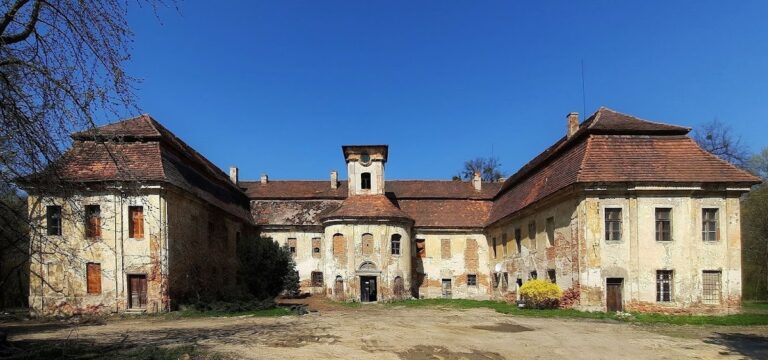
In 1807, the outer bailey, the enclosed area adjoining the main fortified section, was rebuilt for military purposes. A lazaretto, or military hospital for sick or wounded soldiers, was erected there. Further buildings were constructed inside the castle around 1915, and these later additions largely concealed the original plan. The castle was entered in Poland’s register of historic monuments under number 829/64 on 21 April 1964.
Remains
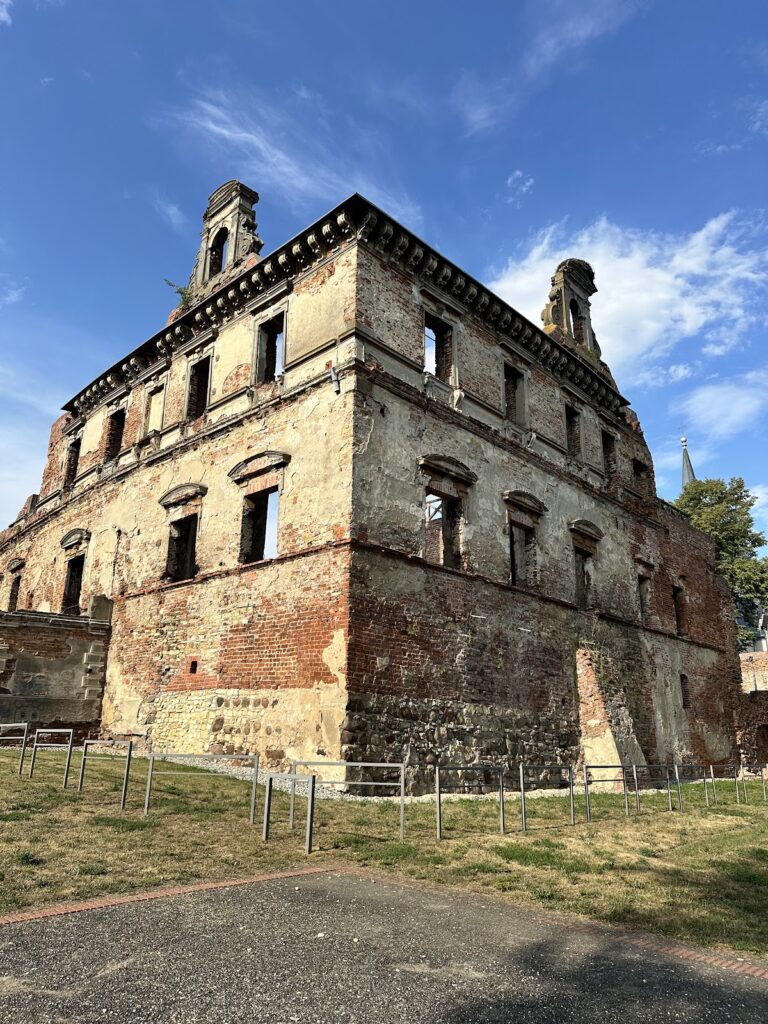
The surviving complex combines the remains of a brick medieval castle built on stone foundations with later Renaissance and military buildings. Its original core developed from a free-standing residential tower into a more enclosed fortified residence. Later construction altered the internal arrangement and obscured much of the early layout.
Medieval fortified core
Piast residential tower
The earliest castle consisted of a free-standing Late Romanesque residential tower. It was built of brick on stone foundations, using the massive masonry associated with the later Romanesque style. The remains of this Piast tower form the oldest surviving part of the castle.
Perimeter wall and entrance defenses
The tower was later enclosed by a perimeter wall with an approximately square plan, measuring about 41.5 by 42.8 metres. The entrance gate stood on the eastern side. A quadrangular bastion, a projecting fortified structure designed to support defensive fire, was added at the southeastern corner. The 1578 inventory places two moats around the castle, completing the picture of its enclosed medieval defensive setting.
Later architectural groups
Renaissance wings
The rebuilding of 1558 to 1562 produced structures forming the southern and western wings. These Renaissance additions expanded the residential complex and introduced an architectural phase based on the classical forms and proportions associated with Renaissance design.
Outer bailey hospital
The outer bailey was reconstructed in 1807 for military use. Its principal recorded addition was a lazaretto building, which served as a military hospital. This structure reflects the conversion of part of the castle complex to nineteenth-century military needs.
Twentieth-century buildings and archaeological finds
Buildings erected within the castle around 1915 substantially obscured the original arrangement of the complex. Flint artefacts dating from the Stone Age were also found within the castle grounds, providing evidence of human activity at the site before the medieval castle was established.
Nearby sites