Castello di Arcuentu: A Medieval Defensive Fortress and Monastery in Sardinia


Site at a Glance
- Rating
- 4.6
- Popularity
- Very Low
- Country
- Italy
- Primary era
- Medieval
- External website
- Open
- Eras represented
- Medieval
- Civilizations
- Unclassified
- Site type
- Military
- Remains
- Castle
On this page10 sections
History
Castello di Arcuentu is a medieval castle in Italy, in the territory of Arbus, Sardinia. Built around 1100 by an uncertain builder, it occupied a strategic position near the boundary between the Judicate of Arborea and the Judicate of Cagliari. A Judicate was a medieval Sardinian polity ruled by a judge who held sovereign authority. The fortress served the rulers of Arborea as a defensive stronghold.
Arborean Fortress and Genoese Control
The first surviving document to mention the castle dates to 1164. In that year, Barisone I de Lacon-Serra, ruler of Arborea and nominal King of Sardinia, pledged Castello di Arcuentu and the Castle of Las Plassas to the Republic of Genoa. He received 4,000 silver marks from Genoa as assistance and financial support for his effort to obtain imperial recognition as King of Sardinia from Frederick I Barbarossa, the twelfth-century Holy Roman Emperor.
In 1172, Genoese forces still occupied Castello di Arcuentu and the castles of Marmilla as security for Barisone’s unpaid claims. After Barisone died, his son Pietro I became ruler of Arborea. In 1189, Pietro sought Genoese citizenship for himself in return for extinguishing his father’s debt. The castle returned to Arborean possession in 1192 and thereafter followed the fortunes of the Arborean rulers.
Arsenal and Vallombrosan Monastery
At a later stage, the complex was used as a military arsenal before being transformed into a monastery of the Vallombrosan Congregation. The exact date of this change is uncertain. The Vallombrosans were a Benedictine reform congregation founded by Saint John Gualbert in the eleventh century, with an ideal centered on strict early Benedictine observance.
In 1066, Saint John Gualbert reportedly sent the monk Domino Arteo Bortichi and ten monks to Sardinia and Corsica to establish three abbeys. The locations were not identified by the Vallombrosan chronicler Eugenio Flammini, and this uncertainty sometimes led to confusion between the Vallombrosan monastery on Monte Arcuentu and the monastery of Saint Michael of Thamis at Masullas. The existence of the Abbey of Saint Michael of Thamis is confirmed by 1188, while the first sources concerning its dependent monastery on Monte Arcuentu date to 1193.
The church on Monte Arcuentu appears in five papal bulls issued between the eleventh and thirteenth centuries. These included one bull from Pope Innocent III, two from Pope Honorius III, one from Pope Gregory X, and one from Pope Innocent IV. In 1342, Silvester, abbot of Thamis, acted for the church of Saint Michael of Monte Arcuentu when he paid a tax of four gold massamutini and ten lire of alfonsini.
Decline and Earlier Occupation
From the sixteenth century, the monastery began to decline. A Barbary raid or the spread of plague may have contributed to this process, which also affected the monastery of Saint Michael on Monte Arcuentu. The castle and monastic complex are now ruined and abandoned.
Monte Arcuentu had been used for thousands of years before the medieval fortress was built. Punic cup- and shell-type lamps, a hoard containing numerous Roman coins, and a Roman settlement with a necropolis at Tzei on the mountain’s slopes show the depth of earlier occupation. The necropolis included three burials with ceramic grave goods.
Remains
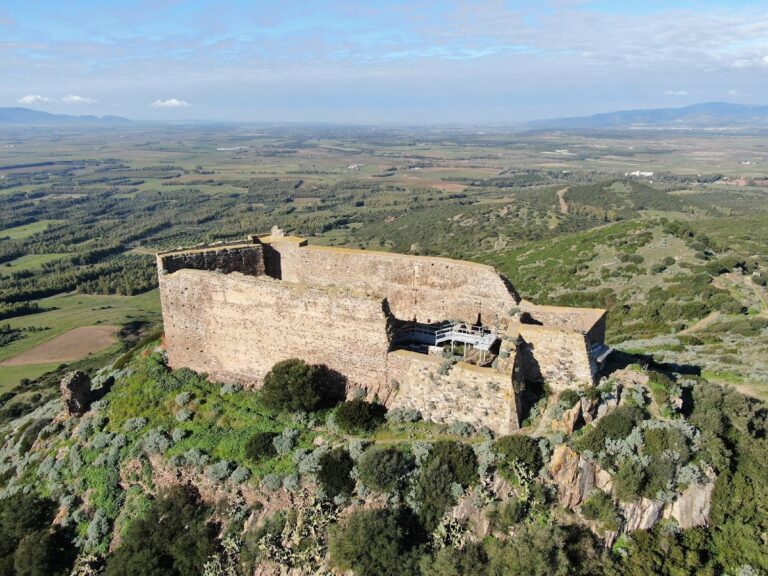
The surviving remains occupy the summit of Monte Arcuentu at 784 metres above sea level, within an area historically described as centuries-old woodland. The castle walls follow the shape of the rocky terrain, and the former castle environments survive as ruins arranged around a rocky ridge.
Castle Enclosure
Perimeter Walls and Entrance
The perimeter walls were adapted to the configuration of the summit on which they were built. The castle had a single entrance on the eastern side of the rocky ridge, defining the principal point of access into the fortified enclosure.
Water Storage
Northern Cistern
Near the castle, the northern cistern was built underground and covered by a barrel vault. A cistern is a constructed reservoir for storing water. This reservoir collected rainwater beneath its vaulted covering.
Opposite Cistern
A second cistern stood on the opposite side of the castle and was larger than the northern reservoir. Together, the two water-storage structures formed part of the physical infrastructure associated with the summit settlement.
Nearby sites