Castello di Monreale: A Medieval Fortress in Sardinia


Site at a Glance
- Rating
- 4.3
- Popularity
- Low
- Country
- Italy
- Primary era
- Medieval
- External website
- Open
- Eras represented
- Medieval
- Civilizations
- Unclassified
- Site type
- Military
- Remains
- Castle
On this page8 sections
History
Castello di Monreale is a medieval castle in Italy, near Sardara in Sardinia, whose history is connected with the Judicates of Cagliari and Arborea. Its construction date remains uncertain. It is generally thought to have been built between the late ninth and early tenth centuries, after the emergence of the Sardinian Judicates and as a continuation of earlier Nuragic fortified structures. A fourteenth-century construction date is also recorded.
Boundary of the Judicates
The Sardinian Judicates were medieval territorial governments ruled by judges rather than by kings in the usual feudal sense. Monreale stood within the political landscape formed by the Judicates of Cagliari and Arborea. Together with the castles of Marmilla and Arcuentu, it marked the boundary between these two territories in 1309.
In that year, the castle appeared in records under the names Castrum de Monte and Castrum Montis Regalis. It already carried the qualification “royal” when James II of Aragon, the medieval king of the Crown of Aragon, granted it to Mariano and Andreotto de Bas, judges of Arborea. The Commune of Pisa administered the castle on their behalf, reflecting the involvement of outside powers in Sardinian political affairs.
Arborean Residence and Later Use
The first recorded use of Monreale as a royal residence dates to 1324. Hugh II of Arborea, encamped near Pabillonis, confronted and defeated Pisan forces in the territory of Sardara and Sanluri. The fortress later reached its greatest splendour under Eleanor of Arborea, who succeeded her brother Hugh III and became one of the prominent rulers of the Arborean Judicate.
After the Arborean defeat at the Battle of Sanluri on 30 June 1409, William III of Narbonne, described as the last Arborean judge, took refuge at Monreale. The castle subsequently served as a district prison until the seventeenth century. Between 1987 and 2011, nine restoration and consolidation campaigns helped conserve the monument and brought the village beneath the hill to light.
Remains
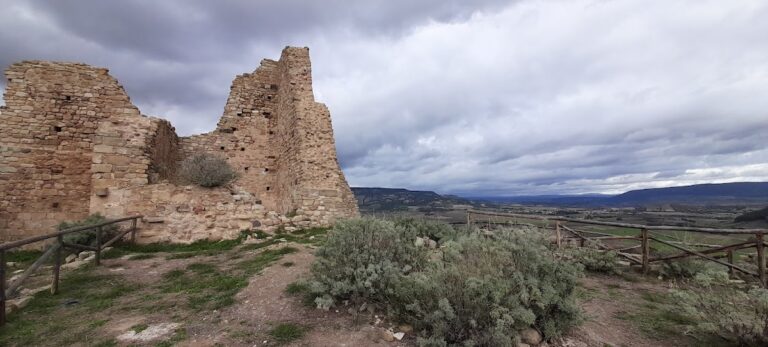
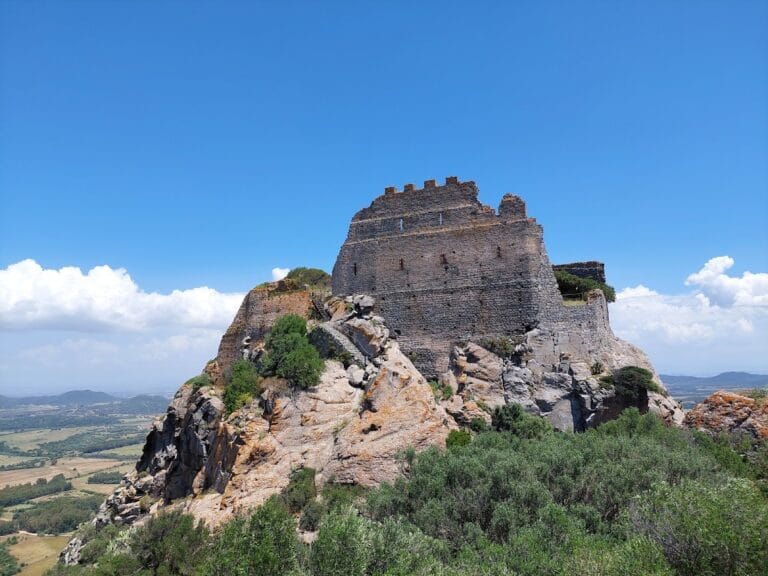
Castello di Monreale occupies the summit of a hill approximately 280 metres above sea level, overlooking the Campidano plain as far as Cagliari. Built with local schist, the fortified enclosure covered about 4.6 hectares and contained both a settlement and a small church dedicated to Saint Michael. The surviving monument is ruined and has undergone partial restoration, while the central defensive structures remain prominent within the enclosure.
Fortified Enclosure
Circuit Walls and Towers
The ruined circuit walls link eight towers with square and circular plans. This combination of tower forms is described as unique among Sardinian castles. The walls enclosed the settlement and church as well as the principal defensive elements, creating a fortified area whose scale extended well beyond the central keep.
Central Keep
The keep stands centrally on the higher of the site’s two rises. A keep, or mastio, is the principal fortified tower of a castle and generally serves as its strongest defensive and residential element. At Monreale, the structure rises about 10 metres and has walls approximately 2 metres thick. Its masonry consists of varied rubble stone, and the walls are almost intact. The keep has no windows or loopholes and reflects the castle’s first function as a fortress before its later use as a residence.
Settlement and Church
Within the fortified enclosure, the remains include the settlement that occupied part of the castle area and a small church dedicated to Saint Michael. The restoration and consolidation work carried out between 1987 and 2011 helped reveal the village beneath the hill, adding the inhabited area to the surviving evidence of Monreale’s former role as both a defensive stronghold and a residential centre.