Palazzo Cornazzani: A Fifteenth-Century Palace in Pavia


Site at a Glance
- Rating
- 4.2
- Popularity
- Very Low
- Country
- Italy
- Primary era
- Medieval
- External website
- Open
- Eras represented
- Medieval, Early Modern
- Civilizations
- Duchy of Milan, Holy Roman Empire, Spanish
- Site type
- Domestic
- Remains
- Elite Residence
On this page9 sections
History
Palazzo Cornazzani is a fifteenth-century palace in Pavia, Italy, built in the late Gothic style while incorporating remains of earlier buildings. Its history connects aristocratic families, prominent residents, and distinguished cultural figures in the city.
Beccaria and Cornazzani Ownership
The palace originally belonged to the aristocratic Beccaria family. Through a marriage in the sixteenth century, it passed to the noble Cornazzani family. The Cornazzani originated in Parma and first served Filippo Maria Visconti, the fifteenth-century Duke of Milan, before entering the service of the Sforza, the dynasty that succeeded the Visconti as rulers of Milan. Through this connection they obtained Milanese citizenship, and one branch later settled in Pavia.
Residents and Literary Associations
Palazzo Cornazzani hosted prominent residents and guests, including Antonio de Guzmán, governor of Milan, and Cardinal Michele Bonelli, who apparently stayed there for more than a year.
The Italian poet and writer Ugo Foscolo lived in the palace with his friend Giulio Gabrielli di Montevecchio while Foscolo was a professor at the University of Pavia. The building consequently became known as Casa del Foscolo, and the street where it stands was later named Via Ugo Foscolo after the poet.
Later Residents
At different periods, the palace was inhabited by the professor Contardo Ferrini, the poet Ada Negri, and Albert Einstein. Einstein, the German-born physicist later known for developing the theories of special and general relativity, lived there with his family between 1895 and 1896 while his father, Hermann, operated an electric-machine factory in Pavia. During this residence, Einstein wrote a short essay entitled On the Investigation of the State of the Ether in a Magnetic Field.
Remains
Palazzo Cornazzani is arranged around two courtyards that belong to different periods. The first courtyard dates from the fifteenth century and retains a late Gothic appearance, while the second was added in the seventeenth century. The palace also preserves decorated architectural elements from the fifteenth century, Baroque painting, and a Neoclassical wing.
Courtyards and Galleries
First Courtyard
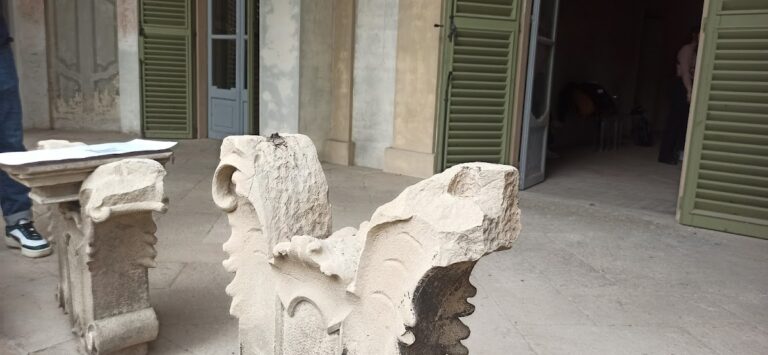
The fifteenth-century courtyard is bordered by a portico with octagonal granite columns, a form common in Lombard construction of the period. Numerous frescoes decorate the portico. On its northern side, a Gothic loggia, an open-sided gallery supported by columns, survives with a balcony carried by wooden columns.
Second Courtyard
The seventeenth-century courtyard contains lunettes, the curved areas above arches, doors, or windows, with a frescoed Cornazzani coat of arms.
Facade and Interior Decoration
The facade was plastered during the modern period and incorporates a fifteenth-century terracotta tile depicting the Nativity. Inside, richly coffered fifteenth-century ceilings survive; these ceilings are formed from recessed decorative panels. The interiors also contain Baroque frescoes and a Neoclassical wing.