Castle of Rivarola: A Medieval Genoese Fortification in Italy


Site at a Glance
- Rating
- 4.1
- Popularity
- Very Low
- Country
- Italy
- Primary era
- Medieval
- Eras represented
- Medieval
- Civilizations
- Genoese
- Site type
- Military
- Remains
- Castle
On this page6 sections
History
The Castle of Rivarola is a medieval Genoese fortification in Italy, in the municipality of Carasco. The Republic of Genoa began building it in 1132 to control and defend the lower Fontanabuona Valley, then under the influence of the Fieschi counts of Lavagna. The castle formed part of Genoa’s expansion into the inland valleys of eastern Liguria and is mentioned in documents from 1145.
Genoese Foundation and Early Use
The fortification was established during a period when the Republic of Genoa, a powerful medieval maritime state, was extending its political and military authority across Liguria and nearby coastal and inland territories. Its position gave Genoa a base from which to supervise movement through the lower Fontanabuona Valley. Archaeological investigations have also considered whether a seigneurial fortification, meaning one controlled by a local lord or ruling family, occupied the hill before the Genoese construction of 1132.
Rivarola had a role in Genoese administration as well as defence. In 1166, an agreement donating the Castle of Levaggi at Borzonasca to the Genoese commune was concluded inside Rivarola. The arrangement provided for a captain appointed by the Fieschi to maintain the garrison, illustrating the compromises through which Genoa managed local political relationships.
Conflict with the Fieschi and Malaspina
The union of the Fieschi and Malaspina families in 1172 began an openly anti-Genoese phase in the region. The Fieschi and Malaspina were prominent aristocratic families whose alliances and rivalries shaped political control in medieval Liguria. Opizzone Malaspina attacked the citadel of Chiavari, while his son Moruello Malaspina invaded Sestri Levante. Forces then moved against Rivarola, reportedly numbering about 250 cavalrymen and 3,000 infantrymen.
The besieging army captured Rivarola soon afterward, as well as Sestri Levante. Genoa responded rapidly with the support of local troops and restored its control over the territory. Once the republic had secured full authority, with assistance from the Fieschi under political agreements and guarantees concerning the administration of local settlements, Rivarola no longer served its earlier military and territorial purpose. The castle then fell into disuse and gradual abandonment.
Archaeological Investigation
Later developments were obscured by historical and flood-related events affecting the municipality. Portions of the fortification are therefore thought to have been reused in houses and boundary walls within the present settlement of Rivarola. Archaeological work carried out between 1996 and 2018 formed part of a wider study of medieval fortifications and settlement in eastern Liguria. The initial campaign examined Rivarola as a representative Genoese fortified settlement while also testing the possibility of an earlier lordly stronghold on the hill.
The investigations also explored the castle’s place in Genoa’s expansion into the Tigullio area during the first half of the twelfth century. Work resumed in 2018 under the direction of archaeologist Fabrizio Benente, within the Chair of Medieval Archaeology at the University of Genoa.
Remains
Hilltop Fortification
The castle stood on a hill at the meeting point of the Lavagna and Graveglia streams, where they join to form the Entella River. The location also brought together the Fontanabuona, Graveglia, and Sturla valley systems. This setting helps explain the fortification’s strategic purpose, since the hill occupied a junction between several routes through the surrounding valleys.
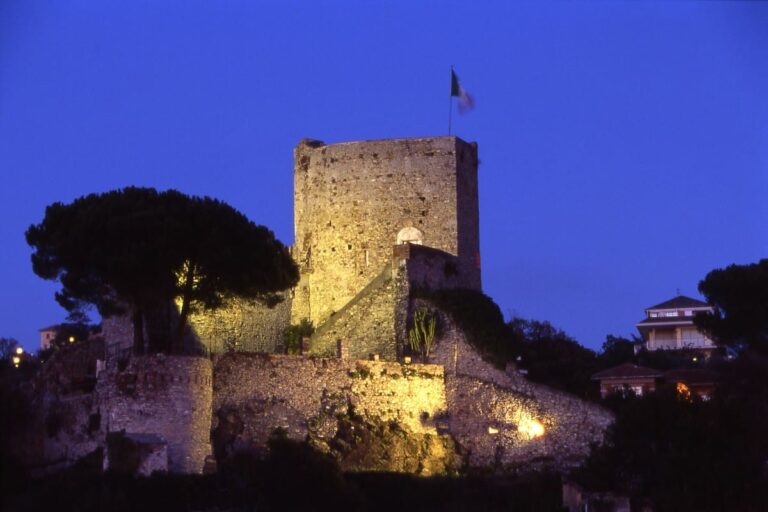
Only fragmentary ruins survive. Traces and sections of walls remain on the hill, with some stretches reaching about two metres in height. Rectangular, semicircular, and square wall forms probably belonged to parts of the principal structure and to lookout towers. The surviving fabric is uneven and ruined, and some portions may have been incorporated into houses and walls in modern Rivarola, linking the remains of the medieval fortification with the later settlement.
Nearby sites