Sanctuary of Our Lady of Montallegro: A Marian Shrine in Rapallo, Italy
Site at a Glance
- Rating
- 4.7
- Popularity
- Medium
- Country
- Italy
- Primary era
- Early Modern
- External website
- Open
- Eras represented
- Early Modern, Modern
- Civilizations
- Genoese, Italian
- Site type
- Religious
- Remains
- Basilica
On this page18 sections
History
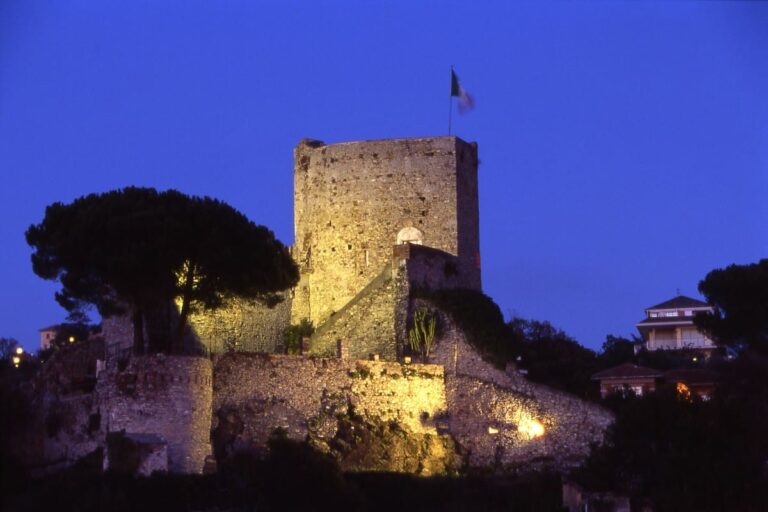
The Sanctuary of Our Lady of Montallegro is a Catholic Marian shrine above Rapallo, Italy, on a hill about 612 metres above sea level. Its history began with the reported apparition of the Virgin Mary on 2 July 1557, and the present complex reflects successive rebuilding in Lombard Gothic and Baroque Revival forms. Administered by the Diocese of Chiavari, it became one of the principal Marian sanctuaries of Liguria and the metropolitan area of Genoa.
The apparition and first sanctuary
Local tradition places the apparition in the early afternoon, when the farmer Giovanni Chichizola was returning from Genoa. He had fallen asleep beside a rocky spur on Mount Letho, a mountain also known locally as the “mount of death” because of brigand raids. The Virgin reportedly appeared to him, left a Byzantine image of the Dormitio Mariae, or the passage of the Virgin’s soul into heaven, and caused a spring to emerge from the rock.
The parish priest, other clergy, local authorities, and the faithful are said to have found the image beside the spring. After it was twice taken down to Rapallo, first to the Basilica of Saints Gervasius and Protasius and then to the parish church, it was twice found again on Mount Letho. These returns established the mountain as the image’s intended place of veneration in local tradition.
Egidio Falceta, vicar of the Archdiocese of Genoa, investigated the apparition in 1558 on the commission of Archbishop Gerolamo Sauli. The investigation record describes local belief in miraculous healings and deliverance from illness associated with the site. A small temple was built in 1557 and 1558 to preserve and display the image, while a hospice for pilgrims and clergy was established before the larger church.
The first full sanctuary was completed in 1559. It was a single-nave building directed by Tommasino Lagomaggiore, a Comacine master, meaning a Lombard or northern Italian master builder associated with organized stoneworking. Transporting materials up the hill presented a considerable practical difficulty. A cobbled mule track about 4 kilometres long was also built between San Bartolomeo di Borzoli and Mount Letho as part of the early development of the shrine.
Church administration and enlargement
In 1572, Pope Gregory XIII united the suppressed monastery of Valle Christi at San Massimo with the sanctuary. An archiepiscopal decree of 8 March 1589 definitively assigned management of the church to the parish of Saints Gervasius and Protasius, despite a competing request from the parish community of San Maurizio di Monti.
During the apostolic visitation of 1582, Bishop Francesco Bossi of Novara ordered changes to the altar. These included enlarging it, installing a larger sacred stone, and improving its protection from dust. A more extensive enlargement in 1640 allowed the addition of side altars and established the church’s overall dimensions, approximately 25 metres long, 11 metres wide, and 12 metres high.
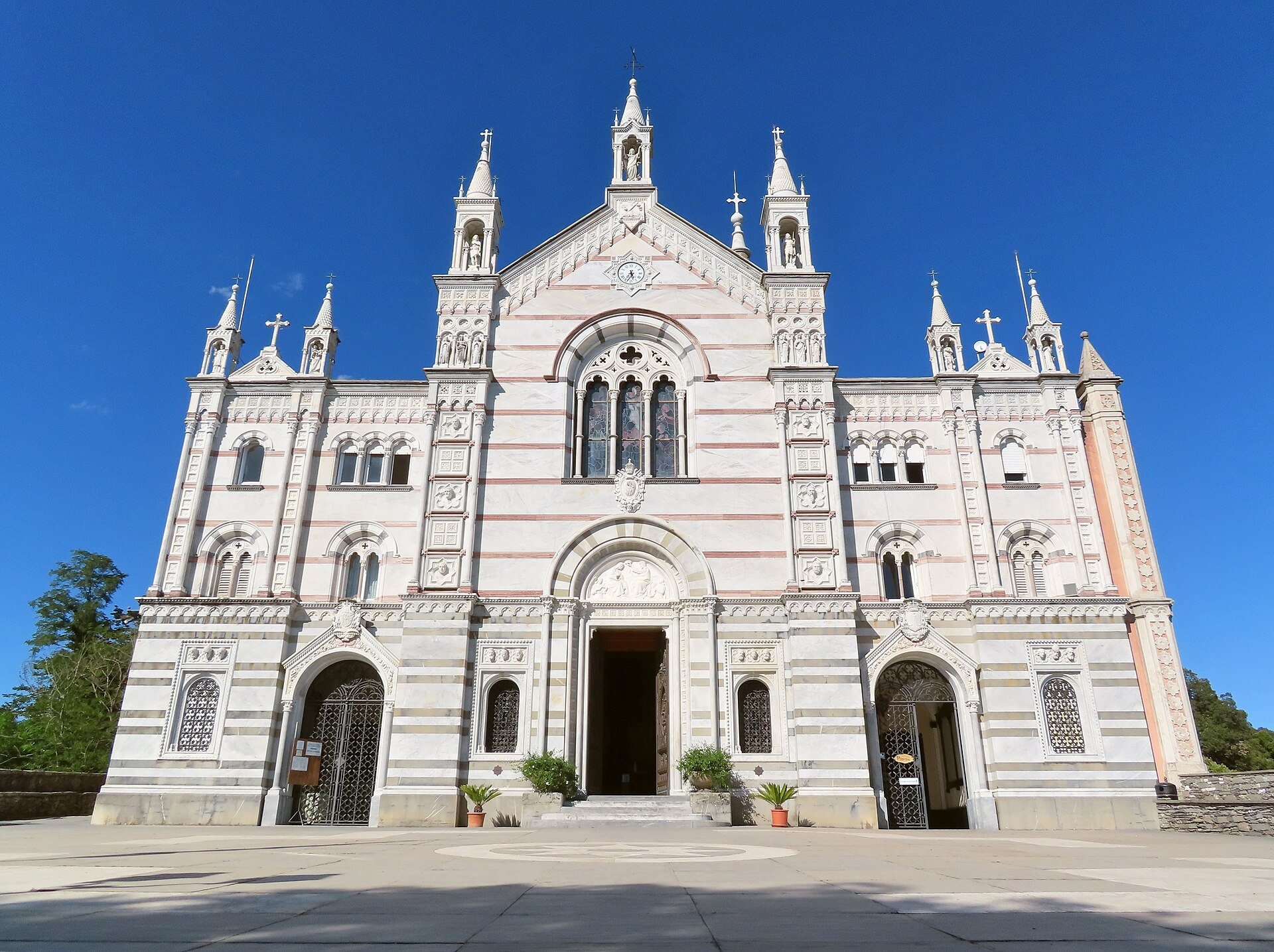
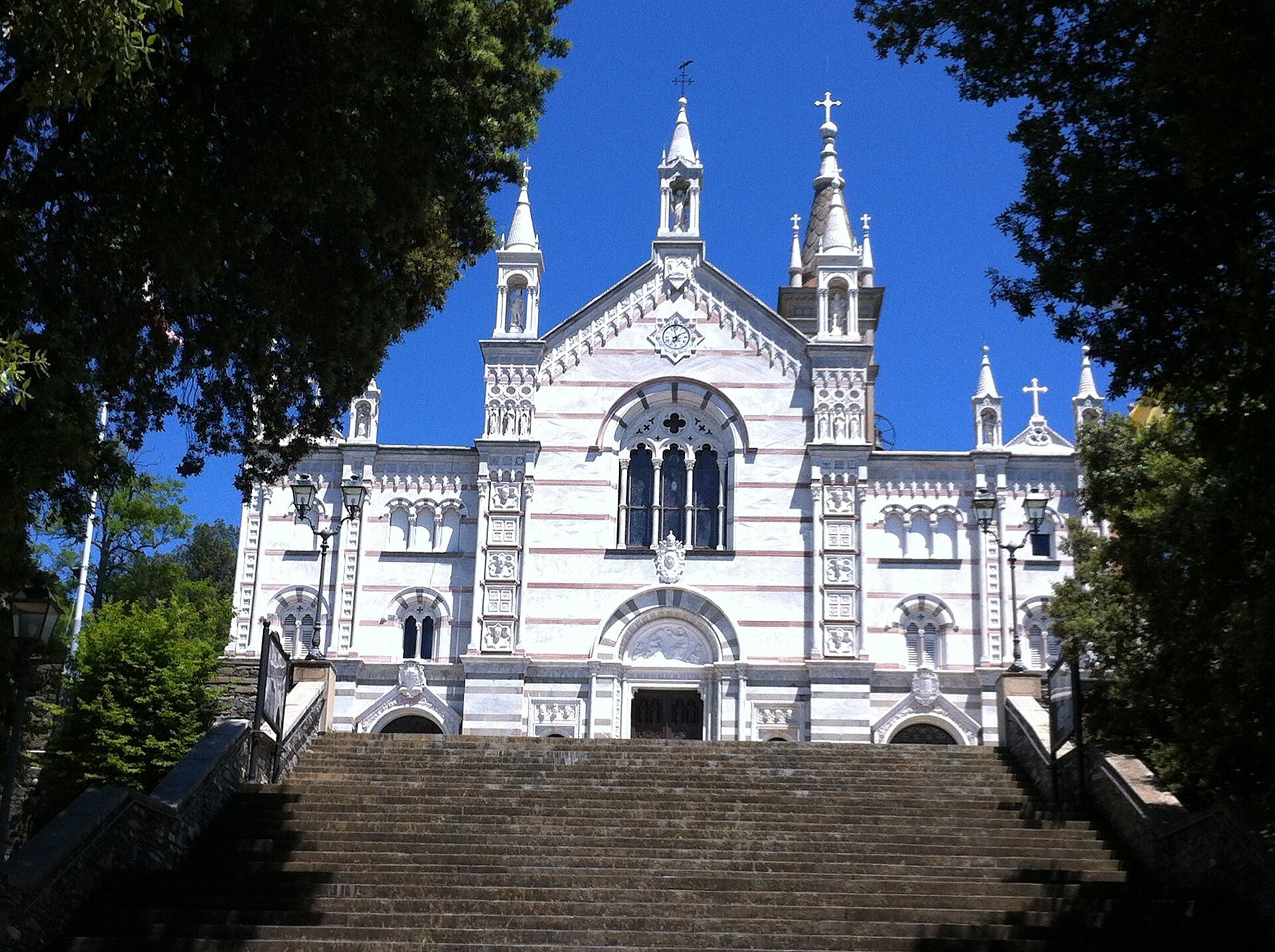
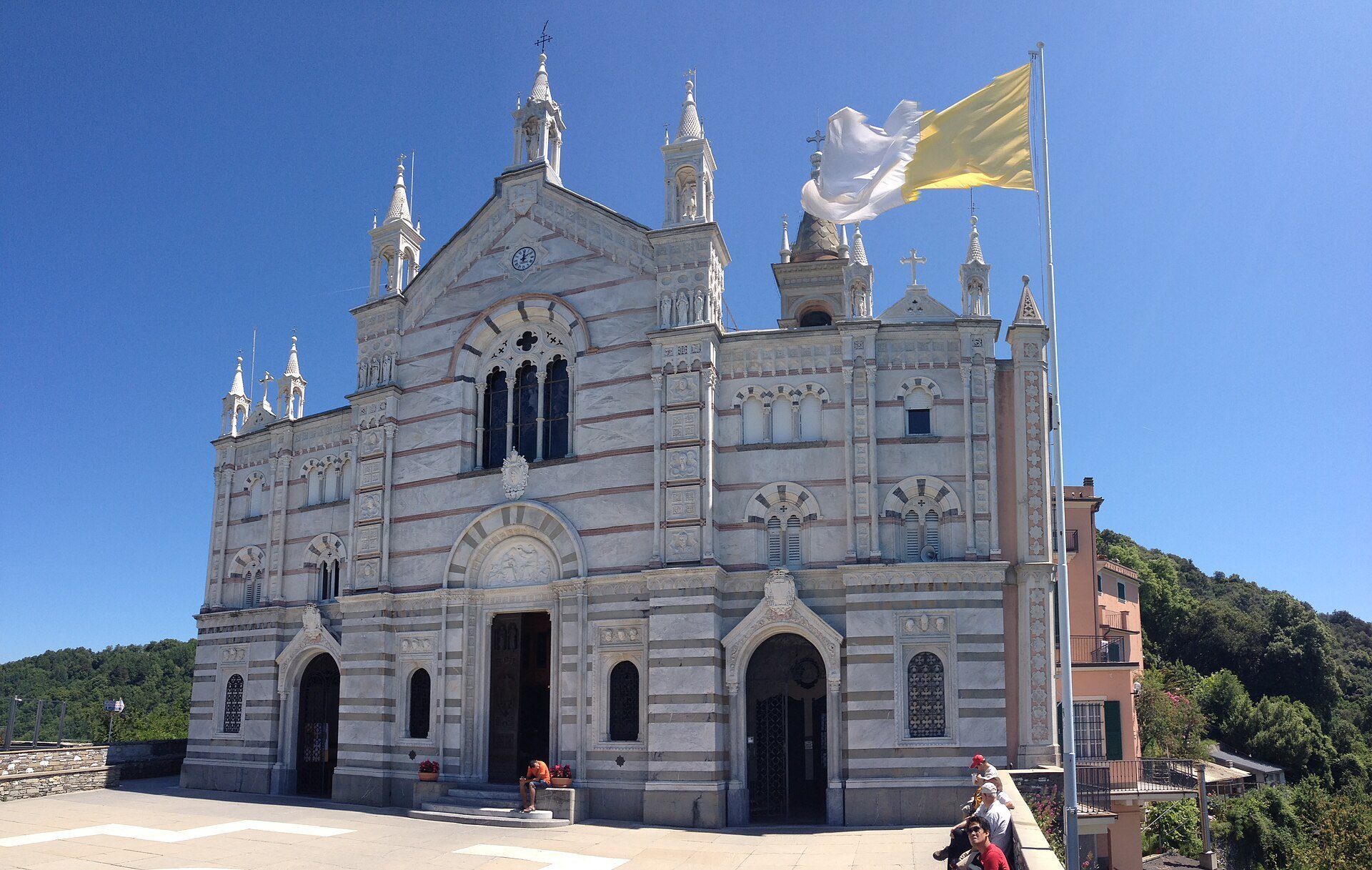
The nearby guesthouse was enlarged in 1772. In 1867, the church interior was artistically renovated under the direction of Descalzo of Chiavari, with stucco, pilasters, and capitals by Pietro Delucchi. Luigi Rovelli designed a new high altar in 1882 and rebuilt the marble facade. The facade was completed and inaugurated on 21 June 1896, and Rovelli also designed the adjoining pointed bell tower, completed in 1907.
Patronage and religious status
Devotion to Our Lady of Montallegro acquired a formal civic and diocesan dimension. In 1739, she was elected patron of Rapallo, its captaincy, and the parishes of Santa Margherita Ligure. The former captaincy of Rapallo was a territorial jurisdiction that existed from 1608 to 1797. The patronage was confirmed in Rome on 14 June 1739 after deliberations involving Rapallo’s civic community, local clergy, religious communities, the Archbishop of Genoa, and the Sacred Congregation of Rites.
Andrea Doria, acting as delegate of the Chapter of Saint Peter in Rome, ceremonially crowned the icon “Queen” on 27 July 1767. Pope Clement XIII granted a plenary indulgence to pilgrims, and the sanctuary was aggregated to the Basilica of Saint Mary Major in Rome. Pope Pius XII elevated it to a minor basilica by decree of 5 August 1942. A minor basilica is a church given a special papal designation recognizing its religious and historical importance.
The sanctuary’s patronal relationship with Rapallo is also represented on the municipal coat of arms, where a Marian monogram has appeared since 1948. Our Lady of Montallegro is co-patroness of the Diocese of Chiavari, established by papal bull in 1892, together with Our Lady of the Garden of Chiavari.
Civic vows and wartime traditions
Local tradition credits the Virgin with protecting Rapallo from plague in the seventeenth century and cholera in the nineteenth. In response, municipal authorities made processional vows and offered silver objects, including a large depiction of the town. The plague vow was made by the municipal council on 29 May 1657 and led to an annual procession to the sanctuary.
During the cholera epidemic of 1835, the council, chaired by Mayor Francesco Maria Pino Della Cella, made another vow. About 5,000 people took part in its fulfillment at the sanctuary on 23 May 1836. Local tradition also attributes Rapallo’s survival during the Allied bombing of 28 July 1944 to the Virgin’s intervention. It holds that a sudden wind caused the bombers to miss their aim and that some bombs which fell among the houses failed to explode.
Modern development and continuing observances
The sanctuary’s access and associated facilities expanded during the twentieth century. A motor road was completed in 1932, a new pilgrim’s house was built in 1948, and a rack-and-pinion elevator was installed on 20 December 2009 to remove the principal architectural barriers between the road and the sanctuary square.
Notable visitors included Saint Francis de Sales in 1591, Cardinal Stefano Durazzo in 1638, Brigida Morello in 1639, Archbishop Tommaso Reggio in 1845, Cardinal Andrea Carlo Ferrari in 1907, and Angelo Giuseppe Roncalli, later Pope John XXIII. Roncalli celebrated a pontifical Mass at the sanctuary on 2 October 1922. Cardinal Tarcisio Bertone and Archbishop Angelo Bagnasco attended the 450th-anniversary commemorations in 2007. The first documented Orthodox wedding at the sanctuary took place on 28 July 2008.
The annual July observances retain the sanctuary’s patronal character. Over three days, processions carry the silver shrine and the image, while traditional Ligurian mortars, short ground-based cannon-like devices used in local celebrations, accompany the festivities. The ceremonies also include fireworks and the symbolic burning of Rapallo’s sea castle.
Remains
The sanctuary occupies a hilltop setting at approximately 612 metres above sea level. Its physical core is a single-nave church enlarged in 1640, with four side altars and a high altar. Later work added the marble facade, pointed bell tower, devotional chapels, votive displays, and approach features, producing a complex that combines the older church fabric with nineteenth- and twentieth-century additions.
Church exterior and interior
Facade and bell tower
Luigi Rovelli’s marble facade was completed in 1896 and is described as Lombard Gothic, while an architectural listing classifies the sanctuary as Baroque Revival. The adjoining pointed bell tower, also designed by Rovelli, was completed in 1907 and rises approximately 30 metres. Eight bells cast by the Capanni foundry of Castelnovo ne’ Monti were installed in 1946.
Altars and paintings
Inside, the nave contains four side altars and a high altar designed by Rovelli. The high altar incorporates an earlier altarpiece and houses the Byzantine image for veneration. On the right are Nicola Carlone’s Visitation, dated 1704, and a white-marble crucifix by Francesco Schiaffino. The left-hand altars contain Luca Cambiaso’s Annunciation and Nicolò Carlone’s Our Lady of Sorrows, dated 1707.
Francesco Boero painted four vault frescoes showing historical and miraculous episodes associated with the Byzantine image. In the semi-dome of the apse, Nicolò Barabino painted the apparition of the Virgin to Giovanni Chichizola. The organ was built in 1907 by the Inzoli firm of Crema.
Devotional spaces
Saint Joseph’s chapel
The chapel of Saint Joseph was created on the left side of the sanctuary and inaugurated on 19 March 1966. The spring traditionally connected with the apparition is preserved there in its original position. Paintings, photographs, and votive offerings relating to alleged miraculous healings accompany the spring.
Confession area
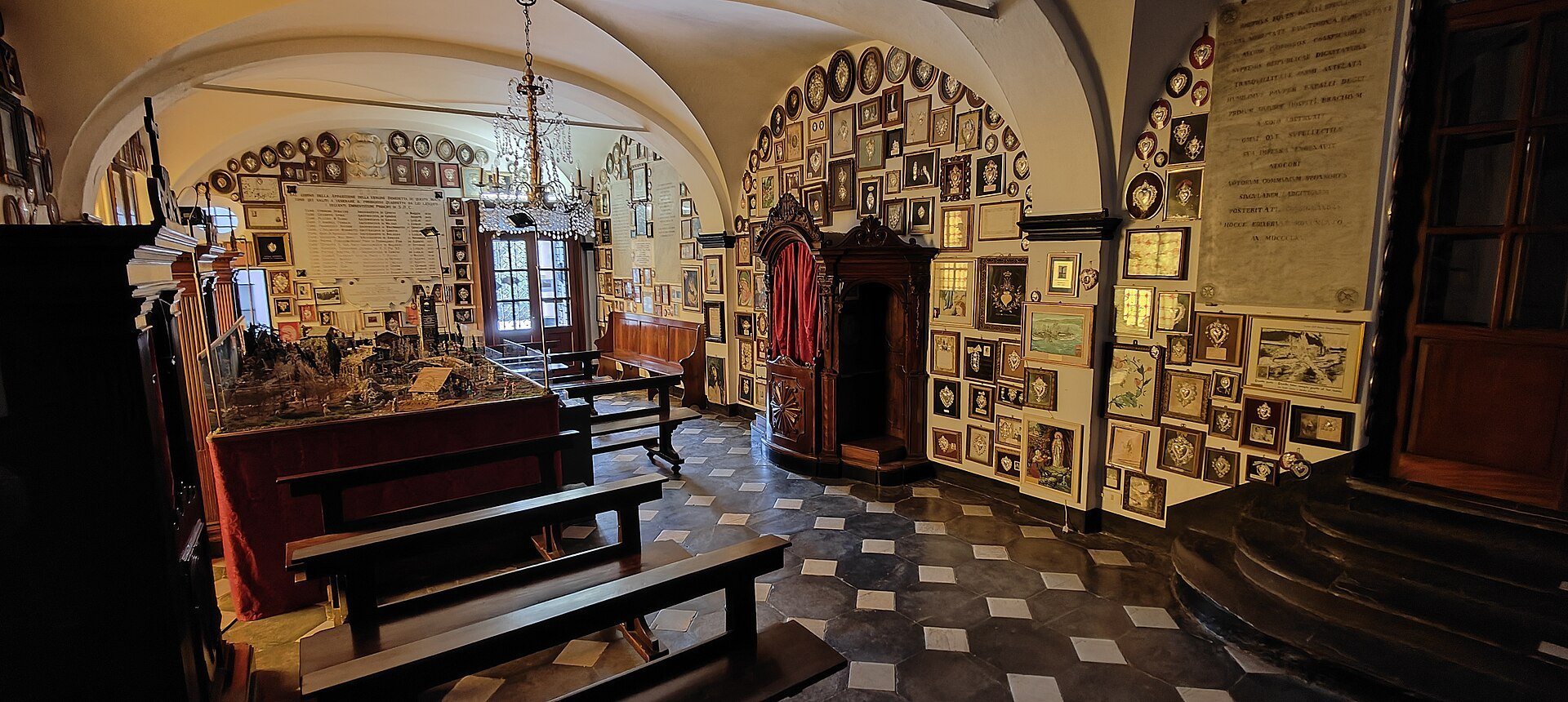
A confession area was established in 1788 in the sanctuary’s right wing. It was dedicated to Saint Ursicinus of Sant’Olcese and Saints Gervasius and Protasius. Its walls carry votive offerings, memorial plaques, and inscriptions commemorating visits by cardinals and other notable figures.
Approach paths
The sanctuary landscape includes a mule track leading toward Mount Rosa, where fourteen ceramic Stations of the Cross were installed in 1941. Another path contains fifteen bronze panels representing the Mysteries of the Rosary. Sculpted by Italo Primi, the panels were inaugurated and blessed between 1957 and 1958.
Other twentieth-century improvements include polychrome stained-glass windows installed in 1937 and 1938, bronze doors installed in 1957, a broader entrance staircase later revised in 1982, and slate paving for the sanctuary square laid between 1992 and 1994.
The Byzantine icon and silver shrine
The venerated image
The Byzantine icon depicts the Dormitio Mariae, the Christian subject showing the Virgin’s death and the passage of her soul into heaven. Painted on a poplar panel measuring about 18 by 15 centimetres, it represents the Holy Trinity and the Virgin’s soul ascending at the moment of her death.
Tradition associates the icon with repeated disappearances and returns. In the episode of 1574, the crew of the Ragusan captain Nicola de Allegretis recognized it at the sanctuary as an image allegedly missing from their church. After a legal order returned it, the icon reportedly disappeared from the ship and reappeared on the sanctuary’s high altar. The sanctuary preserves an ex voto connected with de Allegretis. An ex voto is an offering placed at a shrine in fulfillment of a vow or in thanksgiving for an alleged favor or healing.
The image otherwise remained at the sanctuary apart from patronal processions and its documented journey through the parishes of the former captaincy of Rapallo in 2007. Antonio Floradi of Piacenza engraved it on copper in 1688, allowing printed reproductions to circulate. The image later appeared in decorative paintings on houses in central Rapallo.
Silver shrine
The first silver shrine was made in Genoa in 1698 for the officials of the Basilica of Saints Gervasius and Protasius. It reproduced the Byzantine icon on a pedestal and included figures of Our Lady of the Rosary, Saints Gervasius and Protasius, Saint Blaise, and Saint Erasmus. More than 350 ounces of silver were used.
The shrine was enlarged in 1779 with an icon of the Virgin, angels, a crown, and a reproduction of the miraculous rock. Rapallo’s municipal coat of arms was added in silver in 1782. Austrian forces removed the shrine in 1799 intending to melt down its precious metal, but inhabitants redeemed it. The municipal emblem was removed under Austrian orders.
Restoration in 1838 added new silver-covered components while preserving the earlier elements. The Virgin’s gold crown, dating from 1844, was donated by teachers of lace and bobbin lace in Rapallo.
Votive offerings and historical images
The sanctuary contains numerous ex voto offerings. The earliest recorded offering was donated by Agostino Canevale in 1571 after his survival at the Battle of Lepanto. French soldiers later stole it during the Napoleonic period.
The 1574 Ragusan offering associated with Nicolò de Allegretis is a silver plate about 43 by 39 centimetres. A plaque connected with the 1657 plague vow measures approximately 56.8 by 51.7 centimetres and depicts Rapallo, including the Langano pier, Da Vigo tower, Salt Gate, medieval bridge over the San Francesco stream, former course of the Boate, sixteenth-century sea castle, and sanctuary. It provides a visual record of the historic town.
Another silver plaque, associated with the fighting between Genoese and Austro-Sardinian forces in 1747, measures about 53.9 by 38.7 centimetres. It depicts the eighteenth-century town between the mouth of the San Francesco and the Clarisse monastery. A further plaque, offered after the cholera epidemic, measures approximately 62 by 45 centimetres and shows Rapallo from the Langano harbor, including the road to Santa Margherita Ligure built in 1823 after the diversion of the Boate.
The sanctuary also preserves a votive offering donated by Queen Margherita of Savoy on 30 January 1905 in memory of her husband, King Umberto I, who had been assassinated in 1900. In an adjoining room used for religious books and objects, a three-metre-long stuffed crocodile is traditionally described as the offering of a Rapallo commander who returned from Amazonia about three centuries ago.