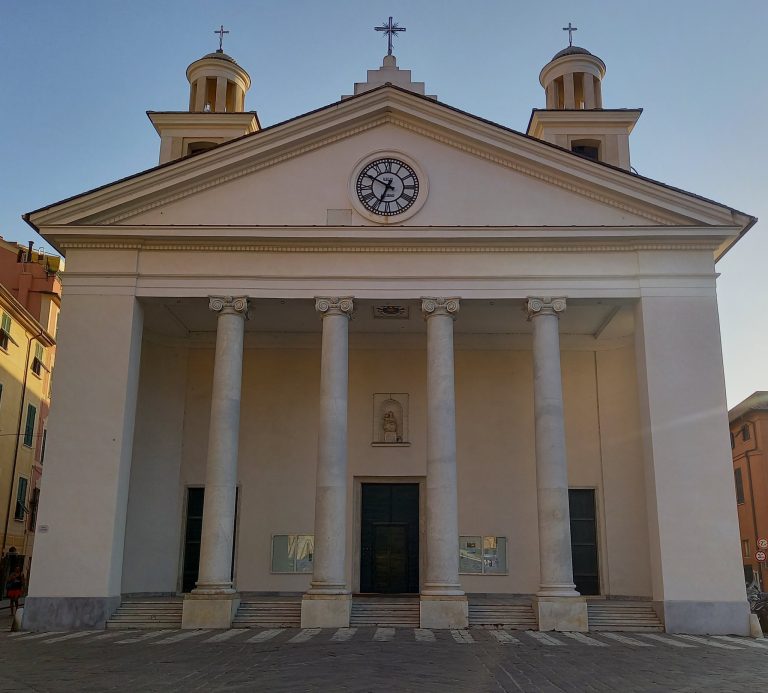
Nostra Signora del Ponte Sanctuary: A Marian Parish Church in Lavagna


Site at a Glance
- Rating
- 4.6
- Popularity
- Very Low
- Country
- Italy
- Primary era
- Medieval
- External website
- Open
- Eras represented
- Medieval, Early Modern, Modern
- Civilizations
- Genoese, Italian
- Site type
- Religious
- Remains
- Sanctuary
On this page13 sections
History
Nostra Signora del Ponte Sanctuary is a Roman Catholic church in Lavagna, Italy, dedicated to Mary, the mother of Jesus and a central figure in Christian devotion. It developed from a thirteenth-century chapel built on the Ponte della Maddalena over the Entella River, and today it serves as the parish church of Santa Maria del Ponte within the Chiavari-Lavagna vicariate of the Diocese of Chiavari. The sanctuary’s history links the bridge, Marian devotion, Franciscan activity, and the growth of the parish community.
The Chapel and the Bridge
According to local history, Pope Innocent IV promoted the renovation of the chapel and bridge to make the connection between Chiavari and Lavagna safer. Innocent IV was born Sinibaldo Fieschi and came from the prominent Fieschi family associated with Lavagna. The chapel was connected with an image of the Madonna del Ponte, whose presence later shaped the development of a larger place of worship.
In 1451, the Fieschi family transferred the bridge and chapel to the Franciscan friars of Chiavari. The Franciscans belonged to the order founded by Saint Francis of Assisi, whose religious life emphasized poverty, preaching, and service. After acquiring land on the eastern bank of the Entella, they began building a new church suited to the Marian image. Simone Gatto directed the work, which was completed and consecrated in 1492.
Franciscan Expansion and Marian Devotion
With the approval of Pope Alexander VI, whose papacy lasted from 1492 to 1503, the image of the Madonna del Ponte was transferred to the new church in 1500. The friars then enlarged the building and erected a small bell tower. Two lateral altars, dedicated to the Ascension and the Crucifixion of Jesus, were added in 1506.
In 1564, the church was sacked during a night raid led by Dragut, a sixteenth-century Ottoman naval commander known for attacks along the western Mediterranean coast. The valuable Marian image was not taken. Its survival strengthened local devotion to the image and to its representation of the Madonna.
Ownership and administration remained under the archpriest of Lavagna, while the Franciscan friars repeatedly sought complete custody from ecclesiastical authorities. The dispute eventually resulted in the church’s closure, and worship ceased there for nine years.
Renewal and Parish Status
The church was transformed and enriched in 1783, then completely renewed at the end of the nineteenth century. This later renewal added the left nave and lengthened the presbytery, the part of the church surrounding the main altar and traditionally reserved for the clergy. A new bell tower was erected in 1898, and the interior was frescoed during the same period.
On 10 January 1903, Bishop Fortunato Vinelli, the first bishop of the Diocese of Chiavari, established the local parish as a separate rectory from the parish of Santo Stefano. The church subsequently acquired the titles of parish church and sanctuary and was declared an Italian national monument.
The Madonna and Child image underwent approximately seven years of restoration by the Ligurian Superintendency for Historical and Artistic Heritage. It returned to the sanctuary on 22 March 2009. The restoration dated the painting to approximately 1290 to 1310 and attributed it, on the basis of its details, to the Sienese painter Pietro Lorenzetti, a major artist of the early fourteenth century.
Marian devotion continues in the annual procession held on the first Sunday after 8 September. The procession takes place at Ponte della Maddalena and is followed by a fireworks display visible from the bridge over the Entella.
Remains
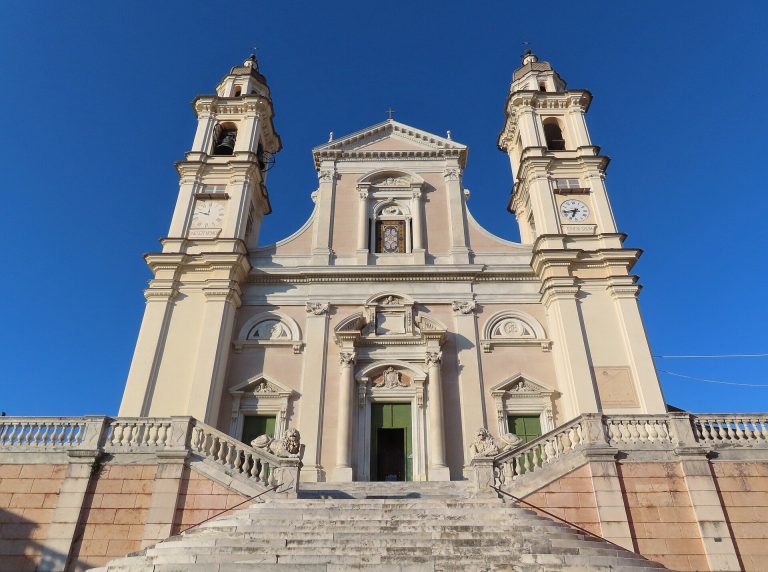
The sanctuary stands in Piazza Abate Lazzaro Podestà beside the historical setting of the Ponte della Maddalena and the Entella River. Its surviving form combines a three-naved church with an apsidal presbytery, a decorated facade, a tall Neo-Gothic bell tower, and paintings and sculptures from several periods.
Facade and Bell Tower
Three-Portaled Facade
The facade has three portals. The central opening has a horizontal stone element spanning its entrance, while the two side portals are surmounted by lunettes, semicircular fields above doors or windows. A fresco of the Madonna of Mercy occupies the main portal and is attributed to Lorenzo Fasolo, with a date at the beginning of the sixteenth century.
The lunette over the left portal contains a sixteenth-century bas-relief of Saint Francis receiving the stigmata, the bodily marks traditionally associated with Christ’s crucifixion wounds. Local tradition identifies a hoodless man holding an open book in the scene as Dante Alighieri, the late medieval Italian poet best known as the author of the Divine Comedy. The tradition holds that Dante crossed the Ponte della Maddalena while travelling toward France.
Neo-Gothic Bell Tower
The bell tower, erected in 1898, rises approximately 40 metres and follows a Neo-Gothic design. Each of its four sides has three levels of paired windows, meaning openings divided into twos by a vertical central member, followed by a level of triple windows. The upper level is framed by two pilasters resting on a narrow cornice and is topped by a pediment that matches the pediment of the church’s central body.
Its spire is completely covered with scale-worked slate, a stone traditionally quarried in Val Fontanabuona. A clock face is placed between the third level of paired windows and the cornice above. The belfry contains eight bells tuned in D3 major. The first five were cast in 1903 by the Milanese Fratelli Barigozzi foundry, while the three smaller bells were cast by the ECAT foundry of Mondovi on 3 November 2014.
Interior and Painted Decoration
Naves and Presbytery
The interior is arranged in three naves and ends in an apsidal presbytery, which terminates in a semicircular or polygonal apse. The central nave has a wooden roof formed by two sloping planes. The lateral naves are covered by cross vaults, ceilings created where two barrel-vaulted forms intersect. The two lateral altars are dedicated to the Ascension and the Crucifixion of Jesus.
Frescoes
The counterfacade contains sixteenth-century frescoes by Lorenzo Fasolo. Its upper section depicts the Massacre of the Innocents, while the lower section represents Franciscan saints.
Carlo Thermignon painted the presbytery vault with the four Evangelists. Carlo Krattly painted the two presbytery walls, except for six paintings on one wall that were designed and painted by Thermignon.
Altars and Sculptures
The high altar is surmounted by an icon of the Madonna by Francesco Maria Schiaffino. Two canvases beside the presbytery portray Jesus ascending Calvary and Jesus crowned with thorns; they are attributed to Antonio Lexerna.
A wooden crucifix made by the eighteenth-century sculptor Anton Maria Maragliano is preserved in the sanctuary. In the chapel of the right nave, the altarpiece depicts the Holy Family and was painted by Francesco Grandi in 1882.
Madonna and Child
The restored Madonna and Child image is housed inside the sanctuary. Dated to approximately 1290 to 1310 and attributed to Pietro Lorenzetti, it is associated with the artistic tradition of medieval Siena and remains the central Marian image connected with the church’s foundation and devotional history.