Chiavari Castle: A Medieval Fortress in Italy


Site at a Glance
- Rating
- 4.1
- Popularity
- Low
- Country
- Italy
- Primary era
- Medieval
- External website
- Open
- Eras represented
- Medieval
- Civilizations
- Genoese
- Site type
- Military
- Remains
- Castle
On this page7 sections
History
Chiavari Castle is a medieval fortress in Chiavari, Italy, built between 1146 and 1147 on a hill above the fortified seafaring settlement of Clavai, now Chiavari. It was one of the earliest castles in the Tigullio Gulf and defended the settlement’s medieval citadel and the surrounding valley.
Genoese Foundation and Medieval Conflicts
The castle’s construction followed the agreement of 1138 that established a perpetual alliance between Genoa and the Fieschi family. Its position above the settlement gave it a defensive role within the wider organization of medieval Chiavari. The castle was besieged in 1172. In 1278, Moruello Malaspina and Alberto Fieschi captured it, but their control lasted only eight days.
During the first half of the fourteenth century, violent struggles between the Guelfs and Ghibellines repeatedly affected the castle. The Guelfs generally supported the papacy, while the Ghibellines generally supported imperial authority. The castle was rebuilt several times during these conflicts, and the surrounding settlement was strengthened as well.
Expansion and Abandonment
In 1404, the Republic of Genoa decided to reinforce and enlarge the medieval citadel beside the sea. The measure was partly intended to deter attacks by Barbary corsairs, maritime raiders operating from the North African coast. The decision was associated with the French marshal Jean Le Meingre, known as Boucicaut, who was then a lieutenant and governor of the Genoese Republic. The work was entrusted to Martino della Torre, a native of Chiavari.
After the hilltop castle ceased to serve as a defensive stronghold, it was gradually abandoned. Its parts began to be demolished from 1575. The property has been privately owned since 1993, and the castle is designated Italian national heritage.
Structural Monitoring
Ground movement became a concern in the early twenty-first century, partly in connection with nearby excavation for a residential unit. Structural investigations in 2007 and 2008 measured movement toward the valley of about one millimetre per month between October 2007 and June 2008, totaling approximately nine millimetres. After stabilization during summer 2008, movement resumed toward the hill at roughly the same rate. The University of Genoa’s Department of Building, Environmental and Territorial Engineering subsequently placed the castle under monitoring, with measurements automatically recorded every six hours.
Remains
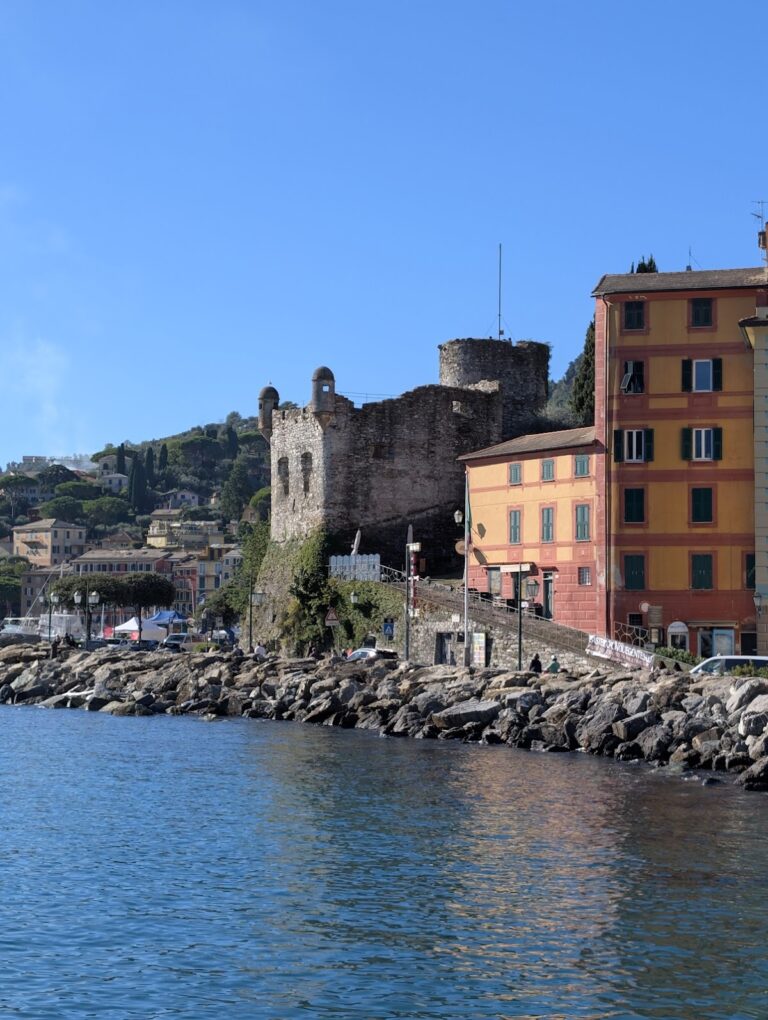
The surviving complex occupies a hill above Chiavari’s medieval fortified settlement. Its layout includes an intact tower on the uphill side, a fortified military yard across from it, and traces of the defensive wall extending toward the citadel. The military yard was an open area within the fortress used for the movement, assembly, and organization of troops.
Fortifications and Water Supply
The medieval settlement connected with the castle was enclosed by a substantial defensive wall with seven gates and fourteen lookout towers. Ruins of this circuit remain visible around the settlement. In front of the surviving tower, two water cisterns are still visible. They supplied water intended to help sustain people inside the castle during sieges.
Evidence of Ground Movement
Cracks in floor tiles were fitted with small glass indicators during the structural monitoring. These devices allowed movement to be measured automatically at six-hour intervals, providing a continuing record of changes affecting the castle’s fabric.
Nearby sites