Kernavė: Medieval Capital and Archaeological Site in Lithuania


Site at a Glance
- Rating
- 5
- Popularity
- Very Low
- Country
- Lithuania
- Primary era
- Medieval
- External website
- Open
- Eras represented
- Classical, Medieval, Modern
- Civilizations
- Grand Duchy of Lithuania, Russian
- Site type
- City
On this page15 sections
History
Kernavė is a medieval Lithuanian capital and archaeological site in Lithuania, associated with the Grand Duchy of Lithuania and the thirteenth- and fourteenth-century development of a fortified proto-urban settlement. Its wooden fortifications, trading activity, and connection with early Lithuanian statehood have made it a symbol of pagan independence and national historical memory.
From prehistoric settlement to medieval center
The area around Kernavė was sparsely inhabited during the late Paleolithic period. The number of settlements increased substantially during the Mesolithic and Neolithic periods, establishing a long human presence before the medieval town developed.
During the thirteenth and fourteenth centuries, Kernavė became a proto-urban settlement with several wooden fortifications and an important trading function. It occupied a strategic position within the Grand Duchy of Lithuania, the medieval state whose political and territorial development made Kernavė an important center before the later prominence of Vilnius.
The first written record and the age of the grand dukes
Kernavė first appears in written sources in 1279, when the Teutonic Knights besieged it. The Teutonic Knights were a Catholic military order that campaigned against pagan and Christian states in the Baltic region, including Lithuania. The Livonian Rhymed Chronicle calls Kernavė a city in the land of Grand Duke Traidenis, a thirteenth-century ruler of Lithuania, and describes it as “the city of Traidenis.” This wording has led some researchers to identify Kernavė as his capital.
A later chronicle, known as the Bychowiec Chronicle, attributes the town’s name to the legendary Lithuanian duke Kernus. Tradition also holds that Kernavė remained a residence of the supreme pagan priests after Vilnius became the grand-ducal capital. Among those associated with the site is Lizdeika, a legendary Lithuanian pagan high priest connected with the pre-Christian religious tradition, who is traditionally placed at Kernavė during the later fourteenth century.
Destruction and preservation
In 1390, during the Lithuanian Civil War of 1389 to 1392, the Teutonic Knights burned Kernavė, including its town, castle, and buildings in the Pajauta valley. The settlement was not rebuilt in the valley after the attack, and surviving inhabitants moved to the hilltop.
The abandoned valley settlement was later sealed beneath alluvial deposits that formed wet peat. These waterlogged conditions preserved many archaeological remains in unusually good condition. Kernavė consequently acquired the informal designation “the Troy of Lithuania” and became an important archaeological site.
Memory, research, and cultural life
Kernavė was marked on the 1613 map Magni Ducatus Lithuaniae, et Regionum Adiacentium exacta Descriptio, printed in Amsterdam and financed by the Polish-Lithuanian magnate Mikołaj Krzysztof Radziwiłł, known as “the Orphan.” Interest in the site revived in the nineteenth century after the romantic writer Feliks Bernatowicz portrayed the area in his 1826 novel Pojata, Daughter of Lizdeika. The Tyszkiewicz brothers and Władysław Syrokomla later excavated the hillforts, with Syrokomla’s work dated to 1859.
Archaeological investigations resumed after the Second World War. Vilnius University worked at Kernavė in 1979, followed by the Lithuanian Institute of History from 1980 to 1983. Later investigations were led by Pranas and Regina Kulikauskas. About 2 percent of the Kernavė archaeological area has been examined, leaving the preserved deposits central to continuing interpretation of the site.
A protected cultural area of the Lithuanian state was established at Kernavė in 1989, followed by the creation of the State Cultural Reserve of Kernavė in 2003. The Kernavė Archaeological Site was added to the UNESCO World Heritage List in 2004. UNESCO’s list recognizes places judged to have outstanding cultural or natural value under an international heritage convention. The inscribed area covers 194.4 hectares, with a buffer zone of 2,455.2 hectares.
The Rasa festival has been held at Kernavė since 1967. Rasa is a traditional Lithuanian midsummer festival associated with pre-Christian seasonal customs. At Kernavė, the celebration also became connected with spiritual renewal, resistance to the suppression of Lithuanian national consciousness, and opposition to the forced introduction of Soviet traditions. The site hosts national commemorations of the coronation of Mindaugas on 6 July. Mindaugas was the first crowned grand duke of Lithuania and is traditionally regarded as the founder of the medieval Lithuanian kingdom.
The churchyard and its chapels form part of Kernavė’s archaeological and historical reservation. People from Kernavė were buried in the grounds of earlier churches from the fifteenth through the nineteenth centuries. The Kernavė Primary School, built in 1929, became an early center of local cultural education. On 28 December 1930, teacher Juozas Šiaučiūnas opened the first museum exhibition there. He continued his educational and cultural work until his deportation by Soviet authorities on 14 June 1941 and died in Siberia on 17 October 1943. The school was named after him in 1998.
Remains
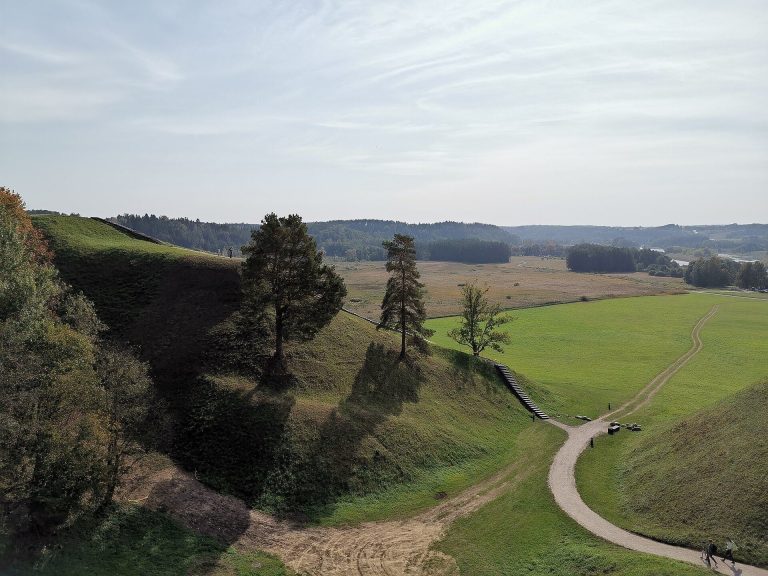
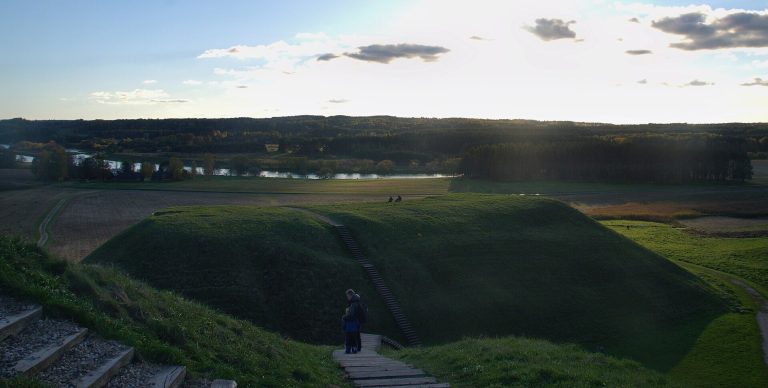
Kernavė lies on the right bank of the Neris River, on the upper Neris terrace. The archaeological landscape includes five wooden fortifications dating broadly from the thirteenth and fourteenth centuries, represented by surviving hillforts. The medieval settlement occupied the Pajauta valley beneath alluvial and peat deposits, where wet ground helped preserve its archaeological remains.
Hillforts and the medieval valley
Wooden fortifications
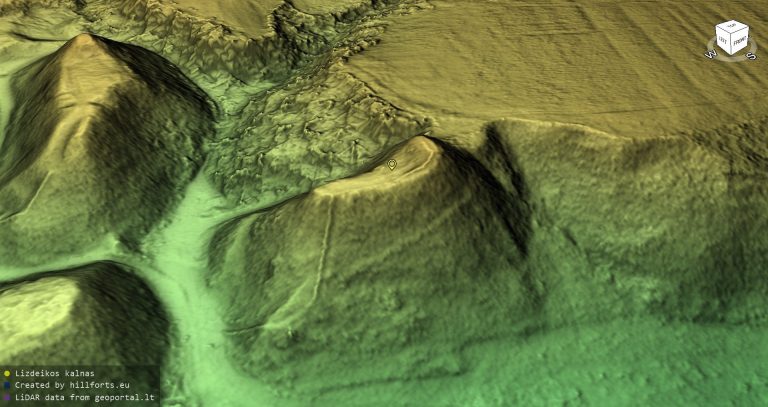
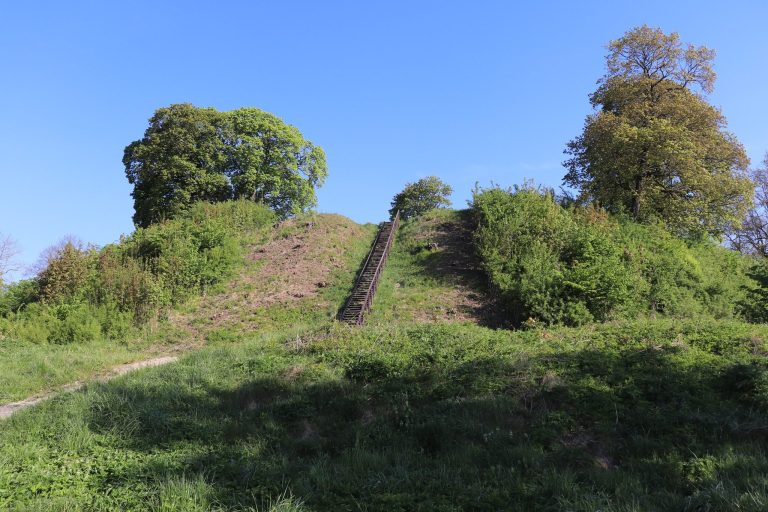
The five hillforts represent the locations of wooden fortifications that formed part of medieval Kernavė. Their thirteenth- and fourteenth-century remains belong to the period when the settlement functioned as a fortified proto-urban center and trading place. Archaeologists have investigated Altar Hill, the mound known as Mindaugas’s Throne, and Lizdeika Hill. Their archaeological layers span the first through the fifteenth centuries AD.
The wooden road
The oldest known medgrinda at Kernavė is a concealed underwater road paved with wood. A medgrinda is a deliberately constructed wooden road or causeway laid through wet ground or shallow water, sometimes for defensive purposes. The Kernavė example may date from the fourth to the seventh century and provides evidence of an early engineered route through the wet landscape.
The churchyard and chapels
Vytautas’s church and the present church
The foundations of the church built in 1420 by Vytautas are exposed beside the present churchyard. Vytautas was the grand duke of Lithuania whose rule in the early fifteenth century is associated with the construction of Kernavė’s first church. A concrete monument with a cross, erected in 1930 during commemorations of the five-hundredth anniversary of Vytautas’s death, commemorates the earlier building.
The present church was built between 1910 and 1920 and has predominantly Neo-Gothic features. During the 1980s, its churchyard was repaired, new gates were built, and the altar and interior were restored on the initiative of Monsignor Česlovas Krivaitis. The churchyard contains Stations of the Cross arranged by the artist Jadvyga Grisiūtė.
Church monuments and furnishings
Two commemorative monuments stand in the churchyard. One shows a hearth and sword, representing the transition from paganism to Christianity. The other shows a sword-bearing knight between city gates, a principal element of Kernavė’s coat of arms. Millstones are incorporated into both monuments. Nearby is the grave of Nikodemas Švogžlys-Milžinas, a priest, writer, and promoter of Kernavė’s history, close to the monument commemorating the seven-hundredth anniversary of the town’s first written mention.
The church contains a Neo-Baroque side-aisle altar centered on a painting of Mary. Columns and sculptures of Saint Peter and Saint Paul flank the image, while five smaller Baroque sculptures represent Mary, two angels, and two saints. The altar’s polychrome architectural details imitate marble and include bronze features.
The oil painting Marija Škaplierinė, made on canvas with metal, dates from 1816 and measures 220 by 120 centimeters. It depicts the Mother and Child, God the Father, and the Holy Spirit as a dove. The eighteenth-century oil painting The Holy Family, measuring 143 by 104 centimeters, shows the Mother and Child with a lamb, Saint Joseph in the background, and angels above. Its asymmetrical composition uses several perspective lines. Other furnishings include a small altar from the early nineteenth century, two glasses from the early nineteenth century, one glass from the early eighteenth century, and a brass bell cast in Vilnius in 1667. The bell has a diameter of 45 centimeters.
Wooden chapel
A small wooden chapel near the church represents Lithuanian folk architecture. It is believed to have been built in the late thirteenth century on the Kernavelė estate and later moved to the Kernavė church. The church used it as a storehouse in the late nineteenth century. After falling into disrepair, it was repaired in 1959 and restored in 1993 and 1994. The chapel belongs to the Kernavė parish and displays wooden church sculptures.
Romer family chapel
A brick chapel built between 1851 and 1856 by the landowner Stanisław Romer houses the Romer family mausoleum. Constructed of brick and plaster, it is an example of late Classicism and has an unusual small octagonal plan. An opening in the floor leads to a crypt where coffins were placed in niches. The stone altar mensa survives, black benches line the side walls, and memorial plaques bearing the family coat of arms and names are attached to the walls. Neglected after the First World War, the chapel was repaired in 1959 and 1987 and belongs to the Kernavė parish.
Parish, museum, and town buildings
A non-traditional presbytery was built during the 1980s, and the surrounding area was cleared. It contains an exhibition on parish life together with historical and sacred relics. A museum of sacramental relics opened in the old presbytery building in 1987, and the prewar Iron Wolf sculpture was reconstructed in the parish hall.
A broad pavement connects the town center with the church. The cultural center designed by architect A. Alekna houses the State Kernavė Archaeological Historical Museum and a district office. The museum contains 16,000 exhibits from excavations at the archaeological site, covering a long period of the region’s history.
The Kernavė Primary School is a two-story building constructed in 1929 and repaired and restored in 1998. Older town architecture is best preserved along Vilnius and Kriveikiškio streets, while buildings in the central part of the town are mainly postwar. The archaeological and historical reservation lies south of the town.