Rittergut Etzdorf: A Historic Estate and Agricultural Enterprise in Germany


Site at a Glance
- Rating
- 4.7
- Popularity
- Very Low
- Country
- Germany
- Primary era
- Modern
- External website
- Open
- Eras represented
- Early Modern, Modern
- Civilizations
- German, Holy Roman Empire, Kingdom of Prussia
- Site type
- Domestic
- Remains
- Manor House
On this page15 sections
History
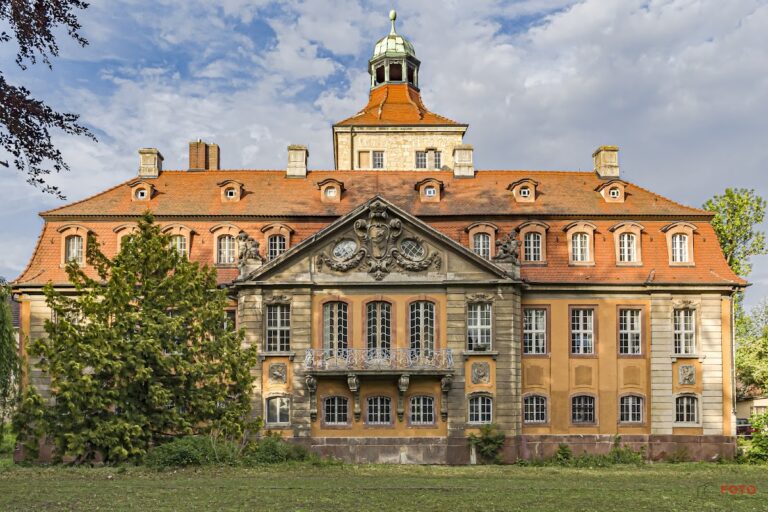
Rittergut Etzdorf is a historic estate in Germany, in Etzdorf near Teutschenthal, whose oldest present part dates from after 1732 and whose manor house was built in 1906 in the Art Nouveau style. Its history encompasses monastic ownership, noble administration, royal property, a large private agricultural enterprise, and several forms of state and academic management.
Monastic property and medieval settlement
Between 880 and about 1200, the Etzdorf estate belonged to monastic property associated with Hersfeld Monastery and Kaltenborn Monastery. The settlement was then known as Erhardesdorp or Erardesdorff and later as the farming village of Erhardesdorf. It eventually became deserted. Its inhabitants probably moved to Steuden, after a military and trade road linking Halle with Querfurt and Thuringia passed the settlement.
During the Middle Ages, Etzdorf was held by several noble families whose identities are not fully established. The von Etzdorf family probably originated in the settlement. In the early sixteenth century, Vollrad von Etzdorf served as a cathedral canon at Naumburg. By 1569, Etzdorf belonged to the Hessian Malsberg, or Malsburg, family and formed part of the subordinate district of Schraplau in the County of Mansfeld.
Transfer among noble and royal owners
Niclas Schwuckardt von Schauburg acquired the Schraplau district, including Etzdorf, in 1620, subject to redemption. After his death in 1643, ownership passed to his nephew Albert. On 18 June 1679, the Counts of Mansfeld transferred Etzdorf and other possessions by settlement to Christoph von der Wense, a Brunswick-Lüneburg-Celle district councillor. With permission from the Archbishopric of Magdeburg, Christoph transferred Etzdorf to his sister Eleonore, who was married to Johann Casimir von der Schulenburg. The estate consequently entered the possession of the von der Schulenburg family.
In 1732, Friedrich Wilhelm I purchased Etzdorf from the von der Schulenburgs for his youngest son, Prince August Ferdinand. The oldest part of the present estate was built during this period. After Prince August Ferdinand died in 1813, his second son, Prince August, inherited the Schraplau district and the Etzdorf outlying estate, or farm attached to a larger manor. His officials administered and leased the property rather than managing it directly.
Tenants and the Hohenzollern period
Around 1800, Chief Bailiff Friedrich Philipp Wentzel became Etzdorf’s tenant. He continued in that role after the estate passed in 1843 to Prince August’s eldest daughter, the unmarried canoness Eveline von Waldenburg. A canoness was a woman, often from a noble family, belonging to a religious foundation. Eveline’s relationship with Pastor Weise of nearby Wansleben caused a stir in the Prussian royal household. Following her death in 1848, Etzdorf remained in Hohenzollern hands. The Hohenzollerns were the ruling dynasty of Prussia and later the German Empire, so the estate formed part of the property holdings of the Prussian royal house.
In 1871, the royal administrative councillor Friedrich Schröder acquired the estate for his son, Amtmann Albert Schroeder, with the support of his friend Baron Wilhelm von Humboldt. An Amtmann was an administrative official. Albert Schroeder, born in 1841, died at Etzdorf in 1916 and was succeeded by his son Clemens. When Clemens died in 1925 at nearly fifty years of age, his wife Katharina, known as Käthe, managed the estate temporarily. Their son Max took over in 1934. Katharina later retired to a villa in the village known as “Tante Käthes Haus.”
Mechanized agriculture under Max Schröder-Etzdorf
Max Schröder-Etzdorf developed the estate’s approximately 500-hectare agricultural enterprise into a highly mechanized operation centred on crop production and storage. Beginning in 1934, the farm introduced new agricultural methods, modern bookkeeping, and social measures within the framework of National Socialist agricultural policy. Schröder-Etzdorf described these changes in a booklet that reached four editions and a revised fifth edition in 1954. In 1935, Erich Neuss characterized Etzdorf as a purpose-built form of the modern large-scale agricultural enterprise.
In 1944, Schröder-Etzdorf was imprisoned and indicted before the State Court because of activities connected with the Reusch-Kreis, an opposition circle in Nazi Germany. The indictment was later dropped. The Schröder family retained ownership of Etzdorf until 1945.
University farm and state ownership
After the Second World War, the new provincial administration expropriated the private owners as part of the land reform in the Soviet occupation zone, the area of Germany administered by the Soviet Union after 1945. Max Schröder-Etzdorf became manager of his former farm. The University of Halle took over the estate, however, preserving the complete agricultural enterprise from division under the land reform. From 1945, it operated as the university’s teaching and experimental farm under Erich Hoffmann.
In 1950, the estate became public property and was reorganized as a Volkseigenes Gut, or state-owned farm, in the German Democratic Republic. After the economic, monetary, and social union of 1 July 1990, it came under the administration of the Treuhandanstalt, the institution responsible for administering and privatizing state-owned enterprises and property in the former East Germany. It was later managed by the Bodenverwertungs- und Verwaltungsgesellschaft and operated as part of the Treuhand agricultural estate company.
Research, cultivation, and return to private management
From 1945, the teaching and experimental farm was affiliated with the Institute of Farm and Labour Studies at Martin Luther University. Its Land Labour Research Department maintained an external office at Etzdorf until 1955. In 1946, the Institute of Arable and Crop Production created an experimental station with an area of approximately 15 hectares. The Agricultural Meteorological Institute occupied rooms in the manor house from 1946 to 1953. A farm-machinery testing station was operated by the Institute of Mechanization at Potsdam-Bornim, while livestock and poultry institutes carried out research and advisory work involving cattle, pigs, sheep, and poultry.
The farm grew grain, sugar beet, potatoes until 1970, and peas for seed production and canning. A closed system for breeding sows and producing feeder pigs continued until 1992. The sow operation then ended, while the Barnstädt Agricultural Cooperative purchased and continued to operate the fattening barns.
In 1995, the central farm complex and its agricultural land were leased long-term to the farmer Herko Hayessen. The Hayessen family, descended from Friedrich Schröder, the first Schröder family owner, has lived at Rittergut Etzdorf since then. The present agricultural enterprise covers approximately 350 hectares and primarily grows grain.
Remains
Rittergut Etzdorf survives as a central farm complex with associated agricultural land. Its buildings reflect several stages of the estate’s development, from the oldest construction undertaken after the royal purchase of 1732 to the agricultural modernization of the twentieth century. The manor house, workers’ facilities, former inn, silo, and retirement villa each preserve a different part of the estate’s residential, administrative, social, or productive functions.
Residential and administrative buildings
Manor house
The manor house was built in 1906 in the Art Nouveau style, an international style characterized by flowing lines, organic ornament, and the integration of architectural and decorative design. It served as the residence of Albert and Clemens Schröder and remained the family’s home until 1946. The building also functioned as the estate’s administrative headquarters and provided accommodation for guests and domestic staff.
From 1946, the manor house became the administrative centre of the University of Halle’s teaching and experimental farm. Branch offices of scientific institutes occupied parts of the building, which also provided housing for farm and institute employees and apprentices. Since 1995, it has been the residence of the Hayessen family.
“Tante Käthes Haus”
Katharina Schröder’s former retirement villa survives in the village of Etzdorf. Known locally as “Tante Käthes Haus,” it is associated with the period after she withdrew from the management of the estate.
Workers’ and agricultural buildings
Former washhouse
Max Schröder-Etzdorf equipped the former washhouse with facilities where estate workers could shower and bathe. The building also provided washing facilities for the laundry of agricultural workers’ families. In 2001, it was adapted for use as a youth club of the Steuden municipality and formally inaugurated for that purpose in the same year.
Former inn and communal building
The former inn was converted by Max Schröder-Etzdorf into a Gefolgschaftshaus, a communal and social building for the workforce under National Socialist terminology. It provided a venue for events in Etzdorf, so such gatherings no longer had to be held in Steuden.
Estate silo
The estate silo was built in 1942 from concrete shells, wood, and roof tiles. The tiles came from the Louisenwerk Thonindustrie Aktien Gesellschaft, founded in 1900 in Voigtstedt in the Kyffhäuser region of Thuringia. The silo represents the storage infrastructure associated with the estate’s mechanized crop-producing enterprise.