Castell de Guàrdia: A Medieval Frontier Fortification in Spain


Site at a Glance
- Rating
- 4.4
- Popularity
- Very Low
- Country
- Spain
- Primary era
- Medieval
- External website
- Open
- Eras represented
- Medieval
- Civilizations
- Unclassified
- Site type
- Military
- Remains
- Castle
On this page9 sections
History
Castell de Guàrdia is a medieval frontier fortification in Spain, above Guàrdia de Noguera in the municipality of Castell de Mur. It formed part of the Romanesque-era network of frontier castles that organized Pallars during the eleventh century and provided Castell de Mur with visual control of the Terradets gorge. The settlement of Guàrdia de Tremp developed around the castle, giving rise to the town and the former municipal district associated with its name.
Origins and the Pallars frontier
The earliest reference to Castell de Guàrdia dates from 958, when Ramon III, Count of Pallars, granted it as a fief to Berenguer. A fief was land or an office held from a superior lord in return for service or allegiance, and Ramon retained one-third of the rights in this grant. The arrangement may have preceded the castle’s conquest, since the stronghold probably passed from Muslim control during the early eleventh century, as the Count of Urgell advanced through the Dellà and Deçà basins.
By 1012, the castle appeared in a donation to Santa Maria de Gerri and belonged to the Counts of Pallars Jussà. In 1051, Miró and his wife Gueraua exchanged Castell de Guàrdia and the town of Guàrdia for Susterris, which belonged to Count Ramon. Ramon then granted Guàrdia to Arnau Mir de Tost, a prominent eleventh-century nobleman associated with Christian expansion into the borderlands of Pallars and the Montsec.
Transfer to the Counts of Pallars
Arnau Mir de Tost assigned the castle in his 1072 will to his daughter Valença, wife of the Count of Pallars Jussà, and to their son, the future count. This testamentary transfer brought the castles and territories controlled by Arnau Mir de Tost into the hands of the Counts of Pallars. The Count of Urgell confirmed these transfers while retaining temporary lordship specifically over Castell de Guàrdia.
Bernat Transver served as castellan at the end of the eleventh century. A castellan was the official responsible for holding and administering a castle. By the thirteenth century, Castell de Guàrdia was held by Bernat de Mur, Archdeacon of Tremp, who transferred it to his nephew Artús.
Royal lordship and later ownership
King Joan I claimed Castell de Guàrdia in 1270 because of its strategic value. It then came under royal lordship, meaning that the monarch became its ultimate lord even when custody or administration remained with another family or institution. The castle continued to be associated with the Mur provostry, an ecclesiastical administrative institution headed by a provost, which received royal recognition to appoint a bailiff there.
Throughout the thirteenth and fourteenth centuries, the castle was a royal fief held by members of the Mur family, including Berenguer Artús de Mur, Simó de Mur, and Dalmau de Mur. In 1381, it was sold to Berenguer d’Abella, Baron of Abella and a trusted figure at the Barcelona court. The king compensated the Mur family with other castles, enabling them to enlarge their possessions westward. Castell de Guàrdia retained its royal status until the nineteenth century.
The former parish church of Sant Feliu de Guàrdia survives from the primitive settlement around the castle. Castell de Guàrdia is protected as a Cultural Asset of National Interest as a historic monument and is also registered as a Spanish Asset of Cultural Interest.
Remains
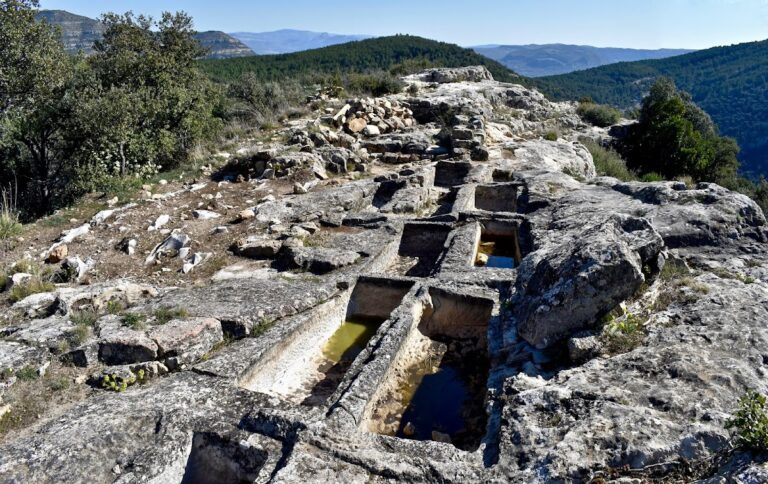
The castle occupies an elongated rock platform on the Cingle del Castell, a rocky escarpment above Guàrdia de Noguera at about 705 metres above sea level. Its surviving defenses combine a distinctive tower with a section of enclosing wall, while the remains of the primitive settlement of Guàrdia de Tremp extend around the fortification.
Fortification
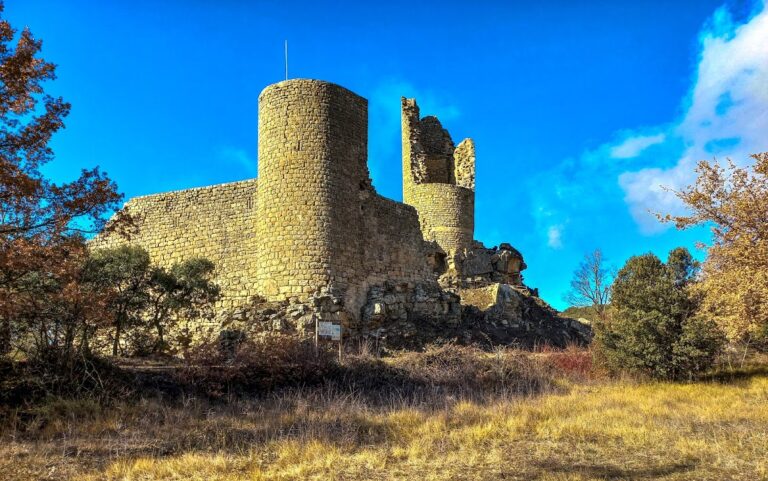
Triangular tower
The principal surviving structure is an unusual tower with a triangular plan and a rounded end. It rises approximately 8 metres and has a ground-level doorway about 150 centimetres wide, together with a second doorway at first-floor level. The remains of battlements can still be discerned along its upper edge. Its position and form suggest construction close to around the year 1000.
Enclosing wall
The surviving eastern section of the enclosing wall measures about 24 metres in length and 3 metres in height. Five loopholes face the Conca de Tremp, providing openings for observation or defense. The wall consists of medium-sized, roughly worked stone blocks carefully arranged in horizontal courses, and most of its fabric appears to date from the late eleventh or early twelfth century.
Settlement and parish church
The primitive settlement of Guàrdia de Tremp spread around the castle and formed the historic community connected with the fortification. The preserved Church of Sant Feliu de Guàrdia is associated with this settlement and remains as part of the surviving historical landscape around the rock platform.