Kukesburg: A Former Refuge Hillfort near Springe, Germany

Site at a Glance
- Rating
- 4.7
- Popularity
- Very Low
- Country
- Germany
- Primary era
- Medieval
- Eras represented
- Iron Age, Medieval
- Civilizations
- Unclassified
- Site type
- Military
- Remains
- Fort
On this page7 sections
History
Kukesburg is a former hillfort in Germany near Springe, built in several phases, with its oldest phase probably dating to the third century BC. Set on a western spur of the Nesselberg ridge between Altenhagen I and Brünnighausen, it was a fortified site on elevated ground that served local communities as a temporary refuge during periods of war.
Early fortification
The earliest early historic phase consisted of an oval defensive circuit made from a rampart and ditch. Kukesburg was never permanently inhabited and was probably occupied only sporadically, when nearby people needed protection. The successive construction phases partly overlapped one another, showing that the defenses were modified over time.
Saxon and medieval boundary
The name Kukesburg first appears in 1007 and derives from Kukswall, meaning a boundary rampart. The fortification stood near the boundary between Engern and Eastphalia, two historical regional groupings of the Saxons. In the medieval period, the boundary between the dioceses of Minden and Hildesheim ran through the surrounding area. A popular name, Hünenburg, reflects a tradition that giants had once lived at the site.
A later phase, probably dating from the ninth or tenth century, belonged to a wider group of comparable fortifications in the Middle Weser and Leine regions. Earlier interpretations described such sites as Saxon or as “Heinrich castles.” More recent research places comparable fortifications broadly between the eighth and twelfth centuries and regards their lack of permanent settlement as evidence for occasional refuge use.
Survey, quarrying, and interpretation
Kukesburg has not yet undergone archaeological excavation. Retired Major General August von Oppermann surveyed and described the site in 1883, and it was included in the Atlas of Prehistoric Fortifications in Lower Saxony in 1888, a project later continued by the archaeologist Carl Schuchhardt.
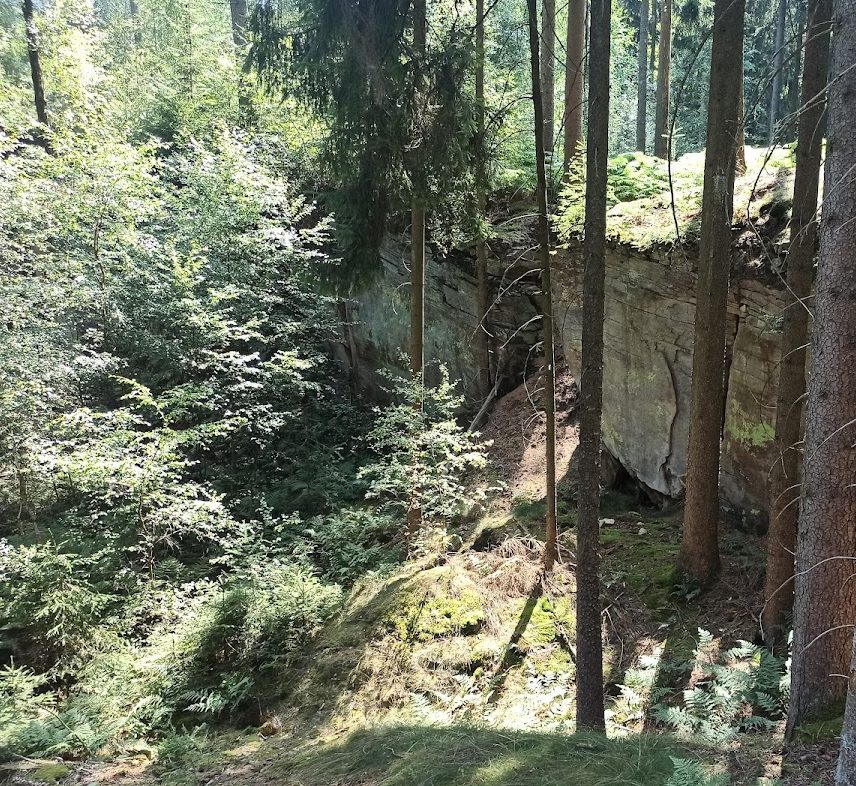
From the late nineteenth into the early twentieth century, the expansion of a sandstone quarry destroyed part of the fortification. The pale sandstone beds of the Nesselberg reach up to 10 metres in thickness and were valued for their quality. Stone quarried in the area, together with material from Obernkirchen and other Deister quarries, was used in buildings such as Hanover’s New Town Hall, opera house, and state museum, as well as the Reichstag building in Berlin.
Remains
Kukesburg stands at approximately 260 metres above sea level. Its surviving remains form a defensive complex of ditches, ramparts, and wall fragments, with the different construction periods partly lying over one another. Most of the surviving wall material is now covered by earth, while the overall layout preserves the character of a fortified enclosure rather than a settled habitation.
Defensive enclosure
The younger fortification enclosed an area of approximately 150 by 100 metres. It consisted of an outer stone wall, about 2 metres high and approximately 1.5 metres thick, with an earth rampart piled against its inner side. A pointed ditch, whose sides meet at a sharp angle, surrounded the enclosure. The builders incorporated a group of natural rock outcrops into the defenses, using the terrain as part of the fortification.
The gate was placed between four large stone blocks. Worked holes cut into the rock held the timber framework of the entrance, preserving evidence of how the gateway was constructed. The older oval circuit and the younger stone-wall-and-earth-rampart enclosure survive in fragmentary form through their ditches, banks, and wall remnants.
Quarry passage
The quarry expansion altered the eastern part of the fortification. A subterranean passage from this period runs beneath the eastern rampart and connected the adjacent White Quarry with extraction areas inside the fortified area. It forms part of the later industrial landscape that affected the physical survival of Kukesburg.
Nearby sites