Glashütte Klein Süntel: An Early-Modern Glassworks in Germany
Site at a Glance
- Popularity
- Low
- Country
- Germany
- Primary era
- Modern
- Eras represented
- Modern
- Civilizations
- German, Kingdom of Hanover
- Site type
- Economic
- Remains
- Production Complex
On this page14 sections
History
Early operation and wartime disruption
Glashütte Klein Süntel is an early-modern glassworks site in Bad Münder, Lower Saxony, Germany. It is first mentioned around 1620 and is regarded as the earliest-founded of seven glassworks in the Deister-Süntel and Osterwald region. Although production was interrupted repeatedly, the works made utility glass for roughly 250 years before closing in 1886.
The surrounding area offered wood and coal from the Süntel, quartz sand for glassmaking, sandstone for furnaces, and clay for crucibles. Salt and potash were often scarce. Fighting near Bad Münder at the start of the Thirty Years’ War, the European conflict of 1618–1648, may have destroyed the glassworks and stopped production. It was rebuilt in 1680. A further glassworks was established at Klein Süntel in 1718 and was damaged twice by French forces around 1760 during the Seven Years’ War, a major European conflict from 1756 to 1763. Buildings in poor condition were replaced in 1769.
Changes of operator, debt, war, material shortages, technical problems, and interruptions to coal mining all contributed to long periods without production, especially in the seventeenth and early eighteenth centuries. The use of coal remains an important question in the site’s industrial history. Local coal was used routinely from the 1830s, but may have been used as early as the seventeenth century, when switching from wood to coal was technically difficult. Coal firing, a method introduced from Britain, used fuel more efficiently but required a stronger air supply. Klein Süntel may have adopted it early; nearby Osterwald, founded in 1701, had previously been considered the earliest coal-fired glassworks east of the Rhine.
Renewed production and expanding markets
More sustained production began around 1755, followed by another pause. In 1810, lessee Conrad Storm ended his 17-year lease after disagreements. Production resumed around 1815 when Hamelin merchant Johann Eduard Hentig took over. The Chronicle of Flegessen says that Hentig built a new glassworks in 1820 on an earlier waste heap. The factory remained in operation until its closure in 1886. Frequent changes in management continued to disrupt operations, with about ten different operators during the nineteenth century.
Bottles were the principal product, and the works supplied customers in towns including Braunschweig, Bremen, Hanover, Magdeburg, and Nordhausen, as well as Saxony, East Frisia, and the Netherlands. Bottles also reached North and South America through Bremen and the Netherlands. Some annual output was committed to individual buyers, and large numbers of bottles went to Pyrmont for mineral water. The works made Hanoverian bottles bearing the Welf horse, an emblem of the dynasty associated with Hanover, and probably held the Electorate of Hanover’s monopoly for these bottles in the mid-eighteenth century. The Electorate was a German electoral state.
From the eighteenth century, seals identifying the glassworks or maker increasingly appeared on bottles, following official action against tavern fraud involving undersized bottles. Examples include GL. FAB. A. Suntel around 1780 and Suntelsche GL.H. around 1800. A 1771 electoral decree required the initials GR, meaning King George and referring to George III; the practice continued until 1818.
The workforce averaged 20 to 30 people, including a master and as many as 12 journeymen. By the mid-nineteenth century there could be up to 20 glassmakers, alongside women workers and mostly adolescent carriers. Glass was first shaped by hand-blowing, with pressed glass introduced later. In 1834–35, mining official Christian Rave made bottle glass at the works with Hentig’s widow. Production also included large quantities of medicine bottles, and smaller amounts of made-to-order flat glass, preserving jars, and bottles for spirits and beer. At its mid-nineteenth-century peak, output reached as many as 350,000 bottles and 500,000 medicine bottles a year. Utility glass was mainly cobalt blue around 1880, and production exceeded 1.2 million bottles in the final year, 1886.
Archaeological investigation and interpretation
Archaeological investigation began in 2011 after excavation work exposed a buried passage. Radar and electrical-resistance surveys in 2012 covered a 40-by-40-metre area and led to test excavations. Further fieldwork took place from 2013 to 2016, then resumed with a three-week investigation in 2020. Analysis continued after the 2016 excavations; following glass archaeologist Peter Steppuhn’s death in 2018, archaeologist Christian Leiber and historian Klaus Vohn-Fortagne carried on the work.
The Lower Saxony State Office for Heritage Management classified the site as an archaeological monument and placed it under protection. Its remains have drawn wider interest because of the possibility of early coal-fired glassmaking and the evidence for a substantial industrial installation. Excavations have also helped clarify the glassworks’ production methods and the range of goods it made.
Remains
The glassworks stood on exposed, elevated ground on the southeastern slope of the Süntel, where wind helped supply air for glass melting. A coal mine lay nearby and a brickworks stood immediately beside the works. The site may have contained one or two glassworks and several manufacturing buildings. Its surviving remains include a former production building above ground and buried foundations, furnace features, and production deposits.
Buildings above ground
Former production building
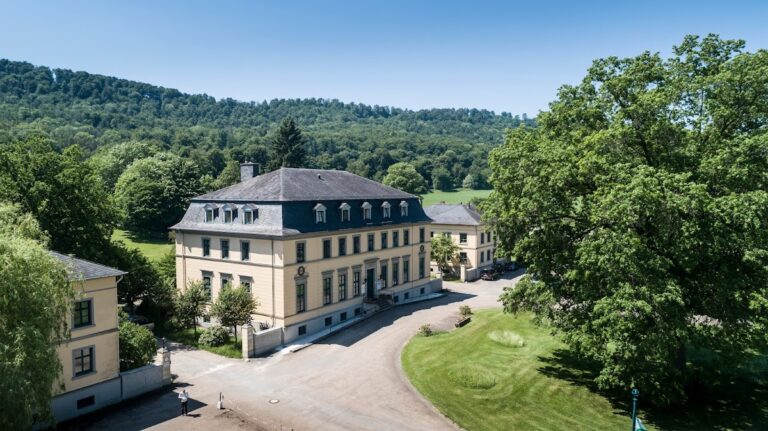
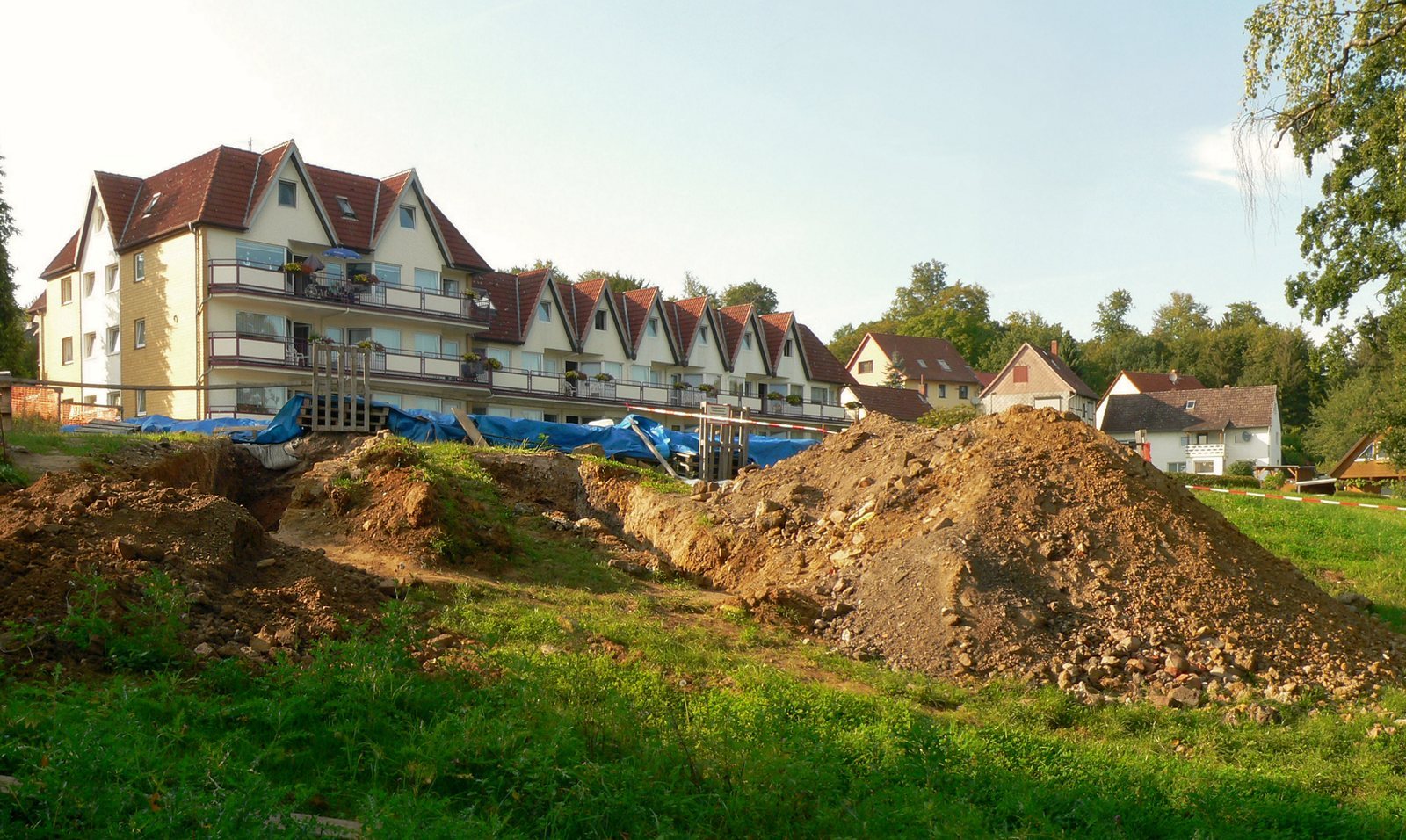
The surviving former production building stands beside Klein Süntel’s main road. It later served as the glassworks owner’s house and was converted into a manor house around 1820. Since 1982, it has formed part of the administrative wing of the adjoining senior residence, built on the former glassworks grounds in the 1980s.
Horse stable
A stone stable once belonging to the glassworks was demolished around the 1980s. Its stones were later reused to make a circular decorative flower bed at the same location.
Buried production structures
Passage and furnace air channels
Beneath a grassy mound about 15 by 30 metres, a passage measures 6 metres long, 2.5 metres high, and 2 metres wide. Its original length is unknown because both ends were later blocked with rubble stone; an inspection shaft was installed above the entrance. It was initially interpreted as either a furnace air passage or a route for charging the furnace. Excavations found red-brick paving and walls just below the surface, as well as a vaulted cavity crossing the passage. These features may have formed air channels to increase the furnace heat, or vaulted ceilings over a glassmaking chamber. Four underground channels supplying air to the melting furnace were identified during later work. One contained production debris and fragments of glass-melting crucibles, heat-resistant vessels used to melt glass.
Possible smoke-exhaust tower
A circular rubble-stone foundation was first thought to be the base of a glassworks tower about 10 metres in diameter. Later-exposed foundation walls suggest a diameter close to 20 metres, while aerial images show a circular installation of about 400 square metres. Whether a tower stood there, and what form it took, remains uncertain. Suggested designs include sandstone masonry, comparable to the smoke-exhaust cone at Steinkrug, or a timber structure. A three-dimensional reconstruction made in 2015 depicted semicircular masonry. A worked foundation stone may have supported a wooden structure inside the cone.
From 2020, exposed foundations were weatherproofed and partly rebuilt using new stones distinguishable from the historic masonry. The work included the entrance to the underground air channel and the circular foundation. In 2021, the historic wall was raised by half a metre to restore the ring and create a walkable platform. By around 2024, the original foundations beneath it had been covered with sand for long-term protection.
Waste deposits and glass finds
Production deposits
Three trenches excavated in 2020 lay at the southeastern end of the buildings, in an area of former waste heaps. Soil sections contained black ash with coal, brick rubble, and glass, including seals from Pyrmont mineral-water bottles. Yellow, clay-rich layers held crucible fragments that indicate the vessels’ size and point to former clay-built structures. The finds also show that the works produced medical and pharmaceutical containers, as well as smaller quantities of colourless drinking glasses.
Glass products and tools
Excavated material includes turquoise production-waste glass, embossed and small glass fragments, and a tool for smoothing glass. Crucible fragments still contain molten glass, while knobs and stems from goblets indicate the kinds of objects made at the works. Two preserved bottles include a Schlegel-type bottle from around 1850, a tall form with a narrow neck, and a beer bottle from around 1870.