Doubay Castle: A Crusader Fortress in Southern Lebanon


Site at a Glance
- Rating
- 4.4
- Popularity
- Very Low
- Country
- Lebanon
- Primary era
- Medieval
- Eras represented
- Classical, Medieval, Early Modern
- Civilizations
- Crusader, Ottoman, Roman
- Site type
- Military
- Remains
- Castle
On this page12 sections
History
Doubay Castle is a Crusader-period fortress in Meiss El Jabal, Lebanon, near Shaqra in the historical region of Jabal Amil. It stands on the remains of a Roman building and incorporates several building phases, including a major early twelfth-century construction or renewal. The fortress belonged to the lordship of Toron, a feudal territory within the Principality of Galilee, and helped maintain the connection between Hunin and Toron while supporting the Crusader campaign against Fatimid-controlled Tyre.
Roman and Crusader foundations
Roman-Byzantine graves surround the fortress, while the site itself occupies the remains of an earlier Roman structure. Its exact chronology remains uncertain. Some descriptions regard the Crusader fortress as a renewal of a Roman building, while others place the first fortified construction in the early twelfth century. Construction has been proposed for 1104 or 1105, during the period when Hugh of Fauquembergues served as Prince of Galilee. He is also associated with the construction of the fortresses of Toron and Hunin.
The name Doubay may derive from de Bouillon, possibly referring to François de Bouillon, a Crusader leader, although this attribution is uncertain. The fortress formed part of the defensive network of Jabal Amil. Its position allowed it to support communications between Hunin and Toron and to assist efforts to seize Tyre from the Fatimids, a Shiite dynasty that ruled Egypt and parts of the eastern Mediterranean before the Crusader conquest.
Debate over the early fortress
The twelfth-century traveler Ibn Jubayr passed through the surrounding area between 1182 and 1185. He described the deeply wooded Astabl valley before reaching Toron. Since Doubay lies about 200 meters from the valley, the character of his account has prompted questions about whether the fortress had already been established at that time. It is also possible that he did not see the site, leaving the question open.
Ayyubid and Mamluk campaigns
In 1219, al-Malik al-Mu’azzam Isa, an Ayyubid sultan, secretly dismantled the fortress’s defenses. This action formed part of a wider policy intended to weaken regional fortifications and prevent the Fifth Crusade from securing a permanent foothold in his territories. The Mamluks, a military ruling elite that established a sultanate centered in Egypt and Syria, captured Doubay on 15 August 1266 after the fall of Toron.
Ottoman-era rebuilding and local rule
The fortress was rebuilt in the late sixteenth century. Nasif ibn Nassar of the Ali al-Saghir family renewed and occupied it, and the newer masonry remained visibly distinct from the earlier construction. His nephew, Zahir ibn Nassar al-Nassar, was among those responsible for the rebuilding. After the work was completed, Zahir fell from the fortress while climbing to inspect the view and died in 1163 AH.
Doubay may have served as the residence of Murad al-Nassar during the rule of his brother Nasif, and later as the residence of Murad’s son Qasim al-Murad. A historical account also links the nearby lands of Marj al-Sitt with cultivation by a woman of the family.
In 1633, Emir Yunus al-Ma’ni and his sons Mulham and Hamdan briefly took refuge at Doubay while fleeing Ahmad Pasha, the governor of Sidon. They were captured after Ahmad Pasha marched against Yunus’s brother, Fakhr al-Din, who had fled to Toron Castle. Yunus and Fakhr al-Din belonged to the Ma’nid ruling family.
The accession of Ahmad al-Jazzar, an Ottoman governor and military ruler, brought the fortress under renewed Ottoman control. After his death in 1804, local Shiite leaders regained control. During the nineteenth century, Doubay served both as a residence and as a school.
Modern conflict and archaeological study
A confrontation took place at and around the fortress on 16 August 1999 between Israel’s Golani Brigade and Hezbollah militants during Operation Breaking Cloud. Archaeological investigation followed between 2011 and 2016, although the work has not established a definitive date for the fortress’s first construction.
In 2026, during the Lebanon war and the operation called Roaring Lion, the Israel Defense Forces took control of Doubay Castle. That year, the fortress was included in the UNESCO World Heritage cultural property “Fortresses of Jabal Amil” under criteria 2 and 4, and the property was also classified as World Heritage in Danger.
Remains
Setting and overall layout
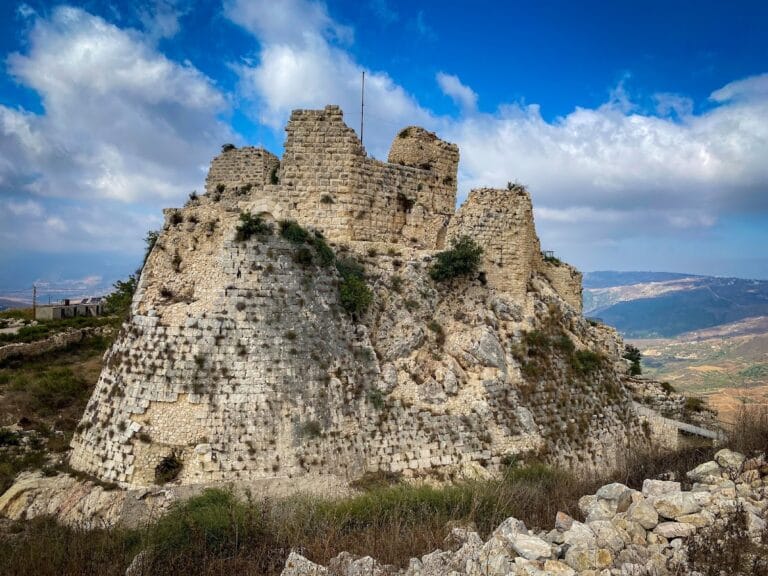
Doubay Castle occupies a low hill where Wadi al-Jamal meets the Saluki River. Valleys surround the site on three sides, while a saddle, or low ridge between higher areas, borders it to the south. The fortress has an overall rectangular plan of approximately 125 by 80 meters, while another measurement identifies the built section as about 70 by 40 meters. A large moat surrounded the enclosure, which contained a central courtyard and roughly thirty rooms and chambers. One historical description counts thirty-two rooms and chambers across the two surviving levels.
Defensive and water installations
Southern Crusader tower
A Crusader tower stands on the southern side of the fortress. Its position was intended to control the route between Damascus and Tyre, linking the defensive purpose of the building to the wider network of Crusader strongholds in the region.
Reservoirs, well, and cisterns
The fortress included a large external reservoir cut into solid bedrock, together with a well inside the enclosure known as al-Mashnaqa. Numerous cisterns were placed both inside and outside the fortress, providing water installations associated with the occupation of the hilltop complex. A western outer settlement was known as al-Zinnar.
Surviving fortress fabric
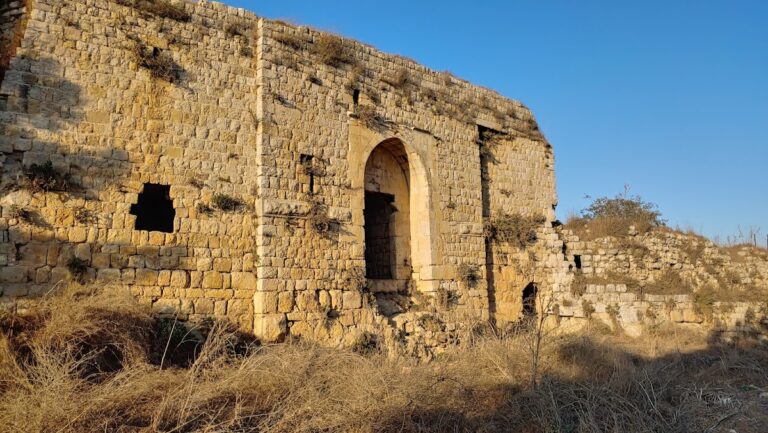
The fortress originally had three stories, but the third has been destroyed, with that destruction attributed to Israeli attacks in 1972. The surviving ruin contains masonry from more than one construction phase, and the later rebuilding can be distinguished visibly from the original work. Some arches appear to have been deliberately dismantled: their crowns were removed while the side walls remained. This pattern is consistent with the disabling of fortifications when they were abandoned, preventing an enemy from occupying and reusing them.
Nearby sites