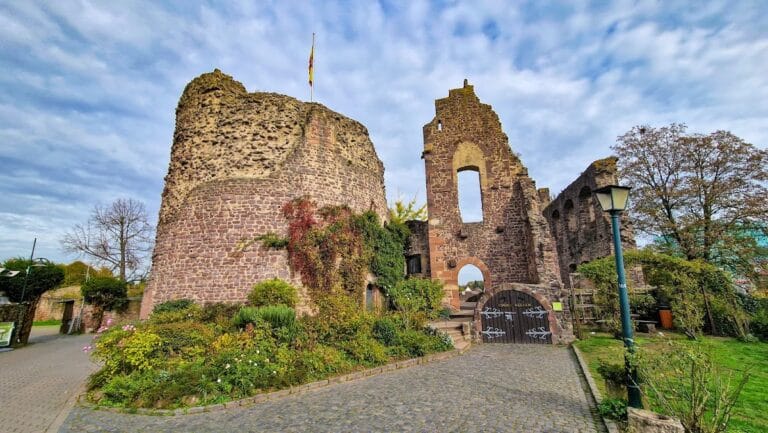
Dianaburg: A Baroque Hunting Lodge and Pavilion in Darmstadt


Site at a Glance
- Rating
- 4.3
- Popularity
- Very Low
- Country
- Germany
- Primary era
- Modern
- External website
- Open
- Eras represented
- Early Modern, Modern
- Civilizations
- Unclassified
- Site type
- Domestic
- Remains
- Elite Residence
On this page9 sections
History
Dianaburg is a historic hunting site in Darmstadt, Germany, built in 1765 as a Baroque lodge within the hunting complex of Kranichstein Hunting Lodge. Located in what is now the Arheilgen district, about 2.5 kilometres northeast of Kranichstein, it served the court’s hunting activities and was dedicated to Diana, the Roman goddess associated with hunting and the wilderness.
Foundation and courtly hunting
Landgrave Ludwig VIII of Hesse-Darmstadt, a territorial ruler in the historical German lands and an enthusiastic hunter, commissioned Dianaburg. He first intended it as a gift for his son and future successor, Ludwig IX. The lodge was ultimately built in honour of Ludwig IX’s wife, Karoline, who shared her father-in-law’s passion for hunting.
Dianaburg supported several stages of a courtly hunt. Hunting parties used it as accommodation before setting out on parforce hunts, mounted pursuits in which hunters followed game over an extended course with hounds, and on driven hunts. The lodge also provided an observation point during these events and a place for hunters to dine after game had been killed.
Decline and demolition
After Ludwig VIII died in 1768, the lodge lost the patronage that had sustained its purpose. Ludwig IX showed little interest in hunting, preferring military affairs. He abolished parforce hunting because he considered it damaging to agriculture and too expensive for a state facing strained finances.
Dianaburg then fell into disuse and decay. The Napoleonic Wars caused further damage, and in 1808 the property was auctioned to citizens of Arheilgen for demolition. The original lodge was taken down that same year.
Excavation and rebuilding
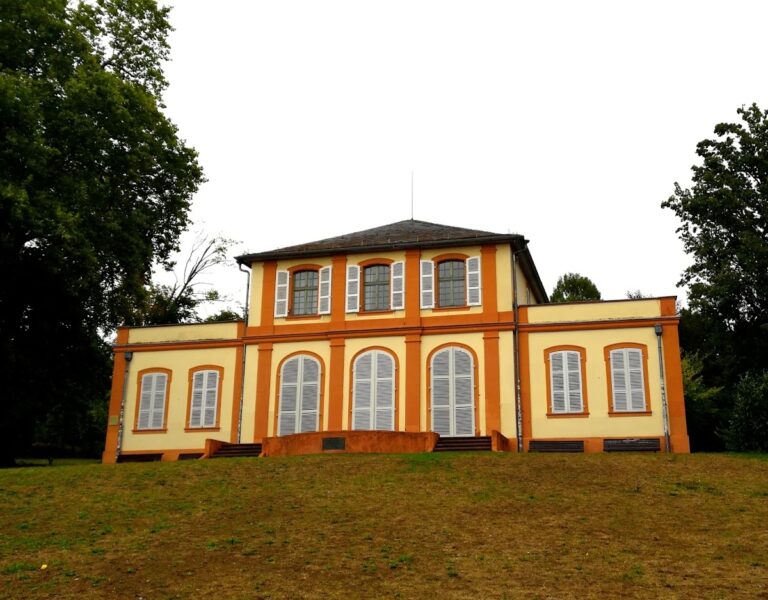
The site attracted renewed attention in the nineteenth century. In 1830, Ludwig III, the art- and history-minded heir to the throne of Hesse and by Rhine, ordered the excavation of the former lodge’s foundation walls. A new hunting pavilion was erected at approximately the same location in 1836 and was given the old name, preserving the association with Dianaburg.
The replacement pavilion served a different community role in the modern period. From 1953 to 1990, it was used as a venue and meeting place by the local branch of the Falken, a German youth and educational organization. After it stood vacant, concern over its poor structural condition led to the creation of a local support association in 2004. With support from the owner, the State of Hesse, the pavilion was renovated over four years. The hunting-star clearings were cleared as part of the work, and the building reopened in October 2008. Since August 2012, one of its interior rooms has been used for wedding ceremonies.
Remains
The original Baroque lodge
The first Dianaburg was a small octagonal hunting lodge on an artificial hill at the western edge of a large woodland area in the Messel hill country. It stood approximately 10 metres above the Untermainebene to the west and originally commanded unobstructed views toward Arheilgen and Wixhausen. A description written by Friedrich V of Hesse-Homburg after his 1768 visit called it a charming round house.
The ground floor contained a kitchen and service rooms. A mechanical device opened a ceiling hatch and lifted a fully set table into the dining room above, linking the service area with the lodge’s principal social space. The first-floor dining room was reached from outside by an open flight of stairs. Decorative Rococo overdoor panels, paintings or reliefs placed above doors, depicted Hessian towns. Several sleeping rooms occupied the second floor, while an additional attic chamber could be reached only by lowering a ladder.
The hunting-star landscape
Dianaburg was set within a network of straight woodland clearings arranged as a hunting star. These paths, created in the eighteenth century, radiated through the surrounding forest and supported mounted hunts and long-distance observation. The present pavilion still lies within this historic network.
The hunting screen at Charlottenplatz
At the eastern end of the straight clearing that led east from the former lodge stands a hunting screen in a clearing called Charlottenplatz. It consists of an artificial hill pierced by shooting loopholes. The sheltered position allowed hunters to fire at wild boar and is a surviving structural element of the original hunting complex.
The replacement pavilion
The building erected in 1836 is a small Neoclassical hunting pavilion in the Biedermeier style, a nineteenth-century Central European form associated with restrained domestic Neoclassical design. Its furnishings included eighteenth-century furniture and paintings chosen to evoke the demolished lodge. Eighteenth-century works by the court painter Johann Conrad Seekatz and by Georg Adam Eger help establish the appearance of the original Dianaburg. Paintings attributed to Prince Friedrich August, apparently based on older models from the lodge’s period, were still present in the pavilion at the beginning of the twentieth century. After restoration, the pavilion also included a room for wedding ceremonies.