Burg Wilhelmstein: A Medieval Refuge Fortress in Germany

Site at a Glance
- Rating
- 4.8
- Popularity
- Very Low
- Country
- Germany
- Primary era
- Medieval
- External website
- Open
- Eras represented
- Medieval
- Civilizations
- Holy Roman Empire
- Site type
- Military
- Remains
- Castle
On this page6 sections
History
Burg Wilhelmstein is a ruined medieval lowland castle in Germany, near Bardenberg in the city of Würselen, built by Count William IV of Jülich between 1265 and 1269 on the remains of an older border fortress. It stood in the Wurm valley on the river’s eastern bank, in a region shaped by important medieval boundaries.
A Border Castle in the Middle Ages
During the Carolingian period, the Wurm marked the boundary between the Jülichgau and Maasgau, two early medieval regional territories. At times, it also formed the diocesan boundary between the bishoprics of Cologne and Liège. The boundary of the Aachen imperial territory, land associated directly with the imperial city of Aachen, lay about one kilometre south of the castle.
William IV, a medieval ruler of the County of Jülich, established Burg Wilhelmstein as the seat of the administrative district of Wilhelmstein. The district belonged to the Duchy of Berg and exercised jurisdiction through three courts. Its area included Bank, Bardenberg, Broich, Dürwiß, Euchen, Hamich, Hastenrath, Heistern, Kohlscheid, Langerwehe, Linden-Neusen, Niederbardenberg, Nothberg, Ofden, Pley, Volkenrath, Vorweiden, and Werth. The castle first appears in a written record in 1344.
The fortress was designed as a refuge during war and other emergencies. It offered protection to people from the surrounding feudal estates and to the settlement of Bardenberg, while also serving the administrative needs of the district.
Damage, Ownership, and Preservation
French troops serving Louis XIV, king of France from 1643 to 1715, inflicted serious damage on the castle in 1690 and 1691. The complex suffered heavier destruction during the War of the Spanish Succession, the European conflict fought mainly from 1701 to 1714 over the succession to the Spanish monarchy. Ownership changed several times during the following centuries.
At the start of the nineteenth century, the French administration declared the castle and its surrounding woodland state property and sold the estate to private owners. After the area became part of Prussia, the estate was compulsorily auctioned in 1825 for 1,500 gold thalers while it was most recently owned by the von der Brügghen family. It was acquired by the family of the Prussian district administrator Friedrich Joseph Baron von Coels von der Brügghen. His descendants sold the estate to the Sevenich family in 1950, and that family remains its owner. Burg Wilhelmstein is designated as an architectural heritage monument in North Rhine-Westphalia.
Remains
Outer Defences
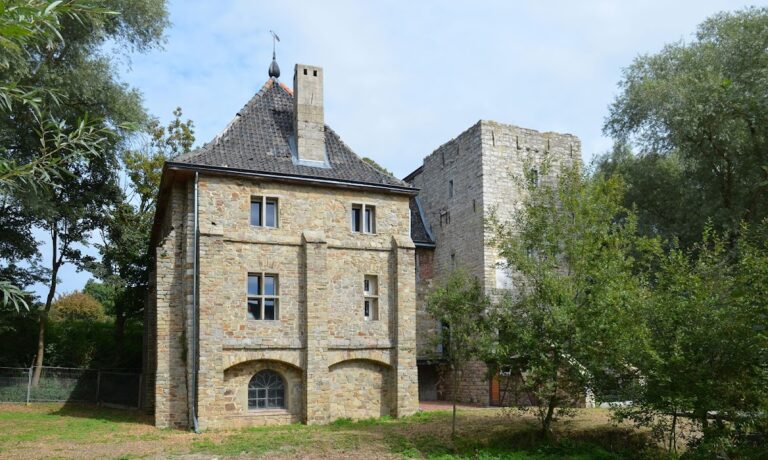
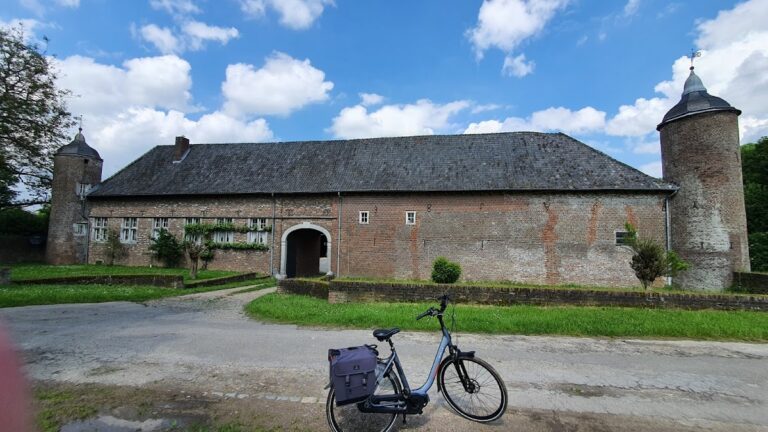
Burg Wilhelmstein survives as a rubble-stone ruin arranged around an outer bailey, the castle’s outer fortified enclosure. A moat originally protected this area. Its surviving features include a defensive bastion, a circular tower, and a Gothic arched gateway. The circular tower once served as the castle dungeon, and the mechanism for the drawbridge chain remains visible.
Inner Castle
The inner part of the ruin contains a courtyard, a well, and the remains of a keep that formerly rose five storeys. The keep, the principal fortified tower of a castle, stood beside an adjoining palas, the principal residential hall. Together, these elements show the relationship between the castle’s defensive tower and its residential spaces. An open-air stage now occupies part of the ruin, which is used from May to September for concerts, cabaret, and cinema events.
Nearby sites